民企融资困境

Search documents
民企融资难,谁能打破 “短、小、少、高” 的困境?
Sou Hu Cai Jing· 2025-12-27 04:25
Core Viewpoint - The financing difficulties faced by small and medium-sized private enterprises (SMEs) in China are significant, characterized by challenges such as high costs, limited access, and slow processes, which hinder their growth and development [1][2]. Group 1: Financing Challenges - SMEs contribute over 50% of tax revenue and 60% of GDP in China, representing over 90% of all enterprises and providing more than 80% of urban employment [1]. - The financing issues can be summarized as "difficult to borrow, expensive to borrow, and slow to borrow" [2]. - Key factors contributing to these challenges include short loan terms, insufficient loan amounts, limited financing channels, and high overall costs [3][4][5][6][7]. Group 2: Case Studies of Successful Financing - Xiamen Youxun Co., a leading private enterprise in optical communication chips, overcame initial funding challenges with the help of local financial support, including a 1 million yuan technology loan guarantee from Xiamen Jinyuan Group [9][10]. - Xiamen Yaxun Zhiliang has become a leading player in the vehicle networking sector, receiving investment from Xiamen Jinyuan Group to support its growth in the rapidly developing new energy industry [12][13]. - The success stories highlight the importance of financial institutions in providing timely support to SMEs, enabling them to navigate funding difficulties and seize market opportunities [14]. Group 3: Innovative Financial Solutions - Xiamen Jinyuan Investment Group has developed over 200 financial products and services tailored to the lifecycle of enterprises, addressing the specific needs of SMEs [15][16]. - The group has implemented a government-backed financing guarantee system to assist enterprises lacking collateral, offering favorable guarantee rates for loans up to 10 million yuan [17]. - Customized financing services are provided based on industry characteristics and business stages, including innovation funds for tech companies and emergency repayment projects for those under financial pressure [18]. Group 4: Digital and Efficient Financing Processes - Xiamen Jinyuan Group has established a "digital + inclusive" service platform, allowing enterprises to apply for loans and complete approvals online, significantly reducing processing times [20][21]. - The platform has streamlined approval processes, cutting down traditional approval times from weeks to days, enhancing accessibility for SMEs [21]. - By integrating various financial tools, the group has supported over 2,600 enterprises and approved funding exceeding 16 billion yuan in the first half of 2024 [25].

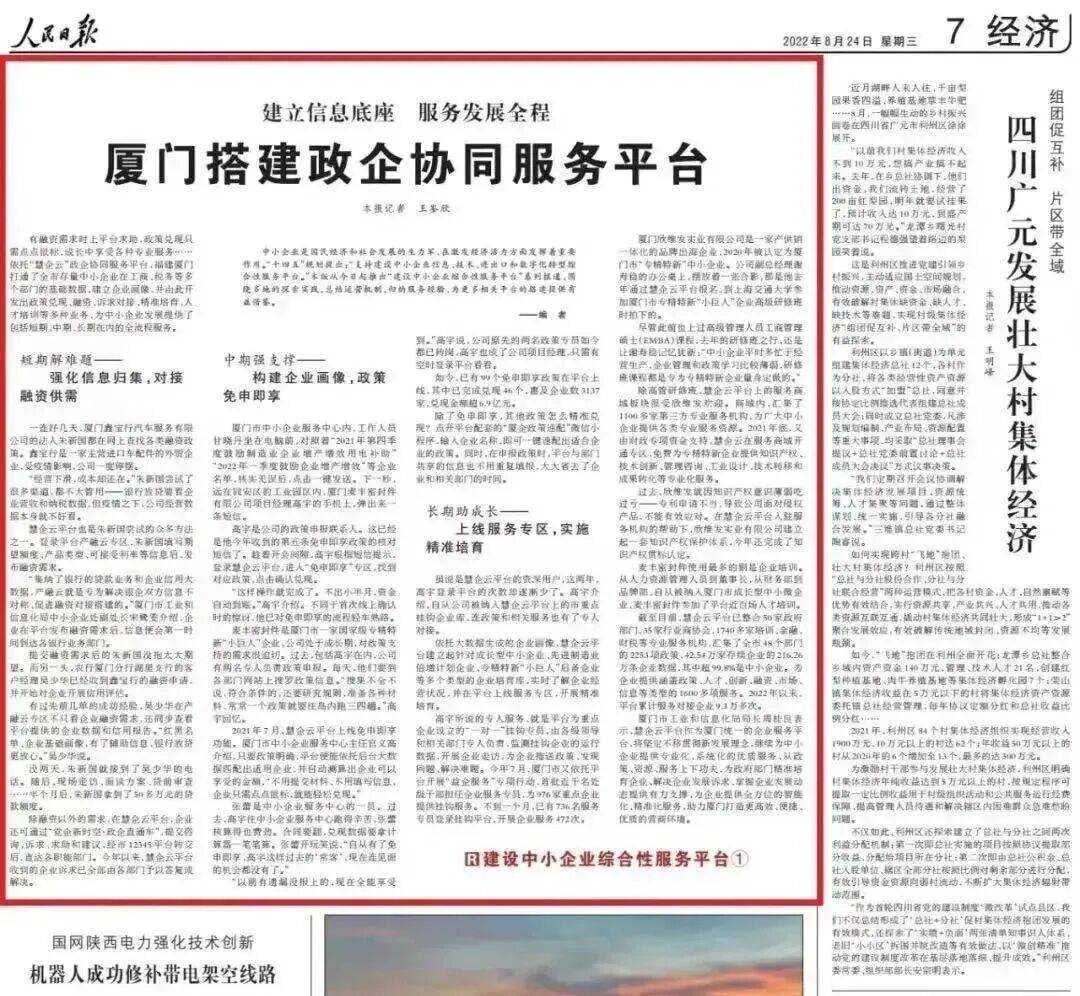
解析民营经济促进法③丨如何真正帮助民企融资
Sou Hu Cai Jing· 2025-05-01 20:54
Core Viewpoint - The "Private Economy Promotion Law" will take effect on May 20, 2025, marking the first foundational law specifically aimed at the development of the private economy in China, with a focus on investment and financing support [1][3]. Group 1: Systematic Institutional Design - The investment and financing promotion chapter of the law aims to address the financing difficulties faced by private enterprises through systematic institutional design, balancing financing convenience with risk prevention and market-driven versus government intervention [1][4]. - The law introduces a differentiated financing support system, including a cap on policy financing guarantee fees (≤1.5%), the establishment of a national private economy development fund, and the creation of specialized financing tools such as Sci-Tech bonds and green bonds [3][5]. - It also reshapes the credit incentive mechanism by requiring commercial banks to separately list credit quotas for private enterprises and implement growth assessments, allowing for a higher tolerance for non-performing loans in inclusive small and micro loans [3][5]. Group 2: Equity Protection and Regulatory Measures - The law emphasizes rigid constraints on equity protection by prohibiting hidden financing barriers such as bundled sales of financial products and requiring the establishment of a 24-hour financing complaint platform for private enterprises [3][4]. - A dual penalty system will be enforced for violations, enhancing accountability within the financial sector [3][5]. Group 3: Addressing Inequities in Financing - The law aims to alleviate the unequal treatment of private enterprises in financing by implementing targeted support policies that restrict ownership bias in commercial banks [5]. - It establishes a risk-sharing mechanism for government financing guarantees, setting a fee cap of 1.5%, which is significantly lower than traditional third-party guarantee fees, and introduces a 7:3 risk-sharing model between banks and guarantee institutions [5].