民生指数

Search documents
房价收入比创历史新低,天津是什么水平?
Sou Hu Cai Jing· 2026-02-24 03:42
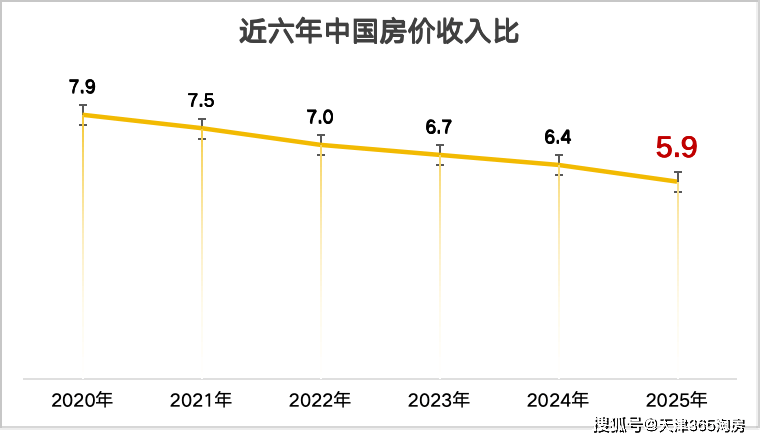
Group 1 - The core viewpoint of the articles indicates that China's housing price-to-income ratio has reached a historical low of 5.9 in 2025, marking a significant decrease from the peak of 7.9 in 2020 [1][3] - The housing price-to-income ratio is calculated as the total price of standard housing divided by the annual disposable income of households, serving as an important indicator of housing affordability [1] - The overall burden of home buying has significantly eased, reflecting the effectiveness of market adjustments, although first-tier and strong second-tier cities still exhibit ratios well above reasonable levels [3][9] Group 2 - In Tianjin, the average household disposable income is estimated at approximately 149,034.6 yuan, with the average transaction price of second-hand homes at 10,096 yuan per square meter, leading to a housing price-to-income ratio of about 6.1 [5] - The housing price-to-income ratio in various districts of Tianjin shows significant disparities, with the highest ratio in Heping at 16.4, indicating greater difficulty in purchasing homes in certain areas [6][10] - Overall, Tianjin's housing price-to-income ratio is close to the national average, but it is considered low for a city of its size and development level, suggesting that a ratio of 8 would be more reasonable [7][8] Group 3 - The articles highlight that first-tier cities have a "super high burden" with ratios above 20, while second-tier cities show a "medium-high burden," indicating ongoing significant pressure on home buyers [9] - The current trend suggests that the housing market is entering a rational and mature phase, with the decline in the housing price-to-income ratio representing a substantial correction in the real estate market [10][11] - Tianjin is currently viewed as a city with high cost-performance, which is beneficial for home buyers [11]