永久性损失

Search documents
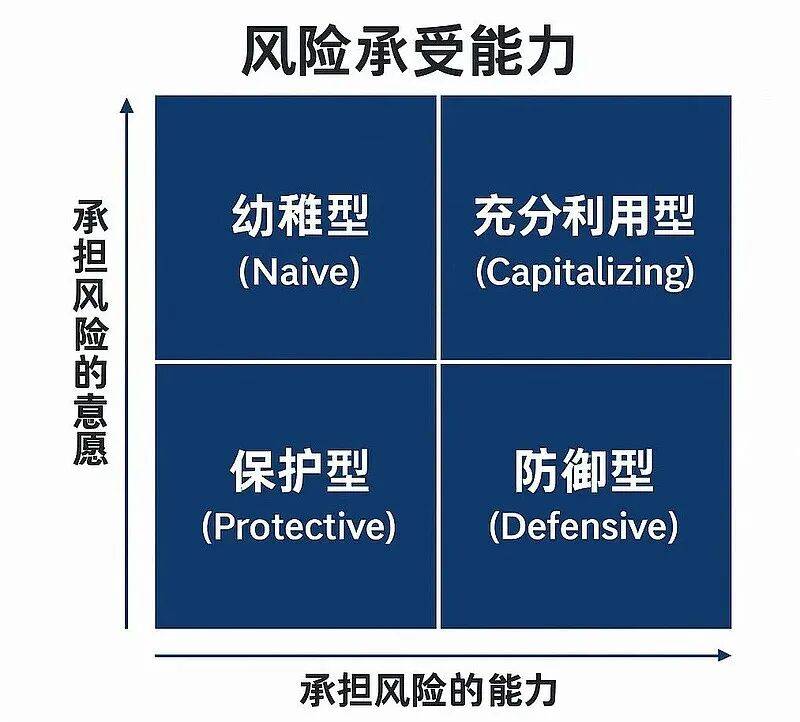
霍华德·马克斯:低承受能力却高风险意愿的人是“幼稚型”
Sou Hu Cai Jing· 2025-11-08 02:05
Core Insights - The memo by Howard Marks emphasizes the importance of rational decision-making in investment, focusing on aligning risk exposure with one's financial situation and goals [1][4][5] Group 1: Risk Attitude - The memo introduces a two-dimensional matrix distinguishing between "risk tolerance" and "risk willingness," categorizing investors into four types: "fully utilized," "defensive," "protective," and "immature" [2][15][16] - The board members of the pension fund prioritize the ability to meet pension obligations over outperforming peers, indicating a rational approach to risk management [3][29][30] - The board acknowledges that risk is not merely price volatility but the probability of permanent loss, reinforcing the need for a long-term perspective in investment [4][26][42] Group 2: Setting Goals - The pension fund board ranks "outperforming peers" as the least important goal, emphasizing the necessity of ensuring pension payments and minimizing costs to the sponsoring entity [29][30][31] - The board's focus is on constructing a portfolio that increases the probability of success across various scenarios, rather than merely achieving relative performance [32][33] Group 3: Performance Evaluation - The board considers achieving actuarial return assumptions as the most critical performance metric, with relative performance against benchmarks being secondary [55][56] - The discussion highlights the challenge of evaluating investment performance over short time frames, advocating for longer evaluation periods that encompass both bull and bear markets [69][70] - The board recognizes the importance of assessing personnel turnover rates as a potential indicator of underlying issues within the investment management process [72][75]

当理性成为稀缺品!从霍华德·马克斯最新备忘录,理解杨东陈光明的“封盘”……
聪明投资者· 2025-11-03 07:03
Core Viewpoint - The recent phenomenon of "big players closing funds" in China's investment circle reflects a complex market sentiment, highlighting the need for investors to reassess risk, evaluate opportunities, and maintain rationality in uncertain times [2][4]. Group 1: Market Reactions - On October 29, Ningquan Asset announced a suspension of new subscriptions for its products, followed by Ruiyuan Fund's similar announcement two days later, indicating a trend among prominent fund managers to exercise restraint [2]. - This trend has sparked speculation regarding its implications for market liquidity and valuation levels, as well as the managers' self-awareness regarding their strategies and cognitive boundaries [3]. Group 2: Decision-Making Framework - Howard Marks, co-founder of Oaktree Capital, emphasizes the importance of understanding one's own risk tolerance and willingness, categorizing investors into four types based on their financial capacity and risk appetite [5][6]. - Rational investors align their risk exposure with their circumstances, focusing on achieving their own goals rather than merely outperforming peers [8][9]. Group 3: Investment Objectives - The board members of the pension fund prioritize fulfilling pension payment commitments over short-term performance rankings, demonstrating a long-term focus on stability rather than relative performance [6][44]. - Marks argues that true success in investment is not about outperforming others but ensuring the ability to meet obligations, particularly in the context of pension funds [46][50]. Group 4: Risk Assessment - The discussion highlights that risk should not be equated with price volatility but rather with the probability of permanent loss, urging investors to differentiate between the two [8][60]. - The board's preference for normal market fluctuations over reliance on opaque strategies for excess returns indicates a mature understanding of risk management [38][41]. Group 5: Performance Evaluation - The pension fund board values achieving actuarial return assumptions as the primary performance metric, with relative performance against peers considered secondary [78][80]. - The importance of a comprehensive evaluation period that includes both favorable and unfavorable market conditions is emphasized, as it allows for a clearer assessment of investment capabilities [101][102].