绩效评估

Search documents
刚刚,字节宣布 2025 绩效调整
程序员的那些事· 2026-01-09 08:10
Group 1 - The core viewpoint of the article is that ByteDance is launching a performance evaluation system in conjunction with a new job level structure to enhance talent competitiveness through differentiated incentives [1][4]. Group 2 - The performance evaluation will feature optimized naming for evaluation levels to improve clarity and objectivity, with changes such as "I" being adjusted to "I (Improvement Needed to Meet Expectations)" and "F" changed to "N (Not Meeting Expectations)" [2][3]. Group 3 - The timeline for the performance evaluation and related incentives includes starting the evaluation on January 15, announcing annual adjustments in late March, and completing the granting of performance options by April 25 [5]. Group 4 - The performance evaluation is a key step in implementing the new ten-level job structure (L1 to L10) that began on January 1, 2026, aimed at providing employees with clearer and more flexible development pathways [4].


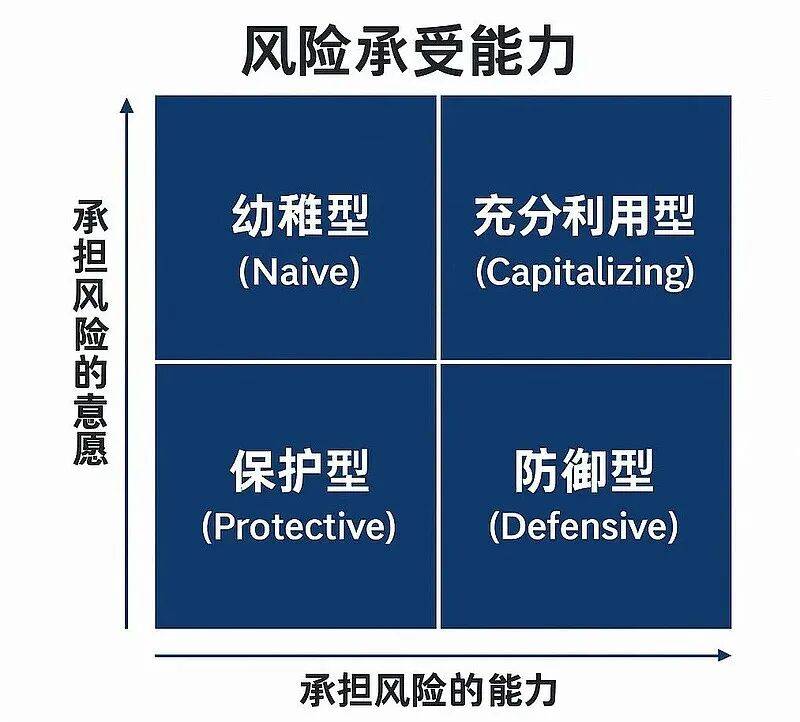
霍华德·马克斯:低承受能力却高风险意愿的人是“幼稚型”
Sou Hu Cai Jing· 2025-11-08 02:05
Core Insights - The memo by Howard Marks emphasizes the importance of rational decision-making in investment, focusing on aligning risk exposure with one's financial situation and goals [1][4][5] Group 1: Risk Attitude - The memo introduces a two-dimensional matrix distinguishing between "risk tolerance" and "risk willingness," categorizing investors into four types: "fully utilized," "defensive," "protective," and "immature" [2][15][16] - The board members of the pension fund prioritize the ability to meet pension obligations over outperforming peers, indicating a rational approach to risk management [3][29][30] - The board acknowledges that risk is not merely price volatility but the probability of permanent loss, reinforcing the need for a long-term perspective in investment [4][26][42] Group 2: Setting Goals - The pension fund board ranks "outperforming peers" as the least important goal, emphasizing the necessity of ensuring pension payments and minimizing costs to the sponsoring entity [29][30][31] - The board's focus is on constructing a portfolio that increases the probability of success across various scenarios, rather than merely achieving relative performance [32][33] Group 3: Performance Evaluation - The board considers achieving actuarial return assumptions as the most critical performance metric, with relative performance against benchmarks being secondary [55][56] - The discussion highlights the challenge of evaluating investment performance over short time frames, advocating for longer evaluation periods that encompass both bull and bear markets [69][70] - The board recognizes the importance of assessing personnel turnover rates as a potential indicator of underlying issues within the investment management process [72][75]
ChatGPT 评估员工绩效,评得是真能力吗?
AI科技大本营· 2025-05-27 12:20
Core Viewpoint - The article argues that relying on AI for key management tasks, such as performance evaluations, may lead to a decline in essential managerial skills, rather than being a step forward in efficiency [1][2][3]. Group 1: The Role of AI in Management - AI is seen as a tool that can assist but should not replace the cognitive functions of a manager [8][9]. - Over-reliance on AI for management tasks can hinder personal growth and skill development, as it removes the opportunity for practice and learning [6][13]. - Effective management requires deep engagement and personal judgment, which AI cannot replicate [23][25]. Group 2: Performance Evaluation Insights - Writing performance evaluations is not inherently difficult; it reflects the manager's growth and understanding of their role [4][5]. - Performance evaluations should be viewed as a developmental exercise for managers, not just a task to complete [7][18]. - AI can be useful for repetitive tasks like resume screening and compliance reminders, but it should not be used for nuanced evaluations that require human insight [19][21]. Group 3: Community Reactions and Concerns - There is a widespread concern that AI may exacerbate existing issues in performance evaluation systems, which are often seen as arbitrary and politically motivated [25][26]. - Critics argue that AI could make poor management practices more efficient, rather than improving the quality of evaluations [25][26]. - Some believe that while AI can assist in structuring information, it should not replace the manager's ability to observe and make judgments about their team [25][26].