
沉睡账户清理

Search documents
多地中小银行沉睡账户或被注销
21世纪经济报道· 2026-03-22 01:28
Core Viewpoint - The recent cleaning action targeting "sleeping accounts" by small and medium-sized banks across China is a response to regulatory compliance and aims to optimize bank operations amid increasing operational pressures and transformation needs [3][6]. Group 1: Cleaning Action Details - Over 7 banks have announced the cleaning of accounts since March, focusing on accounts with no transactions for one year or more [1][2]. - Specific banks have set different criteria for cleaning, such as Sichuan Hejiang Rural Commercial Bank targeting "one person multiple accounts" and accounts with mismatched information [3]. - The cleaning initiative includes both personal and corporate accounts, with banks like China Agricultural Development Bank planning to clean corporate accounts inactive for over a year [4]. Group 2: Implications for Banks - The cleaning of "long-term inactive accounts" is seen as a strategic move to reduce operational burdens and enhance efficiency, helping banks to focus on active customers [6][7]. - This initiative is expected to improve fund utilization efficiency, reduce resource waste, and mitigate risks associated with dormant accounts, such as potential misuse for illegal activities [6][7]. - By optimizing account structures, banks can enhance customer quality and improve profitability, especially in a context of narrowing interest margins [7]. Group 3: Future Outlook - The initiative is likely to become a regular annual process for many banks, as indicated by announcements from various institutions [4]. - Banks are encouraged to enhance customer service and risk management practices, such as notifying customers about inactive accounts and facilitating account closures [7].


银行“沉睡账户”迎集中清理,你的银行卡会受影响吗
Xin Lang Cai Jing· 2025-10-22 00:35
Core Viewpoint - The article discusses the recent initiative by banks in China to clean up long-dormant accounts, referred to as "sleeping accounts," which have become a significant concern due to their potential risks and operational inefficiencies [1][8]. Group 1: Overview of Sleeping Accounts - There are over 10 billion bank cards in China, with an average of about 7 cards per person, leading to many dormant accounts [1][9]. - "Sleeping accounts" are defined as those that have not been actively used for a long time, often forgotten by customers [3]. - Different banks have varying criteria for identifying sleeping accounts, typically based on "long-term inactivity" and "low balance" [3][5]. Group 2: Recent Cleaning Initiatives - Several banks, including Xiamen Bank and local rural banks, have announced plans to clean up dormant accounts, expanding the scope to include electronic accounts and mobile banking [5][6]. - For instance, Xiamen Bank has adjusted its criteria to include accounts with balances below 10 yuan and no transactions for over a year [3][5]. - The cleaning efforts are primarily led by local small and medium-sized banks, particularly in rural areas, where account management issues are more pronounced [6][8]. Group 3: Risks and Operational Efficiency - The cleaning of sleeping accounts is driven by the need to mitigate risks such as fund misappropriation and personal information leakage, as these accounts can be exploited for illegal activities [8][9]. - Approximately 30% of fraud cases are linked to dormant accounts, highlighting the security risks associated with them [8]. - Maintaining these accounts incurs hidden operational costs for banks, making the cleanup a necessity for optimizing resource allocation [9]. Group 4: Customer Guidance - Customers are advised to conduct regular checks on their accounts and can use the Yunshanfu app for inquiries [13]. - For accounts that are no longer in use, customers should promptly close them through official bank channels to avoid risks [15]. - If an account has been restricted, customers can reactivate it by visiting a bank branch with proper identification [11][15].


银行清理“沉睡账户”,你的钱不会丢
Qi Lu Wan Bao· 2025-10-21 02:28
Core Viewpoint - Recent announcements from multiple banks indicate a move to manage or clean up "long-term inactive accounts," raising concerns among customers about the fate of their funds in these accounts [2][5]. Group 1: Definition and Standards of Inactive Accounts - "Sleeping accounts" are defined as personal bank accounts that have not had any transactions for a specified period, with varying standards across banks [4]. - The criteria for identifying long-term inactive accounts include having a balance of 10 yuan (inclusive) or less, no active loan repayments, and no transactions for 365 days or more [3][4]. - Different banks have different thresholds for inactivity, ranging from 1 year to 3 years, and balance limits from 10 yuan to 100 yuan [4]. Group 2: Customer Concerns and Bank Responses - Customers express concerns about the potential loss of funds in sleeping accounts and the lack of clarity on how these accounts will be managed [2][5]. - Banks have stated that they will notify account holders through SMS and mobile banking alerts before any actions are taken on inactive accounts [5]. - Even if an account is closed, customers can reclaim any remaining balance, as the funds remain the property of the account holder [5][6]. Group 3: Regulatory Background and Industry Context - The cleanup of sleeping accounts is part of a broader initiative by the People's Bank of China, which began in 2020, to reduce the number of inactive accounts and improve banking efficiency [7][8]. - As of 2024, the average person holds approximately 7 bank cards, with a significant portion of these being inactive accounts [8]. - Inactive accounts pose operational challenges for banks, as they occupy resources without contributing significantly to revenue, with some banks reporting that low-activity accounts account for 20%-30% of their total accounts [8][9].

银行集中清理“沉睡”账户,确保资金安全提升使用效率
Zheng Quan Shi Bao· 2025-10-21 00:00
Core Viewpoint - Increasing number of banks are conducting centralized cleaning of "sleeping" accounts, with at least 10 banks announcing such measures since the second half of the year [1][2] Group 1: Account Cleaning Initiatives - Xi'an Bank announced plans to clean up long-unused personal and corporate settlement accounts, as well as direct banking accounts, starting November 14 [1][2] - Other banks, including Industrial Bank and Guangxi Beibu Gulf Bank, have also issued similar cleaning notifications, with varying criteria for identifying long-unused accounts [2] Group 2: Criteria for Long-Unused Accounts - The criteria for identifying long-unused accounts differ among banks, with balance thresholds ranging from 10 to 100 yuan and inactivity periods varying from six months to two years [2] - For example, Industrial Bank revised its criteria, lowering the balance requirement from 100 yuan to 10 yuan and extending the inactivity period from 180 days to 365 days [2] Group 3: Risks and Benefits of Cleaning Accounts - Long-unused accounts pose risks such as potential misuse for money laundering and fraud, as account holders may not monitor their accounts regularly [3] - Cleaning these accounts can help consumers reactivate idle funds, improve resource utilization, and enhance overall account management to mitigate risks [3] Group 4: Account Recovery Process - Banks are implementing regular monitoring of long-unused accounts, with measures to restrict fund movements for accounts that meet the criteria [4] - Account holders who need to reactivate restricted accounts can do so by visiting bank branches with valid identification and their bank cards [4] Group 5: Customer Awareness and Fund Security - Customers with multiple bank accounts should be aware of different banks' management regulations to avoid confusion regarding account activity [5] - Funds in long-unused accounts will not be lost; if accounts are not reactivated, the funds will be transferred to a special account managed by the bank, retaining ownership for the account holder [5]
银行清理“沉睡账户”怎么回事?
Yang Shi Wang· 2025-10-20 18:49
Core Viewpoint - Recently, multiple banks have announced plans to clean up long-dormant accounts, referred to as "sleeping accounts" [1] Group 1: Definition and Impact - Long-dormant accounts are defined as accounts that have not been active for an extended period [1] - There are concerns regarding whether the cleaning process will affect the rights of account holders [1] - Questions arise about whether the funds in these bank cards will be confiscated after the cleanup [1]

银行集中清理“沉睡”账户 确保资金安全提升使用效率
Zheng Quan Shi Bao· 2025-10-20 17:10
Core Viewpoint - Increasing number of banks are conducting centralized cleaning of "sleeping" accounts, with Xi'an Bank announcing a cleanup on November 14 for long-unused personal and corporate settlement accounts, as well as direct banking accounts [1][2] Group 1: Account Cleaning Initiatives - At least 10 banks have announced cleaning of long-unused accounts since the second half of the year, including Xinyu Bank and Guangxi Beibu Gulf Bank, with varying criteria for identifying inactive accounts [2] - Xi'an Bank's cleaning scope includes long-unused personal and corporate RMB settlement accounts, with specific definitions for inactivity based on account balance and transaction history [2][3] Group 2: Standards for Identifying Inactive Accounts - Different banks have slightly different criteria for identifying long-unused accounts, with balance thresholds ranging from 10 to 100 yuan and inactivity periods varying from six months to two years [2] - Xinyu Bank recently adjusted its criteria, lowering the balance requirement from 100 yuan to 10 yuan and extending the inactivity period from 180 days to 365 days [2] Group 3: Risks and Benefits of Cleaning Accounts - "Sleeping" accounts, defined as those with no transactions for five years or more, pose risks such as potential misuse for money laundering or fraud [3] - Cleaning long-unused accounts can help consumers reactivate idle funds, improve resource efficiency for banks, and reduce potential risks associated with inactive accounts [3] Group 4: Account Recovery Process - Banks are implementing regular monitoring of long-unused accounts, with Xinyu Bank starting daily management from October 15, restricting fund movements for qualifying accounts [4] - Account holders needing to reactivate restricted accounts can do so by visiting bank branches with valid identification and their bank card [4] Group 5: Customer Awareness and Fund Management - Customers with multiple bank accounts should be aware of differing management regulations to avoid confusion and ensure compliance with activity requirements [5] - Funds in long-unused accounts will not be lost; if accounts are not reactivated, funds will be transferred to a special account managed by the bank, retaining ownership for the account holder [5]
银行将清理“沉睡账户”,如何影响你我?
Yang Shi Xin Wen· 2025-10-20 05:58
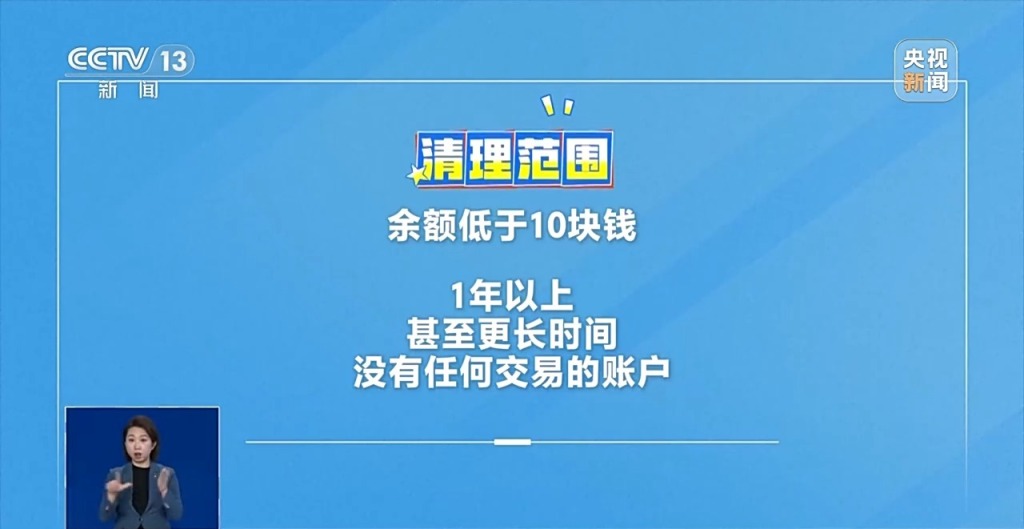
Core Viewpoint - Banks are initiating the cleanup of "sleeping accounts," which are defined as long-term inactive accounts, leading to confusion among account holders regarding their rights and actions needed to prevent account closure [1][17]. Group 1: Definition and Criteria of "Sleeping Accounts" - "Sleeping accounts" refer to personal or corporate accounts that have been inactive for an extended period, typically characterized by "long-term no active transactions" and "low balance" [4][5]. - Most banks define long-term inactive accounts as those with a balance below 10 RMB and no transactions for over a year, although some banks may only clear accounts with zero balance [4][9]. Group 2: Variations in Bank Standards - Different banks have varying criteria for identifying long-term inactive accounts. For instance, one bank requires a balance below 10 RMB and no transactions for three years, while another bank has a threshold of 50 RMB and two years of inactivity [7][9]. - Corporate accounts also have stricter standards, with a six-month inactivity leading to account restrictions and a year leading to classification as a long-term inactive account [13]. Group 3: Account Holder Rights and Notifications - During the cleanup process, banks will notify account holders via SMS and mobile banking alerts. To retain their accounts, holders must conduct at least one active transaction before the cleanup [16][17]. - Even if an account is closed due to inactivity, account holders can reclaim any remaining balance from the bank [16]. Group 4: Reasons for Cleanup - The cleanup of long-term inactive accounts is part of a broader initiative by the National Financial Regulatory Administration to enhance financial management and efficiency [18][20]. - The benefits of this initiative include awakening idle funds, reducing unnecessary resource occupation, and mitigating potential risks associated with dormant accounts, such as fraud [20]. Group 5: Recommendations for Account Holders - Experts suggest that account holders should regularly check their accounts, close unnecessary ones, and perform minimal transactions to keep essential accounts active [24].
一问到底丨银行将清理"沉睡账户" 如何影响你我?
Yang Shi Wang· 2025-10-20 03:56
Core Points - Several banks have announced the cleaning of "sleeping accounts," which are accounts that have been inactive for a long time [2] - Many customers are confused about the lack of prior notification from banks regarding this cleaning action and are uncertain about the implications for their account balances [2] - The cleaning action raises questions about whether customers can still withdraw their balances and how to prevent their accounts from becoming "long-term inactive" [2] - The purpose of banks in cleaning "sleeping accounts" is also questioned [2]