沙产业发展

Search documents
高寒沙地披上“绿色铠甲”
Xin Lang Cai Jing· 2026-01-06 22:38
Core Viewpoint - The article emphasizes the importance of desertification prevention in Qinghai Province, highlighting sustainable development models that balance ecological protection and economic benefits through initiatives like the "Three-North" project [1]. Group 1: Desertification Prevention Efforts - Qinghai Province has a total desertified and desert land area of 35.3 million acres, accounting for 33.8% of the province's total land area, presenting a complex and challenging governance task [1]. - Since the implementation of the "Three-North" project in 1978, Qinghai has completed national land greening of 17.72 million acres and treated desertified land of 5.2346 million acres as of 2023 [1]. - The "Three-North" project is currently in its sixth phase, focusing on consolidating previous achievements and effectively advancing desertification control [1]. Group 2: Innovative Techniques and Strategies - In Hainan Tibetan Autonomous Prefecture, the "Three-North" project has successfully established a 60,000-acre sand fixation greening project, which is set to be completed by June 2024 [2]. - The "2+1+12+N" prevention strategy has been implemented, focusing on two core attack areas and one collaborative area, with 12 key prevention areas identified for sand spread [3]. - Local communities have developed techniques such as water drilling and deep planting of willows, achieving over 90% seedling survival rates and reducing labor by about 20% compared to traditional methods [3]. Group 3: Economic Development through Ecological Restoration - The cultivation of goji berries has emerged as a new path for ecological and economic development, with the roots improving soil structure and enhancing water retention while providing economic benefits [9]. - In the Dulan County, the goji berry industry has become a significant source of income, with the area under cultivation stabilizing at over 210,000 acres, generating ecological value of 2.44 billion yuan from desertification control [10]. - The goji berry industry has created a complete industrial chain, with 87 processing enterprises and 94 cooperatives, contributing to local economic growth and employment [11]. Group 4: Integration of Renewable Energy and Ecological Governance - Qinghai has developed the world's largest water-solar complementary power station, which has reduced soil evaporation by 30% and increased vegetation coverage to 80% over three years [12]. - The integration of photovoltaic projects with ecological restoration has transformed traditional livestock farming into a clean energy-driven economy, benefiting local communities [12]. - The province is promoting a model of "power generation on panels, grass planting between panels, and sheep farming below panels," enhancing income for local farmers and supporting poverty alleviation efforts [12].
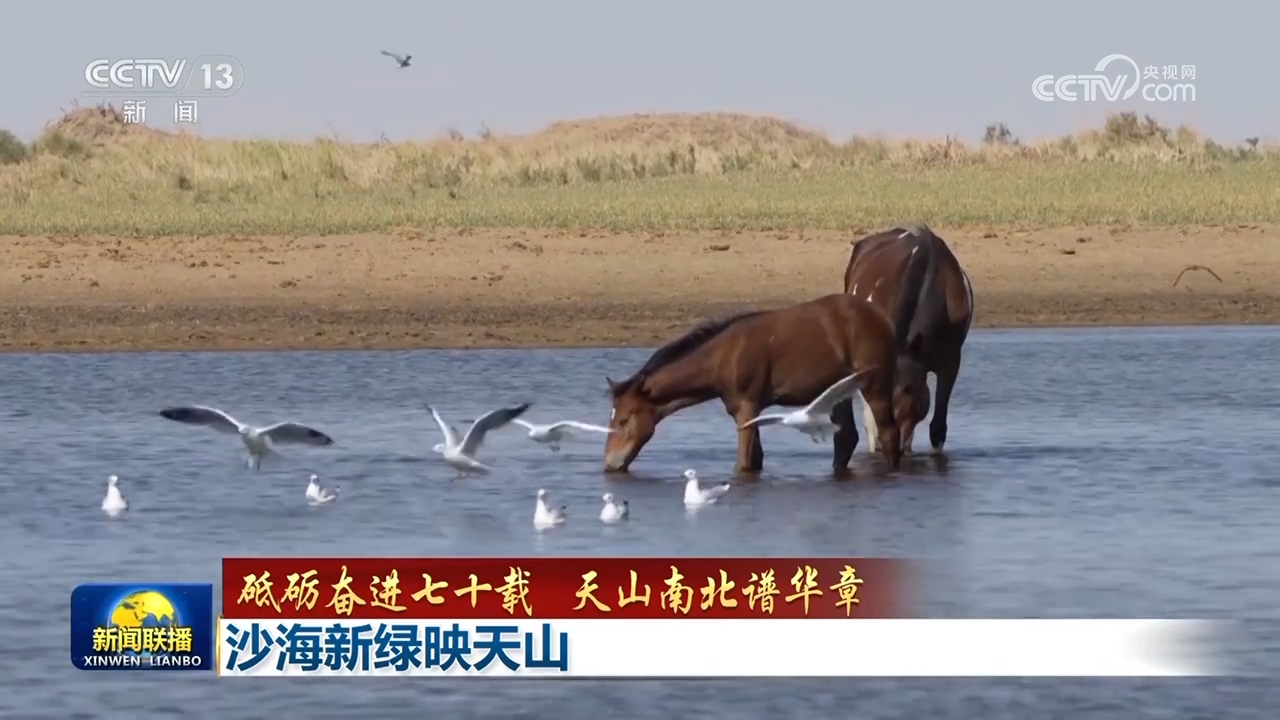
【砥砺奋进七十载 天山南北谱华章】沙海新绿映天山
Yang Shi Wang· 2025-09-17 12:27
Core Insights - Since the 18th National Congress of the Communist Party, Xinjiang has achieved a significant transformation from "desert encroachment" to "greening the desert" through scientific governance [1][3] Group 1: Environmental Restoration - The ecological restoration of the Tarim River's lower reaches has been facilitated by ecological water replenishment from the upper reaches, with seven large water conservancy projects storing snowmelt water from the Tianshan Mountains [3] - Over the past decade, the groundwater level within one kilometer of the Tarim River has risen by approximately 7 meters, leading to the restoration of 2,300 square kilometers of vegetation [3] - The area of desertified land treated in Xinjiang since the 18th National Congress has reached 52,000 square kilometers, equivalent to the area of eight Shanghai cities [5] Group 2: Economic Development - The area for planting specialty economic crops in Xinjiang's sandy regions has reached 1.845 million acres, with the sand industry generating an annual output value exceeding 4.37 billion yuan [7] - The successful greening efforts have allowed local families, such as the Abdurayim brothers, to expand their agricultural activities, including the cultivation of grapes on 1,100 acres of previously barren land [5][7] - The restoration of the ecosystem has also led to the return of over 170 species of wildlife, indicating a healthy and revitalized environment [5]