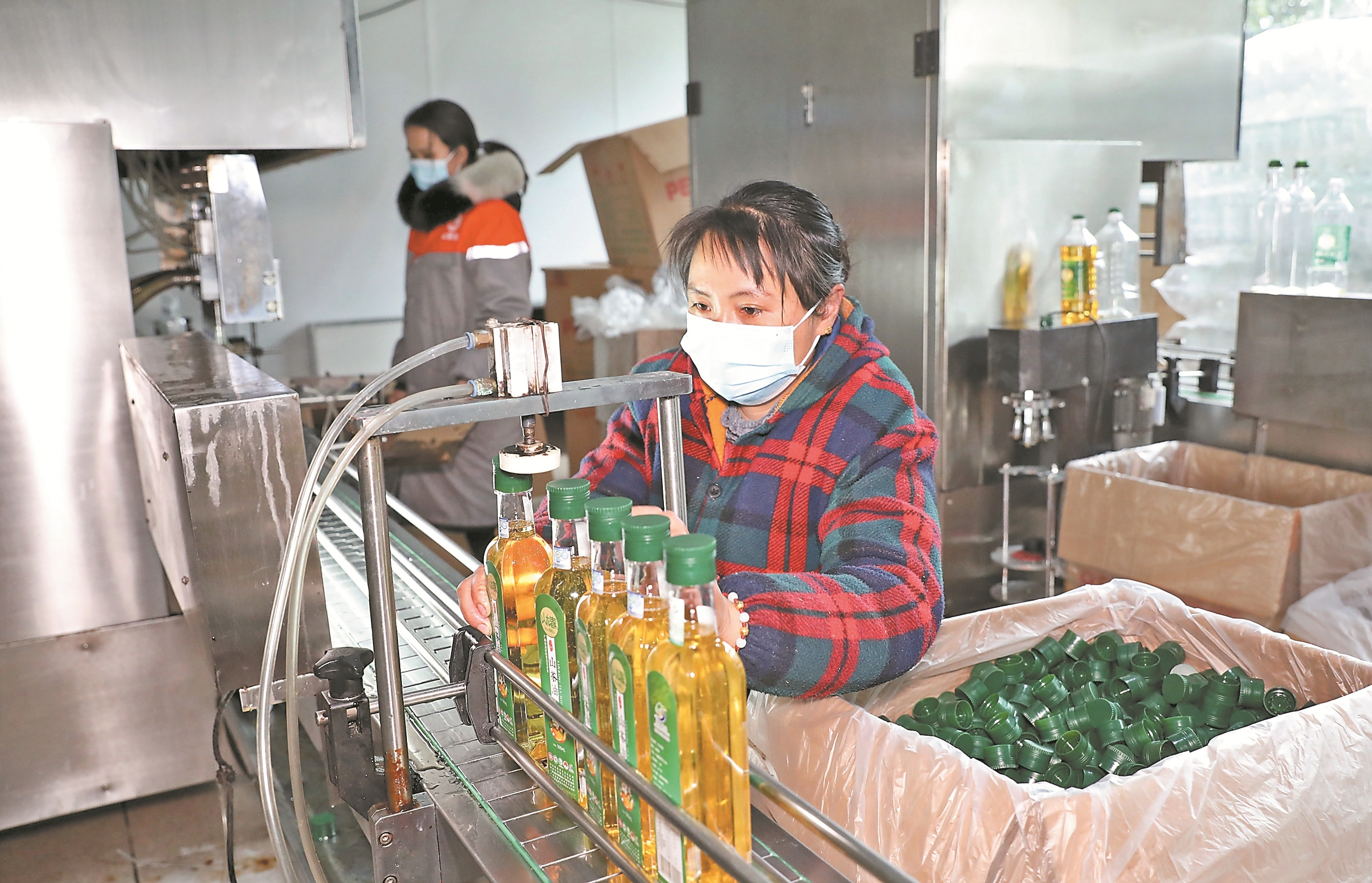
油茶产业发展

Search documents
“十四五”期间中国茶油产量增长53%
Zhong Guo Xin Wen Wang· 2026-02-05 08:21
Core Viewpoint - The Chinese oil tea industry has achieved significant progress during the 14th Five-Year Plan period (2021-2025), with a planting area exceeding 75 million mu and a production of 1.1 million tons of tea oil, marking a 53% increase from 2020 [1][2] Group 1: Industry Development - The Chinese government has implemented a three-year action plan to accelerate the development of the oil tea industry, with over 12 billion RMB invested to date [1] - The number of operational entities in the oil tea industry has reached 2.47 million, with more than 2,200 tea oil processing enterprises established [1] Group 2: Future Focus - The next five years will emphasize quality improvement, area expansion, and efficiency enhancement in the oil tea industry, aiming for high-quality development [2] - There will be a focus on high-standard oil tea forest construction, resource protection, and the exploration of land use for oil tea cultivation [2] - The industry will promote technological innovation and improve single yield through the use of quality seeds, methods, and water and fertilizer management [2] - The development of leading oil tea processing enterprises and the expansion of high-quality tea oil product supply will be prioritized, along with the comprehensive development of oil tea by-products [2] - The exploration of composite business models such as "oil tea + tourism" and "oil tea + medicinal materials" will be encouraged to enhance the overall benefits of oil tea cultivation [2]
新种油茶1300亩
Xin Lang Cai Jing· 2026-02-02 22:11
Group 1 - The core viewpoint of the article highlights the development of the oil tea industry in Yupi County, Guizhou, with a focus on the efficient cultivation practices and the establishment of a modern oil tea seedling breeding base [1] - Yupi County has built the largest modern oil tea seedling breeding base in Southwest China, covering an area of 234,500 acres and producing 10 million seedlings annually [1] - The oil tea planting project in Tianchong Village is part of a key demonstration project supported by the central government, with the village responsible for cultivating 1,300 acres using high-yield, quality varieties [1] Group 2 - The project has completed land transfer and planning since its launch in April 2024, with over 300 acres currently planted and more than 500 acres of tree pits excavated [1] - The cultivation practices involve specific techniques such as cutting open nutrient bags to promote root expansion and ensuring proper soil filling to enhance seedling survival and growth [1] - The project aims to utilize favorable weather conditions to expedite construction and ensure the timely completion of the 1,300-acre planting task [1]
神州茶油处处香
Jing Ji Ri Bao· 2025-12-31 02:59
Core Viewpoint - The oil tea industry in China is experiencing significant growth, becoming an important source of edible oil and contributing to rural prosperity and national food security [2][3]. Industry Overview - Oil tea, a unique tree species with over 2000 years of cultivation history, has evolved into a major edible oil variety in China, with over 2990 processing enterprises and a production value exceeding 150 billion yuan in 2023 [2][3]. - The national oil tea planting area has reached over 75 million acres, with tea oil production surpassing 1.1 million tons, marking a 53% increase compared to five years ago [2]. - Hunan province, as the largest oil tea producer, reported a record high of over 23 million acres of oil tea forest and a production value of 93.4 billion yuan in 2024 [2]. Technological Advancements - A comprehensive technological innovation system for oil tea has been established, leading to significant improvements in yield, with new varieties producing 6 to 10 times more oil than traditional ones [3]. - The development of grafting techniques has resulted in over 3 billion high-quality grafted seedlings, enhancing the overall quality of oil tea production [3]. Challenges in the Industry - Approximately 40 million acres of low-yield oil tea forests exist, primarily consisting of old varieties with poor management practices [4]. - The long cultivation cycle of 7 to 8 years and high initial investment costs (6000 to 7000 yuan per acre) pose significant barriers for farmers [4]. - Labor-intensive harvesting methods and rising labor costs are compressing profit margins for producers [4]. - The market is plagued by confusion over product quality, with prices for tea oil varying widely, leading to consumer distrust [5][6]. Strategies for Improvement - The "oil tea+" model is being promoted to enhance income through intercropping and diversified farming practices, supported by substantial government subsidies [7]. - There is a push for technological advancements in harvesting and processing, including the development of rapid quality testing standards and smart agricultural technologies [7]. - Brand building and regional cooperation are emphasized to enhance market presence and consumer trust in oil tea products [8]. Future Outlook - The industry is set to expand with new processing lines and increased production capabilities, aiming for a more sustainable and profitable future [9].
政策“组合拳”发力显效 “十四五”期间我国茶油产量增长53%
Yang Shi Wang· 2025-11-10 23:49
Core Insights - The Chinese government has implemented a three-year action plan to accelerate the development of the oil tea industry during the 14th Five-Year Plan period, resulting in a 53% increase in tea oil production compared to 2020 [1][2] Group 1: Industry Growth - The tea oil production in China has reached 1.1 million tons, with a total planting area of over 75 million acres [1] - The number of operational entities in the oil tea industry has reached 2.47 million, with over 2,200 tea oil processing enterprises [2] Group 2: Government Initiatives - The government has invested over 12 billion yuan in the oil tea industry through central financial support policies, with plans to plant an additional 11.8 million acres and improve 9.7 million acres of low-yield forests [1] - The establishment of 19 national key breeding bases for oil tea and a 100% usage rate of improved varieties in planting and low-yield forest renovation [2] Group 3: Future Plans - The National Forestry and Grassland Administration aims to enhance high-standard oil tea forest construction, scientifically plan the industry layout, and cultivate leading oil tea processing enterprises to increase the supply of high-quality tea oil products [3]
全国油茶种植面积逾7500万亩
Qi Huo Ri Bao Wang· 2025-11-06 00:55
Core Viewpoint - The article highlights the significant progress in China's oil tea industry, focusing on high-standard oil tea forest construction and the coordination of the entire industry chain to enhance tea oil production capacity [1] Industry Development - China has over 75 million acres of oil tea planted, with a tea oil production of 1.1 million tons [1] - The oil tea tree is a unique high-quality woody oil species in China, with a cultivation history of over 2000 years, providing both ecological and economic benefits [1] Policy and Initiatives - During the "14th Five-Year Plan" period, China has implemented a three-year action plan to accelerate the development of the oil tea industry, focusing on expanding planting areas and increasing production [1] - Measures include supporting the construction of high-standard oil tea forests, promoting the use of superior oil tea varieties, and developing leading enterprises and industrial parks in the oil tea sector [1] Industry Structure - The oil tea industry currently has 2.47 million operating entities and over 2,200 tea oil processing enterprises [1]
全国油茶种植面积达7500多万亩
Xin Hua She· 2025-11-05 14:39
Core Viewpoint - The Chinese government is focusing on high-standard oil tea forest construction and the coordinated development of the entire industry chain to enhance tea oil production capacity, with significant progress made in recent years [1] Industry Development - The total area of oil tea cultivation in China has exceeded 75 million acres, with tea oil production reaching 1.1 million tons [1] - Oil tea is a unique high-quality woody oil crop in China, with over 2000 years of cultivation history, providing both ecological and economic benefits [1] Policy and Action Plans - During the "14th Five-Year Plan" period, China has implemented a three-year action plan to accelerate the development of the oil tea industry, focusing on expanding cultivation and increasing production [1] - Measures include supporting high-standard oil tea forest construction, promoting the use of superior oil tea varieties, and developing leading enterprises and industrial parks in the oil tea sector [1] Industry Structure - The number of operational entities in the oil tea industry has reached 2.47 million, with over 2,200 tea oil processing enterprises [1] - The future development of the oil tea industry will emphasize quality improvement, area expansion, and efficiency enhancement, alongside innovative policy support and resource assurance [1]
习近平总书记关切事|让油茶树变成百姓“摇钱树”——把地方特色产业做优做强之三
Xin Hua She· 2025-07-28 15:15
Core Insights - The article emphasizes the development of the oil tea industry in China, particularly in Henan province, highlighting its potential to enhance local economies and improve farmers' incomes through sustainable practices and innovative processing techniques [1][2][3]. Industry Overview - Oil tea is a unique woody oil crop in China with over 7 million acres planted and an annual production exceeding 1 million tons, contributing significantly to national grain and oil security [1][3]. - The oil tea industry has been recognized by national leadership, with President Xi Jinping advocating for its growth and integration into poverty alleviation strategies [2][3]. Economic Impact - The expansion of oil tea cultivation has led to the establishment of 2.16 million acres of oil tea plantations, generating 360 tons of tea oil annually and providing employment for over 3,000 local farmers [3][7]. - The economic benefits of oil tea cultivation are evident, with local farmers reporting additional income from related activities such as agritourism and value-added products [4][6]. Technological Advancements - The introduction of cold pressing and refining techniques has improved the quality of tea oil, allowing for better retention of nutrients and removal of harmful substances, thus enhancing the overall value of the product [4][5]. - Research and development efforts are ongoing to cultivate new oil tea varieties that are better suited for local conditions, further boosting productivity and sustainability [2][5]. Market Potential - The oil tea industry is diversifying into deep processing, with products ranging from cooking oil to cosmetics and health products, indicating a market potential that could reach 50 billion yuan [5][6]. - The ecological benefits of oil tea plantations, such as carbon trading opportunities, are also being explored, adding another layer of income for farmers [7].
八桂油茶香:产业蝶变正当时
Guang Xi Ri Bao· 2025-06-09 02:04
Core Insights - The total production of oil tea in Guangxi for 2024 is projected to reach 2.753 million tons of fresh fruit, equivalent to 666,300 tons of seeds and 176,400 tons of oil, representing year-on-year increases of 44.56% and 26.65% respectively [2] - The oil tea industry has become a significant contributor to rural revitalization and ecological civilization in Guangxi, with a planting area exceeding 10.5 million acres and a comprehensive output value of approximately 63 billion yuan [2] Policy Empowerment - The Guangxi Forestry Bureau has implemented a "Double Thousand" plan aiming for 10 million acres and 100 billion yuan in output value, alongside a three-year action plan to accelerate oil tea industry development [4] - In 2024, Guangxi cultivated 180 million high-quality oil tea seedlings and completed 880,000 acres of new planting and 450,000 acres of low-yield forest renovation, exceeding national targets [4] Technological Advancements - The introduction of high-yield varieties and improved grafting techniques has significantly increased productivity, with some varieties yielding over 50 kg per tree and achieving an average of 448 kg per acre [5][6] - The average yield for improved oil tea varieties reached 437.89 kg per acre, a 32% increase compared to non-improved varieties [6] Innovative Business Models - The integration of oil tea with other agricultural products, such as cinnamon, has created new revenue streams, with some operations generating 69,900 yuan per acre [7] - The promotion of a "company + cooperative + farmer" model has facilitated technical support and guaranteed pricing for farmers, enhancing the scale of oil tea cultivation [8] Industry Growth - The total output value of the oil tea industry in Guangxi is expected to grow by 36% year-on-year in 2024, driven by increased production and innovative business practices [8]