
波动率均值回归

Search documents
沪银期权高波动率下藏何策略密码
Qi Huo Ri Bao Wang· 2025-12-29 01:36
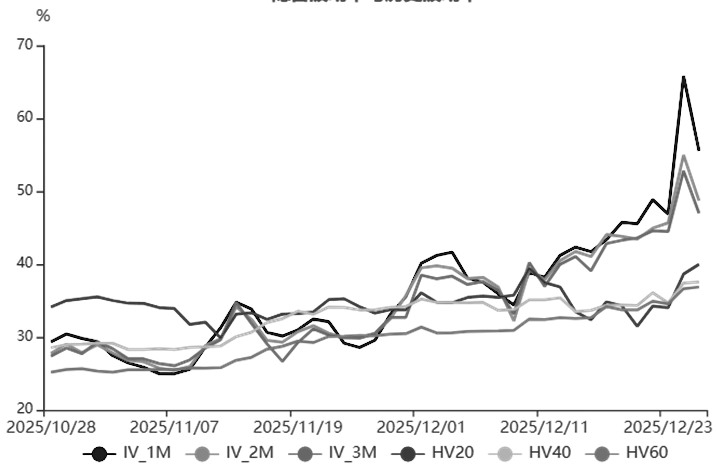
Core Viewpoint - The article discusses the high implied volatility of Shanghai silver options, suggesting that investors can develop corresponding options strategies based on their predictions of Shanghai silver futures prices. The volatility is influenced by macroeconomic or geopolitical events, leading to significant short-term fluctuations in precious metals options [1][8]. Group 1: Market Overview - Last week, precious metal futures surged, with the implied volatility of Shanghai silver options reaching a historical high of over 65%, indicating a strong market expectation for price fluctuations [1][3]. - As of December 26, 2025, the total trading volume of options contracts was 607,227, a decrease of 308.93% from the previous trading day, while total open interest increased by 12.36% to 344,794 contracts [3]. Group 2: Volatility Analysis - Implied volatility is a key variable in options pricing, and high implied volatility often indicates that options may be overvalued, especially if it significantly exceeds historical volatility [4][8]. - The article emphasizes the importance of understanding the relationship between implied volatility and options pricing, noting that higher volatility typically leads to higher option premiums [5][8]. Group 3: Options Strategies - Investors are advised to consider various options strategies in the context of high implied volatility, such as buying out-of-the-money call options for potential high returns, while being aware of the risks associated with time decay and volatility regression [9][15]. - The bull call spread strategy is recommended for those expecting limited price increases, allowing investors to reduce the cost of buying call options while still benefiting from upward price movements [10][12]. - The covered call strategy is suggested for investors holding long positions in Shanghai silver futures, enabling them to enhance returns by selling out-of-the-money call options [13][15].

浅析原油期权运行特点及波动规律
Qi Huo Ri Bao· 2025-05-09 13:43
Core Insights - The launch of crude oil options has led to stable operations, active trading, and rapid growth in trading volume and open interest. The returns of crude oil futures do not follow a normal distribution, exhibiting skewness and heavy tails, indicating more frequent large price changes than would be expected under normal distribution [1][5]. Group 1: Crude Oil Futures Performance - The average return of crude oil futures increased from 0.0036% before the options launch to 0.0605% after, while the median rose from 0.0452% to 0.2206% [3][4]. - The standard deviation of returns increased slightly from 2.31% to 2.61%, indicating a minor rise in the dispersion of returns post-launch [3][4]. - The JB test results confirm that the returns of crude oil futures before and after the options launch do not follow a normal distribution, with both periods showing a JB statistic greater than 6 [5]. Group 2: Volatility Analysis - Historical volatility calculations show that the volatility of crude oil futures has increased since the launch of options, with the average historical volatility rising from 0.3426 to 0.4211 [10]. - The volatility exhibits impulse characteristics, with sharp spikes followed by reversals, indicating extreme short-term fluctuations [11]. - Seasonal patterns in volatility have been identified, with higher volatility observed in March, April, May, and October, while lower volatility occurs in January, February, August, September, and November [15]. Group 3: Market Dynamics and Implications - The primary factors driving the rise in the domestic crude oil market include geopolitical premiums and OPEC production cut expectations, while declines are influenced by Federal Reserve interest rate hikes and macroeconomic factors [16]. - The relationship between crude oil futures and historical volatility is weak, with correlation coefficients ranging from 6.025% to 19.816% across different volatility calculation methods [9]. - The characteristics of historical volatility suggest that investors can utilize these insights for volatility trading, as the short-term volatility tends to be more volatile than long-term volatility [19].
