期权波动率

Search documents
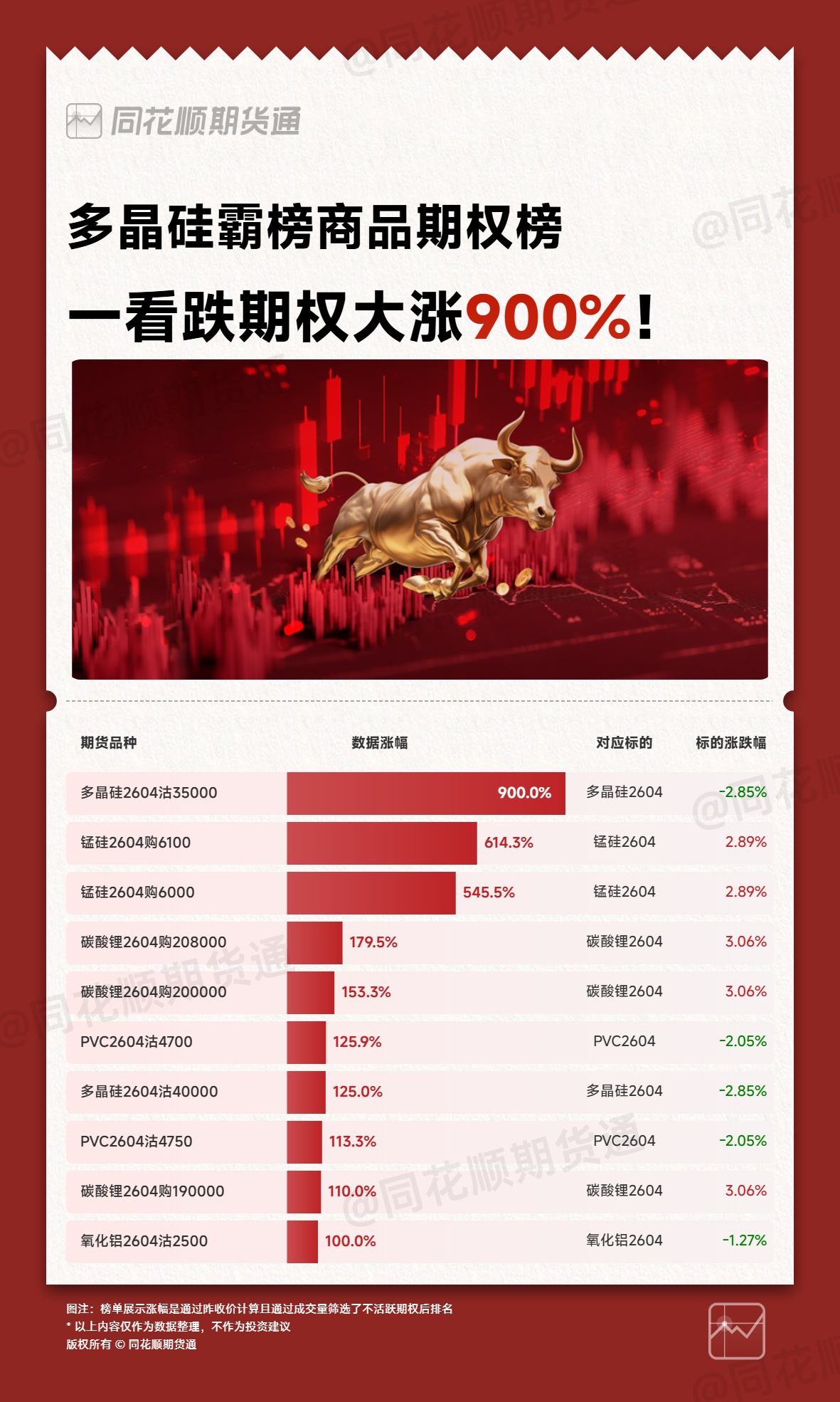
多晶硅期权大涨900%夺得期权榜首
Xin Lang Cai Jing· 2026-02-26 10:27
Core Insights - The commodity options market has experienced significant volatility, with the price of polysilicon put options surging nearly 900% in a single day, highlighting the potential for high returns from small price movements [5][9] - The top three options that saw the largest increases were all out-of-the-money options, indicating that low initial prices and premiums can lead to substantial gains when the underlying asset experiences minor fluctuations [7][9] Market Performance - Polysilicon put option 2604 at 35000 increased by 900% while the underlying asset decreased by 2.85% [3] - Manganese silicon call option 2604 at 6100 rose by 614.3% with the underlying asset increasing by 2.89% [3] - Manganese silicon call option 2604 at 6000 saw a 545.5% increase, also with the underlying asset up by 2.89% [3] Market Dynamics - The current market conditions are driven by a combination of high implied volatility, the nature of out-of-the-money options, and supportive policies affecting supply and demand [5][9] - The increase in volatility is attributed to high inventory levels of polysilicon and export policy disruptions for manganese silicon, leading to heightened market expectations for future price movements [7][9] - The fundamental factors, including supply surplus and policy changes, have led to increased investment in polysilicon, while manganese silicon is supported by export controls and supply-side reforms [7][9]

金融期权周报-20260111
Guo Tai Jun An Qi Huo· 2026-01-11 12:50
1. Report Industry Investment Rating - No relevant content provided 2. Report's Core View - Implied volatility is positively correlated and rising. It is advisable to consider a bull spread strategy with caution and take a long position [2] 3. Summary by Relevant Sections 3.1 Option Market Transaction Overview - The daily average total trading volume of options reached 9.5451 million lots, with a total turnover of 12.5736002 billion yuan. For specific options: - Shanghai 50 Index Option: Call trading volume was 41,200 lots, Put trading volume was 17,700 lots, and total turnover was 288.733 million yuan [2] - CSI 1000 Index Option: Call trading volume was 221,300 lots, Put trading volume was 158,100 lots, and total turnover was 4.8323127 billion yuan [2] - Shanghai and Shenzhen 300 Index Option: Call trading volume was 114,200 lots, Put trading volume was 57,500 lots, and total turnover was 1.1351234 billion yuan [2] - Other ETF options also had corresponding trading volumes and turnovers [2] 3.2 Option Volatility Statistics - For near - month options, the ATM - IV, IV weekly change, 20HV, HV weekly change, Skew, Skew weekly change, VIX, and VIX change of various options were presented. For example: - Shanghai 50 Index Option: ATM - IV was 14.71%, IV weekly change was 1.83%, 20HV was 12.63%, HV weekly change was 4.01% [4] - CSI 1000 Index Option: ATM - IV was 24.13%, IV weekly change was 5.29%, 20HV was 16.18%, HV weekly change was 1.92% [4] 3.3 Option Liquidity - Various charts showed the changes in total trading volume, total open interest, total turnover, total trading market value, and total open - interest market value of financial options, as well as the trading volume and open - interest proportions of each option variety [5][6][7][8][9] 3.4 Option Volatility Level - Comparing the at - the - money implied volatility (ATM - IV) and historical volatility of options, last week, the ATM - IV and historical volatility of most options showed signs of divergence or convergence. The current ATM - IV and the positive correlation between the ATM - IV and the underlying asset price were also presented. For example: - Shanghai 50 Index Option: The current ATM - IV was 14.71%, and the correlation coefficient between the underlying asset and the ATM - IV was 95.75% [10] - CSI 1000 Index Option: The current ATM - IV was 24.13%, and the correlation coefficient was 96.30% [12] 3.5 Option Market Bull - Bear Sentiment - The Put - Call - Ratio (PCR) indicator of options can reflect the market's bull - bear sentiment to some extent. The report presented the PCR trends and daily - on - daily incremental percentages of various options [39][40][41][42][43][44][46] 3.6 Market Support and Resistance Level Information - The trading volume and open interest at different strike prices of options can help reveal the support and resistance levels of the underlying asset. For example: - Shanghai 50 Index: Key support level was 3000, and resistance level was 3150 [46] - CSI 1000 Index: Key support level was 7700, and resistance level was 8000 [46] - Shanghai and Shenzhen 300 Index: Key support level was 4650, and resistance level was 4750 [46] - Other underlying assets also had corresponding support and resistance levels [46]
2025年11月银行间外汇市场运行报告
Sou Hu Cai Jing· 2025-12-31 04:38
Summary of Key Points Core Viewpoint The foreign exchange market in November 2025 experienced a decline in overall trading volume, with the average daily trading volume decreasing month-on-month. The US dollar index fluctuated and depreciated, while the Chinese yuan continued to appreciate, reaching a new high for the year. The market shifted from a net buying to a net selling position, and the volatility of options decreased, indicating short-term appreciation pressure on the yuan. Group 1: Foreign Exchange Market Activity - The average daily trading volume in the interbank foreign exchange market was $191.46 billion, a year-on-year decrease of 2.57% and a month-on-month decrease of 6.69% [2] - The average daily trading volume for the yuan was $146.23 billion, with a slight year-on-year decrease of 5.11% [2] - The foreign currency market showed significant increases in trading activity, while the foreign currency interest rate market saw a decline of over 20% due to external holiday impacts [2] Group 2: Currency Exchange Rates - The US dollar index fluctuated and depreciated, closing at 99.45, down 0.35% from the previous month [3] - The yuan to US dollar exchange rate appreciated, breaking through the 7.12 to 7.08 levels, with the onshore yuan closing at 7.0794, appreciating 0.48% from the previous month [4] - The CFETS index for the yuan against a basket of currencies rose to 97.92, an increase of 0.32% [4] Group 3: Market Positioning and Sentiment - The domestic foreign exchange differential shifted from negative to positive, with an average daily differential of 10.50 basis points by month-end [5] - The average daily net buying of foreign exchange decreased to $7.86 billion, down $3.94 billion from October [5] - The market's herd effect index was 60.77, a decrease of 1.12 points from October, below the historical average of 62.62 [5] Group 4: Options and Volatility - The average daily trading volume of yuan foreign exchange options was $5.44 billion, a month-on-month increase of 3.93% [6] - The implied volatility for the yuan against the US dollar showed a downward trend, with the 1-month ATM implied volatility dropping to 1.68% before rebounding to 2.1% [6] - The 1-year ATM implied volatility decreased from 3.6% to 3.4%, indicating a general decline in market expectations for yuan appreciation [6] Group 5: Interest Rates and Swap Points - The domestic and foreign interest rate differentials remained negative, with the 10-year US Treasury yield fluctuating around 4.0% [7][9] - The 1-year swap points decreased by 9 basis points to -1296 basis points, reflecting a slight downward trend in market pressure [8] - The offshore swap points continued to rise, but the spread between onshore and offshore 1-year swap points narrowed to around 50 basis points, the lowest in three months [8]

沪银期权高波动率下藏何策略密码
Qi Huo Ri Bao Wang· 2025-12-29 01:36
Core Viewpoint - The article discusses the high implied volatility of Shanghai silver options, suggesting that investors can develop corresponding options strategies based on their predictions of Shanghai silver futures prices. The volatility is influenced by macroeconomic or geopolitical events, leading to significant short-term fluctuations in precious metals options [1][8]. Group 1: Market Overview - Last week, precious metal futures surged, with the implied volatility of Shanghai silver options reaching a historical high of over 65%, indicating a strong market expectation for price fluctuations [1][3]. - As of December 26, 2025, the total trading volume of options contracts was 607,227, a decrease of 308.93% from the previous trading day, while total open interest increased by 12.36% to 344,794 contracts [3]. Group 2: Volatility Analysis - Implied volatility is a key variable in options pricing, and high implied volatility often indicates that options may be overvalued, especially if it significantly exceeds historical volatility [4][8]. - The article emphasizes the importance of understanding the relationship between implied volatility and options pricing, noting that higher volatility typically leads to higher option premiums [5][8]. Group 3: Options Strategies - Investors are advised to consider various options strategies in the context of high implied volatility, such as buying out-of-the-money call options for potential high returns, while being aware of the risks associated with time decay and volatility regression [9][15]. - The bull call spread strategy is recommended for those expecting limited price increases, allowing investors to reduce the cost of buying call options while still benefiting from upward price movements [10][12]. - The covered call strategy is suggested for investors holding long positions in Shanghai silver futures, enabling them to enhance returns by selling out-of-the-money call options [13][15].
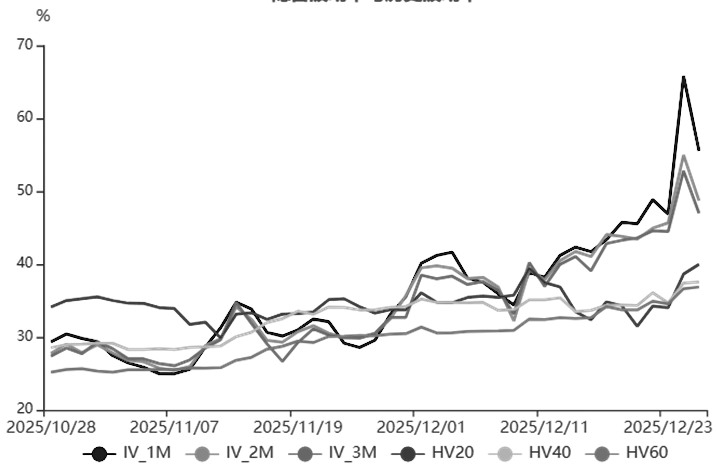
股市成交缩量,股指震荡分化
Bao Cheng Qi Huo· 2025-12-24 11:05
1. Report Industry Investment Rating - No relevant content provided. 2. Core Viewpoints of the Report - Today, the stock indices showed mixed trends. The CSI 1000 and CSI 500 rose significantly, while the SSE 50 and CSI 300 fluctuated within a narrow range. The total stock market turnover was 1897.2 billion yuan, a decrease of 24.1 billion yuan from the previous day. The power equipment, commercial space, consumer electronics, and liquid - cooled server sectors led the gains, which was favorable for small - and medium - cap indices. The stock market is still in a sector rotation market, with the overall trading volume not significantly increasing. Active funds are concentrated in high - growth sectors, resulting in a structural differentiation of the indices. In the long - term, positive policy expectations and the inflow of funds form the long - term support for the indices. In the short - term, as the end of the year approaches, the liquidity of funds has tightened, and the incremental policy signals are not clear, so the short - term upward driving force of the stock indices is insufficient. Overall, the stock indices will maintain a range - bound trend in the short - term [3]. - Currently, both the PCR of open interest and the implied volatility are within the normal range. A bull spread or ratio spread strategy with a mild bullish view can be adopted for options trading [3]. 3. Summary According to Relevant Catalogs 3.1 Option Indicators - On December 24, 2025, the 50ETF rose 0.03% to close at 3.099; the 300ETF (SSE) rose 0.36% to close at 4.757; the 300ETF (SZSE) rose 0.42% to close at 4.832; the CSI 300 Index rose 0.29% to close at 4634.06; the CSI 1000 Index rose 1.54% to close at 7506.38; the 500ETF (SSE) rose 1.30% to close at 7.470; the 500ETF (SZSE) rose 1.48% to close at 2.950; the ChiNext ETF rose 0.85% to close at 3.212; the Shenzhen 100ETF rose 0.29% to close at 3.478; the SSE 50 Index fell 0.08% to close at 3025.18; the STAR 50ETF rose 0.92% to close at 1.42; and the E Fund STAR 50ETF rose 0.95% to close at 1.38 [5]. - The PCR of trading volume and open interest for various options on December 24, 2025, and their changes compared with the previous trading day are presented in detail in the report, including the 50ETF option, SSE 300ETF option, SZSE 300ETF option, CSI 300 index option, CSI 1000 index option, SSE 500ETF option, SZSE 500ETF option, ChiNext ETF option, Shenzhen 100ETF option, SSE 50 index option, STAR 50ETF option, and E Fund STAR 50ETF option [6]. - The implied volatility of at - the - money options in January 2026 and the 30 - trading - day historical volatility of the underlying assets for various options are also provided, including the 50ETF option, SSE 300ETF option, SZSE 300ETF option, CSI 300 index option, CSI 1000 index option, SSE 500ETF option, SZSE 500ETF option, ChiNext ETF option, Shenzhen 100ETF option, SSE 50 index option, STAR 50ETF option, and E Fund STAR 50ETF option [7][8]. 3.2 Related Charts - The report presents a series of charts for different options, including the trend, volatility, PCR of trading volume, PCR of open interest, implied volatility curve, and each - term at - the - money implied volatility of the 50ETF option, SSE 300ETF option, SZSE 300ETF option, CSI 300 index option, CSI 1000 index option, SSE 500ETF option, SZSE 500ETF option, ChiNext ETF option, Shenzhen 100ETF option, SSE 50 index option, STAR 50ETF option, and E Fund STAR 50ETF option [9][22][35][49][62][75][88][101][113][126][140][151].
期权策略总结与案例分析
Qi Huo Ri Bao Wang· 2025-12-22 02:29
Core Viewpoint - Options strategies play a significant role in financial markets, providing investors with flexible investment methods for risk management, asset allocation optimization, and enhanced returns [1] Group 1: Four Dimensions of Options Strategies - The theoretical research on options can be categorized into pricing, trading strategies, and risk management, with pricing serving as the foundation for the other two [2] - The four key dimensions affecting options pricing are direction (delta), acceleration (gamma), volatility (vega), and time value (theta), which explain most price changes [2][3] - Various options strategies can be classified based on these dimensions, such as bull spreads and bear spreads under directional strategies, and calendar spreads and selling put options under time value strategies [3] Group 2: Relationship Among the Four Dimensions - Direction and volatility are often the primary focus for investors due to their significant impact on options pricing and potential returns [4] - The relationship between acceleration and time value is typically one of opposition, requiring a balance between the two [8] Group 3: Volatility Strategy Framework - Volatility is crucial in options research, with various strategies based on volatility, including timing strategies and the "volatility smile" arbitrage strategy [9] - Historical and implied volatility are interrelated, with market conditions affecting their dynamics [9] Group 4: Application Case Study - A case study involving a polypropylene production company illustrates the use of a collar strategy to hedge against price declines, where the company bought a put option and sold a call option [10][11] - The company calculated the necessary options to hedge 200 tons of polypropylene, resulting in the purchase of 40 put options and the sale of 40 call options [11][12] - The strategy was executed on June 18, with a closing price of 7214 yuan/ton, establishing a collar with strike prices of 7200 yuan/ton for the put and 7300 yuan/ton for the call [13] Group 5: Risk Management - The primary risks in the collar strategy include the underlying price rising significantly, which could lead to losses on the sold call option, and liquidity issues as the expiration date approaches [12][14] - The company can adjust its options positions based on market trends to mitigate potential losses [12]

震荡偏弱,注意波动率上升风险
Hong Yuan Qi Huo· 2025-12-05 08:54
1. Report Industry Investment Rating - Not provided in the given content 2. Core Viewpoints - Short - term oil prices may fluctuate weakly, but attention should be paid to the risk of rising volatility [1][4][69] - The short - term main influencing factors of the crude oil market are the development of geopolitical issues, including the Russia - Ukraine peace talks and the situation in Venezuela [4][69] - The possibility of Russia - Ukraine peace talks is still the biggest bearish factor for current oil prices [4][69] - If the Trump administration wants to suppress the Russian economy through low oil prices, the possibility of intensifying the situation in Venezuela is not high [4][69] - Investors with high risk appetite are advised to pay attention to the opportunity of going long on option volatility [4][69] 3. Summary by Directory 3.1 Market Review - Oil prices have been in a range - bound oscillation recently. The complexity of the Russia - Ukraine peace talks and the situation in Venezuela has made it difficult for the market to choose a direction. As of December 4, the active contract of WTI crude oil futures closed at $59.70 per barrel, and Brent crude oil closed at $63.37 per barrel. As of December 5, the active contract of SC crude oil futures closed at 453.7 yuan per barrel [4][9][69] - The inter - monthly spread has been oscillating at a low level [10] - As of the week of November 25, Brent fund net long positions were 125,587 lots, a week - on - week decrease of 52,240 lots, and diesel net long positions were - 19,363 lots [14] 3.2 Crude Oil Supply - OPEC+: In October, the production growth rate slowed down. OPEC+ crude oil production decreased by 106,000 barrels per day month - on - month in October. OPEC crude oil production increased by 33,000 barrels per day month - on - month. The slowdown in production increase was due to the decline in Saudi Arabia's production growth rate and the production decline in some countries affected by sanctions or production compensation. OPEC+ reiterated the decision to suspend production increase in Q1 of next year [19] - US: The daily crude oil production has been oscillating at a high level. As of the week of November 28, the US crude oil daily production was 1,381.5 barrels per day, a week - on - week increase of 100 barrels per day. The OPEC report in November revised up the US crude oil production increase in 2025 to 410,000 barrels per day, and kept the increase in 2026 at 100,000 barrels per day unchanged [28] 3.3 Crude Oil Demand - US: The demand for refined oil products may pick up before Christmas. As of the week of November 28, the demand for gasoline, distillates, and jet fuel showed different trends. The total demand for petroleum products decreased slightly week - on - week but increased year - on - year. The crack spreads of gasoline and diesel rose and then fell, and the estimated profit of US refineries also showed a similar trend. After the end of maintenance, the operating rate of US refineries continued to rise [32][39][41] - China: The crude oil processing volume has continued to grow. From June to October, the crude oil processing volume increased year - on - year. In October, it was 63.43 million tons. The increase was mainly due to the significant increase in the operating rate of major refineries since June, and the improvement in the operating rate of local refineries since the second half of the year [47] 3.4 Crude Oil Inventory - US: Crude oil inventories have increased slightly, and the inventory level has rebounded from a low level. As of the week of November 28, the US crude oil inventory (excluding SPR) was 427.503 million barrels, a week - on - week increase of 574,000 barrels. The SPR inventory increased by 250,000 barrels. Gasoline and diesel inventories continued to increase, but the absolute level was not high, and the gasoline inventory was still at a five - year low [54][59] - OECD: The surplus pressure has gradually increased. In October 2025, the global crude oil monthly supply - demand gap was 443,000 barrels per day, and the OECD continued to accumulate inventories, with the inventory at the end of October reaching 2.903 billion barrels, a month - on - month increase of 25 million barrels [65]
股票股指期权:隐波持续回落,可考虑备兑策略。
Guo Tai Jun An Qi Huo· 2025-12-01 11:41
1. Report Industry Investment Rating No relevant content provided. 2. Core Viewpoint of the Report The implied volatility of stock index options continues to decline, and investors can consider the covered call strategy [1]. 3. Summary According to Relevant Catalogs 3.1 Market Data Statistics - **Underlying Market Statistics**: The closing prices of various indices and ETFs showed increases, with trading volume changes varying. For example, the Shanghai Composite 50 Index closed at 2993.68, up 24.06 points, and its trading volume was 46.52 billion shares, an increase of 9.25 billion shares [1]. - **Options Market Statistics**: The trading volume and open interest of different options also changed. For instance, the trading volume of Shanghai Composite 50 Index Options was 28,345, an increase of 9,677, and the open interest was 65,173, an increase of 2,743 [1]. 3.2 Options Volatility Statistics - **Near - Month Options**: The ATM - IV of most options decreased, while the same - term HV showed different trends. For example, the ATM - IV of Shanghai Composite 50 Index Options was 10.97%, a decrease of 1.04%, and the same - term HV was 12.03%, an increase of 0.54% [4]. - **Next - Month Options**: Similar to the near - month options, the ATM - IV of most next - month options decreased, and the same - term HV also had various changes [4]. 3.3 Individual Option Analysis - **Shanghai Composite 50 Index Options**: The report presents multiple charts including the full - contract PCR, the main - contract skewness trend, the volatility cone, and the volatility term structure [7][8]. - **CSI 300 Index Options**: Charts such as the full - contract PCR, the main - contract skewness trend, the volatility cone, and the volatility term structure are provided [11][12]. - **CSI 1000 Index Options**: The full - contract PCR, the main - contract skewness trend, the volatility cone, and the volatility term structure are shown in relevant charts [15][16]. - **Shanghai Composite 50ETF Options**: Multiple charts including the full - contract PCR, the main - contract skewness trend, the volatility cone, and the volatility term structure are presented [24][25]. - **Huatai - Peregrine 300ETF Options**: The full - contract PCR, the main - contract skewness trend, the volatility cone, and the volatility term structure are included in the analysis [28][29]. - **Southern CSI 500ETF Options**: Relevant charts show the full - contract PCR, the main - contract skewness trend, the volatility cone, and the volatility term structure [33][34]. - **Huaxia Science and Technology Innovation 50ETF Options**: The full - contract PCR, the main - contract skewness trend, the volatility cone, and the volatility term structure are presented in the report [41][43]. - **E Fund Science and Technology Innovation 50ETF Options**: The full - contract PCR, the main - contract skewness trend, the volatility cone, and the volatility term structure are included in the analysis [47][48]. - **Harvest 300ETF Options**: The full - contract PCR, the main - contract skewness trend, the volatility cone, and the volatility term structure are shown in relevant charts [58][59]. - **Harvest CSI 500ETF Options**: The full - contract PCR, the main - contract skewness trend, the volatility cone, and the volatility term structure are presented [63][64]. - **Growth Enterprise Market ETF Options**: The full - contract PCR, the main - contract skewness trend, the volatility cone, and the volatility term structure are included in the analysis [67][68]. - **Shenzhen 100ETF Options**: The full - contract PCR, the main - contract skewness trend, the volatility cone, and the volatility term structure are shown in relevant charts [72][73].
股票股指期权:ETF期权临近到期,近月隐波上升
Guo Tai Jun An Qi Huo· 2025-11-25 14:59
Report Summary 1. Report Industry Investment Rating No information provided in the report. 2. Core View of the Report ETF options are approaching expiration, and the implied volatility of near - month contracts is rising [2]. 3. Summary by Related Catalogs 3.1 Market Data Statistics - **Underlying Market Statistics**: The closing prices of the Shanghai Composite 50 Index, CSI 300 Index, and CSI 1000 Index increased by 17.64, 42.36, and 93.54 respectively. The trading volumes of the Shanghai Composite 50 Index and CSI 300 Index decreased by 8.40 billion and 16.26 billion hands, while that of the CSI 1000 Index increased by 4.77 billion hands. For ETFs, the trading volume of some decreased, while others increased [3]. - **Option Market Statistics**: The trading volumes of some option contracts decreased, such as the Shanghai Composite 50 Index Option and Shanghai Composite 50 ETF Option, while others increased, like the CSI 1000 Index Option and Southern CSI 500 ETF Option. The open - interest also showed different trends of increase or decrease [3]. - **Option Volatility Statistics**: In the near - month contracts, the ATM - IV of most option contracts decreased, except for the Southern CSI 500 ETF Option and Huaxia Science and Technology Innovation 50 ETF Option which increased. The same - term HV of some contracts increased, and the Skew also had different changes [6]. 3.2 Option Index Data Statistics - **PCR and Maximum Positions**: The VL - PCR and OI - PCR of different option contracts varied. For example, the VL - PCR of the Shanghai Composite 50 Index Option was 54.85%, and the OI - PCR was 69.94%. The maximum positions of call and put options in the near - month contracts also differed for each option [3]. 3.3 Option Charts - For each type of option (e.g., Shanghai Composite 50 Index Option, CSI 300 Index Option), there are charts showing the full - contract PCR, the main - contract skewness trend, the volatility cone, and the volatility term structure, which visually present the historical and current option data [10][14][24]
2025年10月银行间外汇市场运行报告
Sou Hu Cai Jing· 2025-11-25 03:02
Group 1 - The interbank foreign exchange market showed stable trading volume, with the average daily trading volume increasing by 6.72% month-on-month to $205.18 billion, despite a slight year-on-year decline of 0.3% [2] - The average daily trading volume in the RMB foreign exchange market was $152.54 billion, down 5.72% year-on-year but up 6.3% month-on-month, with both spot and swap transactions increasing by over 7% [2] Group 2 - The US dollar index continued to strengthen, reaching around 99.5 before declining to above 98, with a month-end value of 99.804, reflecting a 2.08% appreciation from the previous month [3] - The RMB exchange rate rose to a yearly high of 7.0995 against the US dollar before fluctuating, ending the month at 7.1135, a slight appreciation of 0.07% [4] Group 3 - The domestic foreign exchange spread shifted from negative to positive by the end of the month, with an average daily spread of -29 basis points, which was wider by 25 basis points compared to the previous month [5] - The market saw a shift from net buying to net selling of foreign exchange by institutions, with an average daily net buying of $11.80 million throughout the month [5] Group 4 - The implied volatility of RMB foreign exchange options remained low, with an average daily trading volume of $5.23 billion, down 9.07% month-on-month [6] - The 1-month implied volatility for RMB against the US dollar reached a low of 2.19%, the lowest since June 2017 [6] Group 5 - The long-term swap points reached a new high not seen in nearly three years, with the 1-year swap points ending at -1287 basis points, an increase of 35 basis points from the previous month [7] - The market's buying pressure remained strong, with the 1-year swap points reflecting significant market supply and demand factors [8] Group 6 - The dollar liquidity in the foreign currency interest rate market remained loose, with the overnight dollar interest rate spread maintaining a negative direction, reaching a yearly high of -40 basis points by the end of the month [10] - The SOFR rate fluctuated, ending the month at 4.22% after a drop following the Fed's rate cut [9]