
流感病毒耐药性

Search documents
抗流感药物“玛巴洛沙韦”耐药性如何?张文宏团队发布研究
Xin Lang Cai Jing· 2026-01-23 10:41
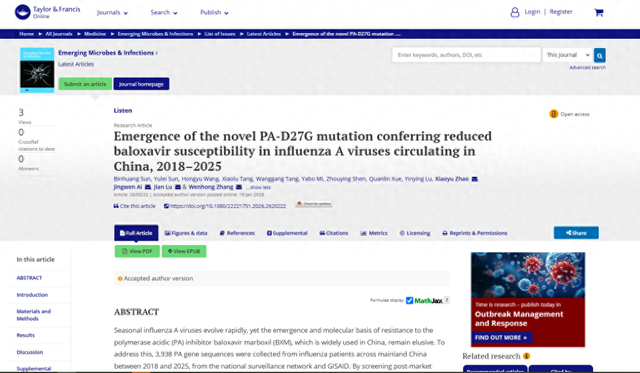
Core Viewpoint - A recent study conducted by a team from Fudan University’s Huashan Hospital assessed the sensitivity of the antiviral drug "Marbofloxacin" against influenza viruses in nearly 4,000 Chinese patients, revealing a very low mutation rate associated with drug resistance, thus confirming the drug's effectiveness and safety in clinical applications in China [1][2]. Group 1: Study Findings - The overall detection rate of known mutations related to reduced sensitivity to Marbofloxacin in mainland China is only 0.05% [1]. - The hallmark resistance mutation I38T, previously reported globally, was not detected in this study, indicating that it does not have a competitive advantage in natural transmission due to its significantly reduced viral adaptability [1][2]. - The study identified only one new mutation, PA-D27G, in the H1N1pdm09 virus, with a very low prevalence of 0.32%, which decreases sensitivity to Marbofloxacin by approximately 12.4 times, significantly lower than the typical I38T mutation [2][4]. Group 2: Implications and Future Research - The low prevalence of the D27G mutation, both in China (0.32%) and globally (below 0.1%), suggests that such mutations face adaptive constraints in natural transmission and are unlikely to become mainstream strains [4]. - The study's findings support the notion that flu virus mutations occur randomly and are not directly influenced by the age of patients, with no evidence suggesting that children using Marbofloxacin are at a higher risk of inducing viral mutations [4][5]. - The research team plans to continue monitoring known resistance points and utilize advanced research methods and big data to predict unknown mutations, emphasizing the importance of early detection and treatment in managing viral changes [5].

11月全国报告的流感样病例暴发疫情超过4000起,奥司他韦耐药了吗?
Di Yi Cai Jing· 2025-12-04 05:49
Core Viewpoint - The effectiveness of antiviral drug Oseltamivir against A(H3N2) influenza remains intact despite rising flu cases in China, with a significant proportion of reported cases linked to this strain [1][5]. Group 1: Flu Activity and Statistics - As of the end of November 2025, China reported a total of 4,351 influenza-like illness outbreaks, with 3,313 cases (approximately 76.14%) associated with A(H3N2) [1][3]. - The ILI percentage in southern provinces reached 10.3% in the 48th week of 2025, an increase from 7.8% the previous week and higher than the same period in 2022, 2023, and 2024 [3]. - Northern provinces reported an ILI percentage of 9.1% in the same week, up from 8.6% the previous week, also exceeding the levels of the previous three years [3]. Group 2: Antiviral Drug Resistance - The National Influenza Center's analysis indicated that 3.9% of A(H1N1)pdm09 strains showed reduced sensitivity to neuraminidase inhibitors, while all A(H3N2) and B strains remained sensitive [5]. - Oseltamivir is still widely used and effective against A(H3N2), with clinical observations suggesting that resistance issues are not significant at this time [5][6]. Group 3: Antiviral Drug Guidelines - The "Chinese Influenza Treatment and Drug Prevention Clinical Practice Guidelines (2025 Edition)" states that antiviral drugs should be considered a supplementary measure to vaccination for flu prevention in community settings [6][7]. - Routine use of antiviral drugs for pre-exposure prevention is not recommended due to potential for inducing resistance and associated costs, with specific exceptions for high-risk groups [7].

全国流感进入快速上升期
第一财经· 2025-11-24 09:10
Core Viewpoint - The article highlights the significant increase in flu activity across China, with many provinces experiencing high levels of flu cases, leading to a surge in demand for flu vaccines and antiviral medications [3][4][5]. Vaccine Supply and Demand - Flu vaccine demand has surged, particularly in northern provinces like Beijing, Liaoning, and Shaanxi, with reports of full appointment schedules for vaccinations [5][6]. - While the supply of quadrivalent flu vaccines is stable, there is a noted shortage of innovative vaccines such as nasal spray and subunit vaccines in some areas [5][6]. - The availability of flu vaccines for children aged 6-35 months remains stable, with sufficient stock reported across various community health service centers [5][6]. Antiviral Medication Demand - There has been a dramatic increase in the demand for antiviral medications, with sales figures showing a 22-fold increase in flu medication sales since the onset of the flu season [8][9]. - Specific antiviral products like Oseltamivir and other flu medications have seen sales growth of 4.5 times and 5 times, respectively, in the latest week [9]. - The current flu season is characterized by the predominance of the H3N2 strain, but existing antiviral treatments remain effective against the circulating strains [9][10]. Regulatory Actions - To ensure the stability of antiviral medication supply and pricing, regulatory authorities in various regions, including Beijing and Qinghai, have initiated special inspections to prevent price gouging [10].

这些和流感有关的说法可信吗
Ke Ji Ri Bao· 2025-11-18 01:37
Core Viewpoint - The article emphasizes the importance of understanding the flu and its prevention methods, particularly the risks associated with the misuse of antiviral medication Oseltamivir and the necessity of flu vaccination as the most effective preventive measure [2][3][5][10] Group 1: Misuse of Oseltamivir - There are claims that long-term use of Oseltamivir can prevent flu, which experts strongly oppose, stating that the drug should not be used casually [2] - Oseltamivir is effective only when taken within 48 hours of flu symptoms appearing, and its use for post-exposure prevention is limited to high-risk groups [2][3] - Misuse of Oseltamivir can lead to adverse effects such as nausea and potential neuropsychiatric reactions, as well as the risk of developing drug-resistant virus strains [3] Group 2: Understanding Flu vs. Common Cold - The article clarifies that flu is a serious respiratory illness caused by the influenza virus, distinct from common colds caused by other viruses, with significant differences in symptoms and complications [4][5] - Flu symptoms include high fever, muscle aches, and severe fatigue, while common colds typically present milder symptoms [4][5] - The World Health Organization reports that flu can lead to 3 to 5 million severe cases and 290,000 to 650,000 respiratory disease-related deaths annually [5] Group 3: Immunity and Vaccination - Immunity from a previous flu infection lasts only 6 to 8 months, not a lifetime, due to the virus's ability to mutate [6][7] - Vaccination is recommended for everyone aged 6 months and older, with the timing of vaccination being crucial for effectiveness [8][10] - Individuals with mild cold symptoms can receive the flu vaccine, but those with fever or severe symptoms should postpone vaccination [8][9]