海洋资源开发与保护

Search documents
10亿吨海里“金矿”,全球多国竞相争夺,中国或将成为最大赢家
Sou Hu Cai Jing· 2026-02-21 05:27
Core Insights - Antarctic krill is a crucial species in the Antarctic ecosystem, supporting the entire food chain and has an estimated population of 6 to 10 billion tons, significantly surpassing the total weight of humans and most land animals [3] - The potential of Antarctic krill as a high-quality protein source is highlighted, with its resources capable of supporting 1.4 billion people globally [1][4] - China is emerging as a key competitor in the global krill resource competition, leveraging technology and strategic positioning to potentially become the largest beneficiary [4] Industry Overview - Krill has strong environmental adaptability, capable of reducing its size and metabolic rate during food shortages, and can reproduce prolifically, with females laying 6,000 to 10,000 eggs annually [6] - Krill meal is becoming a premium substitute for traditional fish meal, with a replacement ratio of 2.5 tons of fish meal per ton of krill meal, thus reducing fish resource consumption [8] - The global krill fishing competition began in the 1970s, with China entering the market in 2007 and reaching a catch volume of 100,000 tons by 2019, accounting for one-fourth of the global total [10] Sustainability Challenges - The development of krill resources faces sustainability challenges due to climate change, which is causing Antarctic ice melt and affecting their habitat and food sources [10] - International agreements limit the global annual catch to no more than 620,000 tons to protect the ecosystem [10] - Balancing development and ecological protection is essential for the sustainable utilization of this marine protein resource, which is critical for human development [12]


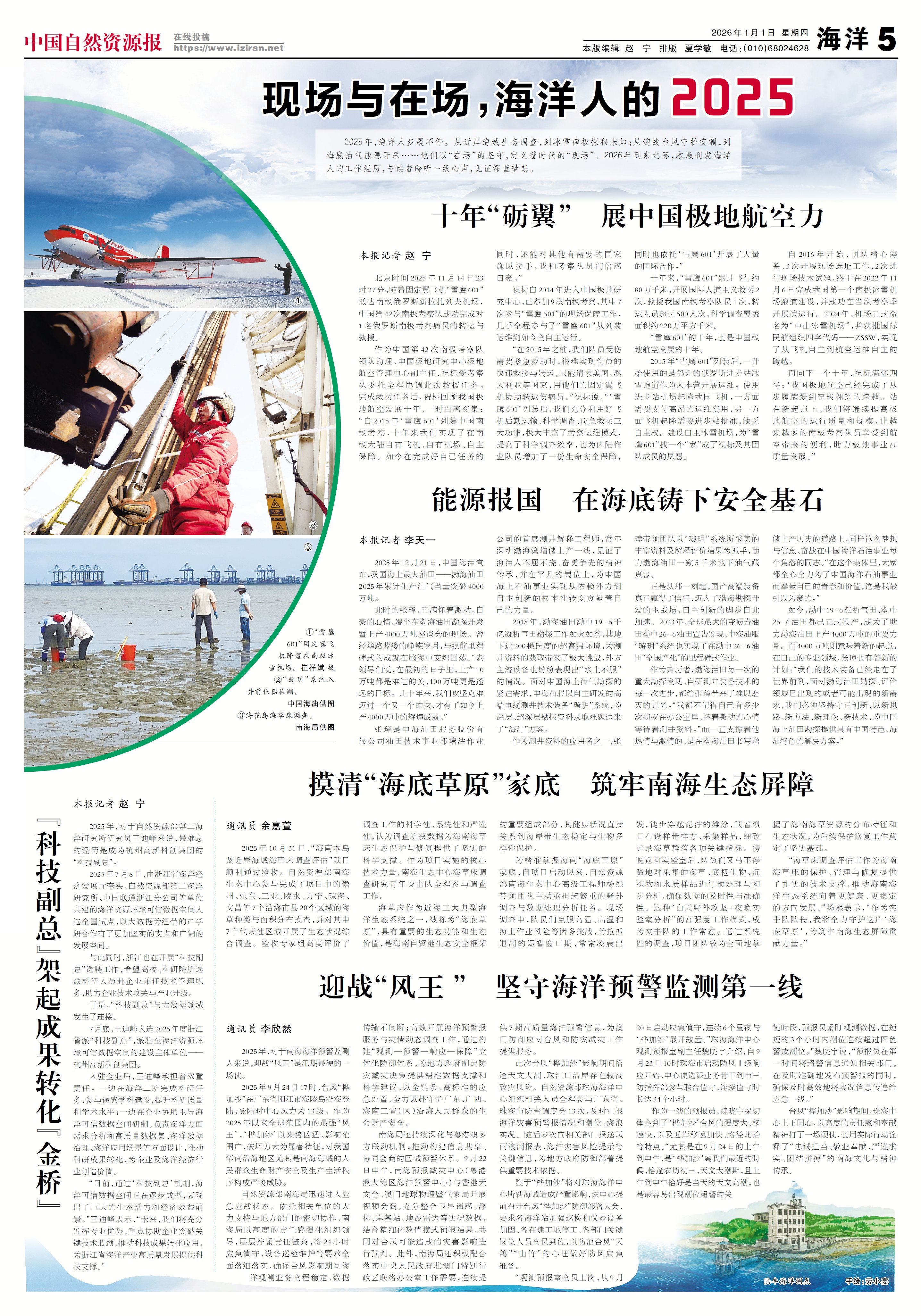
现场与在场,海洋人的2025
Zhong Guo Zi Ran Zi Yuan Bao· 2026-01-06 05:23
Group 1: Polar Aviation Development - The "Snow Eagle 601" fixed-wing aircraft has successfully completed its mission of transporting and rescuing personnel in Antarctica, marking a significant milestone in China's polar aviation development over the past decade [10][11] - Since its commissioning in 2015, "Snow Eagle 601" has flown approximately 800,000 kilometers, conducted two international humanitarian rescues, and transported over 500 personnel, significantly enhancing the efficiency of scientific investigations [11][12] - The establishment of China's first Antarctic ice and snow airport, named "Zhongshan Ice and Snow Airport," was completed in November 2022, allowing for autonomous operations and marking a leap in aviation self-sufficiency [12][14] Group 2: Offshore Oil Production - China National Offshore Oil Corporation (CNOOC) announced that the Bohai Oilfield has surpassed a cumulative production of 40 million tons of oil and gas equivalent in 2025, showcasing a significant achievement in offshore oil production [15] - The development of the Bohai Oilfield has transitioned from reliance on foreign technology to independent innovation, with the introduction of domestically developed high-end cable logging technology, "Xuan Yue," which has been crucial for deep exploration [15][16] - The successful production of the Bohai Oilfield's major gas fields, such as the Bohai Zhong 19-6 and Bohai Zhong 26-6, has contributed significantly to the overall production milestone of 40 million tons [18] Group 3: Marine Data and Technology - The establishment of a marine resource environment credible data space in Zhejiang Province aims to enhance collaboration between academia and industry, facilitating technological advancements and industrial upgrades [19][21] - The "Technology Vice President" initiative allows researchers to assist enterprises in overcoming technical challenges and promoting the application of scientific achievements, thereby supporting the high-quality development of the marine industry in Zhejiang [21][22] Group 4: Marine Ecosystem Protection - The successful completion of the "Hainan Island and Nearshore Sea Grass Bed Survey and Assessment" project provides essential scientific support for the protection and restoration of sea grass beds, which are vital for coastal ecosystem stability [22][24] - The project involved extensive field surveys and data analysis, enabling a comprehensive understanding of the distribution and ecological status of sea grass resources in Hainan [23][24] Group 5: Typhoon Response and Monitoring - The South China Sea Bureau rapidly activated emergency response measures during Typhoon "Huanjiasha," ensuring continuous marine observation and data transmission to support disaster prevention and mitigation efforts [26][29] - Collaborative efforts with regional partners, including Hong Kong and Macau, were established to enhance the effectiveness of the early warning system and provide timely information for disaster response [27][29] - The proactive measures taken by the South China Sea Bureau during the typhoon highlighted the commitment to safeguarding the lives and property of coastal residents [30][31]