消费金融信托

Search documents
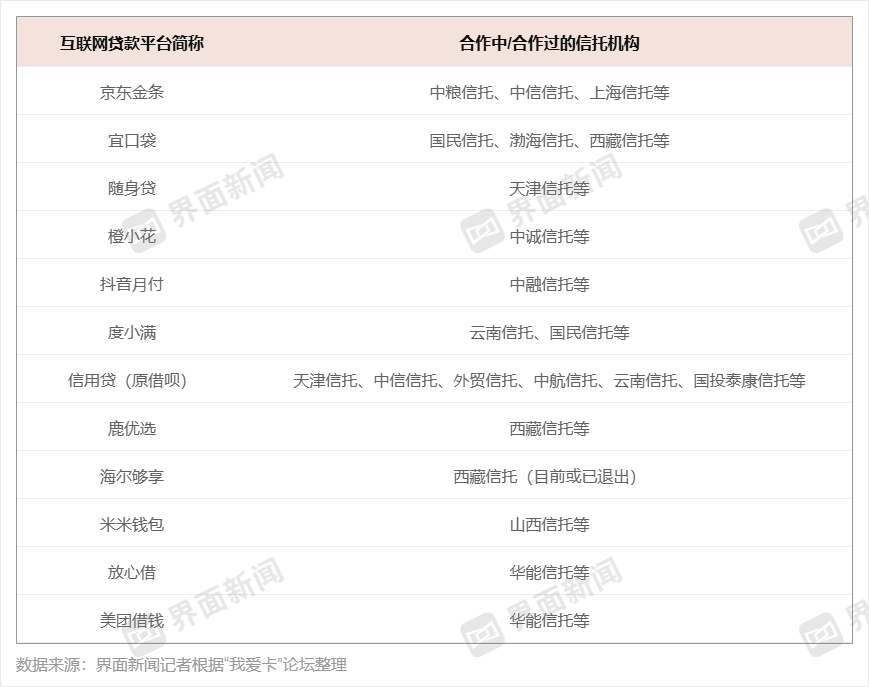
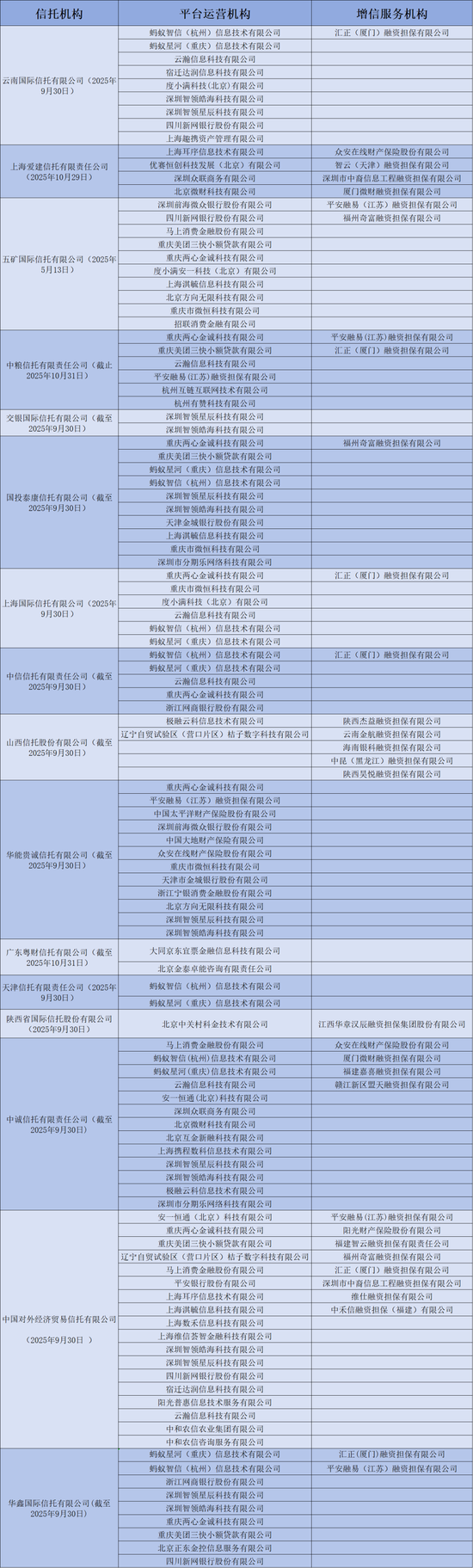
至少16家信托披露助贷合作机构名单:蚂蚁、头条、美团等成热门合作机构
Xin Lang Cai Jing· 2025-11-26 11:29
Core Viewpoint - Multiple trust companies have disclosed their lists of internet lending business cooperation institutions, following the regulatory guidelines issued by the National Financial Supervision Administration, which mandates a list management system for platform operators and credit enhancement service providers [1][4]. Group 1: Disclosure of Cooperation Institutions - At least 16 trust companies, including Zhongcheng Trust, CITIC Trust, and Huaneng Trust, have publicly announced their cooperation institutions for internet lending on their official websites [1]. - The disclosed cooperation institutions primarily consist of platform operating entities and credit enhancement service providers, with a focus on platform operating entities [4]. Group 2: Key Players in Internet Lending - Notable companies frequently appearing in the cooperation lists include Ant Group's Ant Zhixin (Hangzhou) Information Technology Co., Ltd., and Meituan-related companies such as Chongqing Meituan San Kuai Small Loan Co., Ltd. [4]. - The cooperation with these entities reflects the evolving landscape of trust companies' lending operations amid stringent regulations [4]. Group 3: Market Context and Trends - The trust companies' lending business is rapidly evolving under strong regulatory oversight, connecting their transformation needs with the vast consumer finance market [4]. - Consumer finance aligns with national policies aimed at boosting domestic demand, making it a crucial area for trust companies' transformation efforts [4]. Group 4: Advantages and Disadvantages of Trust Companies - Trust companies possess flexible transaction structure design capabilities, allowing them to engage deeply in asset securitization (ABS) models to lower funding costs [5]. - However, they face challenges such as higher funding costs compared to banks, reliance on partner institutions for customer acquisition and risk control, and high complaint rates leading to compliance and reputational risks [5].



审视华能信托被骗17亿案:信托重返消金牌桌,助贷新规将带来什么?
Xin Lang Cai Jing· 2025-09-26 04:05
Core Viewpoint - The recent developments in the consumption finance trust business highlight a resurgence in the sector, driven by regulatory changes and market dynamics, despite the risks exemplified by the Huaneng Trust loan fraud case [1][4][14]. Group 1: Regulatory Environment - The local securities regulatory bureau has initiated a special self-inspection of asset-backed securities (ABS) related to Huaneng Trust's "credit guarantee loan" business to prevent similar fraud risks from affecting the ABS market [1]. - The implementation of the new lending regulations on October 1 is expected to impose stricter constraints on trust institutions involved in consumer loans, including limits on borrowing rates and platform management [2][7]. Group 2: Market Trends - In the first eight months of 2025, 26 trust companies issued consumption finance collective trust plans totaling 173.3 billion yuan, marking a year-on-year increase of over 50% [4][6]. - Major trust companies such as Tianjin Trust, Guomin Trust, and Huaxin Trust have significantly increased their issuance of consumption finance trust products, with some companies doubling their issuance compared to the previous year [4][6]. Group 3: Business Models - The consumption finance trust business, which primarily involves providing consumer loans, has evolved from a focus on non-standard financing to a more regulated environment due to increased scrutiny [3][11]. - The trust companies are now exploring various business models, including lending partnerships with banks and consumer finance companies, to mitigate risks and enhance profitability [10][12]. Group 4: Risks and Challenges - The Huaneng Trust loan fraud case serves as a cautionary tale for the industry, highlighting the risks associated with over-reliance on third-party platforms and inadequate risk management practices [14][15]. - The new lending regulations are expected to challenge traditional financing models, pushing trust companies to adapt their strategies to comply with stricter regulatory requirements [29][30]. Group 5: Future Outlook - The consumption finance trust business is anticipated to continue evolving, with a focus on compliance and proactive risk management becoming paramount for trust companies [29][30]. - The shift towards asset service trusts, particularly in prepayment funding services, is seen as a potential optimal solution for trust companies facing regulatory pressures [30].