
互联网助贷业务

Search documents
嘉银科技余额是?宜人智科投资「加密货币」挣了不少|附6家上市互金业绩
Sou Hu Cai Jing· 2025-11-29 13:22
Core Insights - The article focuses on the Q3 performance of two fintech companies, JiaYin Technology and Yirendai, highlighting their financial results and strategic adjustments in response to regulatory pressures in the fintech sector. JiaYin Technology - JiaYin Technology reported a loan issuance of 32.2 billion, a slight increase of 1.35% from Q2's 31.7 billion, despite a significant revenue decline of 22% to 1.4702 billion [1][2] - Net profit for Q3 was 376.5 million, showing a year-on-year increase of 39.65% but a quarter-on-quarter decrease of 27.47% [1][2] - Revenue breakdown: loan facilitation service income decreased by 24% quarter-on-quarter, while guarantee income increased by 20% [1][2] - Marketing and administrative expenses decreased by 23% and 34% respectively, while provisions for bad debts saw a dramatic reduction of 95% [1][2] - As of the end of September, the outstanding loan balance was 83 billion, which decreased to 80.3 billion by the end of October [4][5] - The company maintains partnerships with 75 financial institutions and is in discussions with 64 others [6][8] - In the overseas market, JiaYin's Indonesian business grew nearly 200% year-on-year, with a 150% increase in borrower numbers [10][11] - The company anticipates a loan facilitation volume of 23 to 25 billion for Q4, representing a quarter-on-quarter decrease of 22% to 29% [17] Yirendai - Yirendai's loan balance reached 34.2 billion, marking a quarter-on-quarter increase of 9.62% and a year-on-year increase of 50% [19] - The company facilitated loans totaling 20.2 billion in Q3, a slight decrease of 0.49% from Q2 but a year-on-year increase of 50.75% [20] - Revenue for Q3 was 1.555 billion, down 5.88% quarter-on-quarter but up 5.13% year-on-year, with net profit at 318 million, reflecting a quarter-on-quarter decrease of 11.16% [20][21] - The financial consulting segment, primarily loan facilitation, contributed 91.52% of total revenue, with a significant 70% year-on-year growth driven by guarantee service income [22][23] - The company reported a 68.8% increase in provisions for bad debts, reaching 460 million, due to the growth in risk-bearing loan facilitation [26] - Yirendai's overseas operations in Indonesia are expected to contribute significantly to growth in 2026 [29] - The company has seen a resurgence in its insurance business, with a 204% increase in internet insurance premiums, although overall premiums are down 15% year-on-year [31] - Notably, half of Yirendai's net profit in Q3 was attributed to cryptocurrency investments, with a fair value adjustment gain of 161.3 million [34][38] - The company projects total revenue for Q4 to be between 1.4 billion and 1.6 billion, driven by growth in both domestic and international loan markets [39]


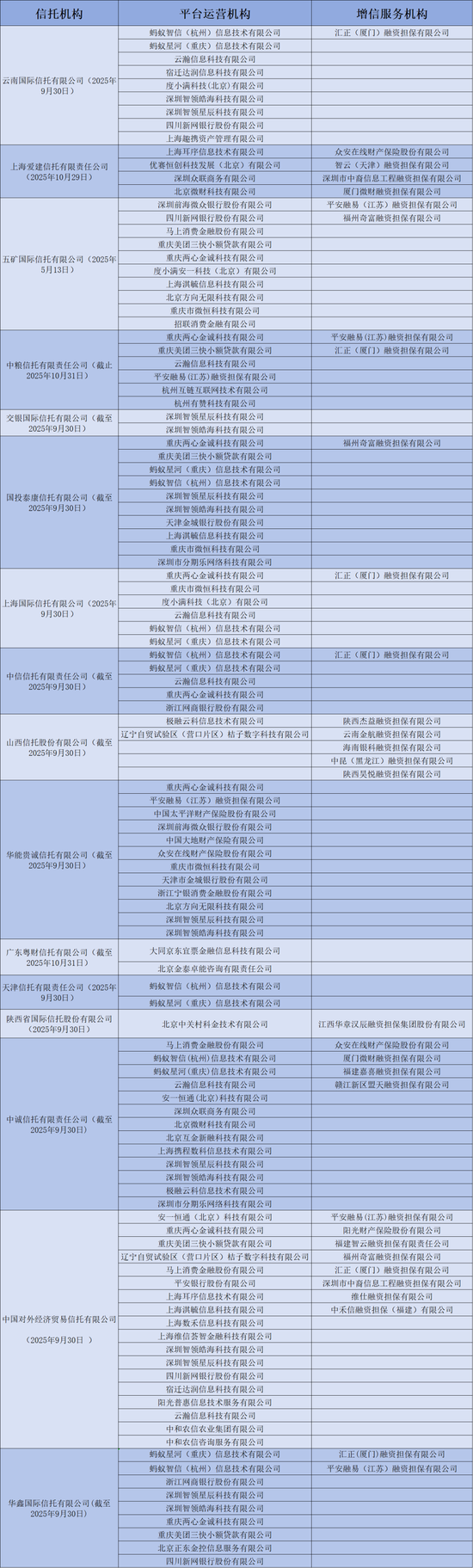
至少16家信托披露助贷合作机构名单:蚂蚁、头条、美团等成热门合作机构
Xin Lang Cai Jing· 2025-11-26 11:29
Core Viewpoint - Multiple trust companies have disclosed their lists of internet lending business cooperation institutions, following the regulatory guidelines issued by the National Financial Supervision Administration, which mandates a list management system for platform operators and credit enhancement service providers [1][4]. Group 1: Disclosure of Cooperation Institutions - At least 16 trust companies, including Zhongcheng Trust, CITIC Trust, and Huaneng Trust, have publicly announced their cooperation institutions for internet lending on their official websites [1]. - The disclosed cooperation institutions primarily consist of platform operating entities and credit enhancement service providers, with a focus on platform operating entities [4]. Group 2: Key Players in Internet Lending - Notable companies frequently appearing in the cooperation lists include Ant Group's Ant Zhixin (Hangzhou) Information Technology Co., Ltd., and Meituan-related companies such as Chongqing Meituan San Kuai Small Loan Co., Ltd. [4]. - The cooperation with these entities reflects the evolving landscape of trust companies' lending operations amid stringent regulations [4]. Group 3: Market Context and Trends - The trust companies' lending business is rapidly evolving under strong regulatory oversight, connecting their transformation needs with the vast consumer finance market [4]. - Consumer finance aligns with national policies aimed at boosting domestic demand, making it a crucial area for trust companies' transformation efforts [4]. Group 4: Advantages and Disadvantages of Trust Companies - Trust companies possess flexible transaction structure design capabilities, allowing them to engage deeply in asset securitization (ABS) models to lower funding costs [5]. - However, they face challenges such as higher funding costs compared to banks, reliance on partner institutions for customer acquisition and risk control, and high complaint rates leading to compliance and reputational risks [5].



告别流量依赖、握紧风控自主权 中小银行与助贷机构合作逻辑生变
Zhong Guo Zheng Quan Bao· 2025-11-18 23:31
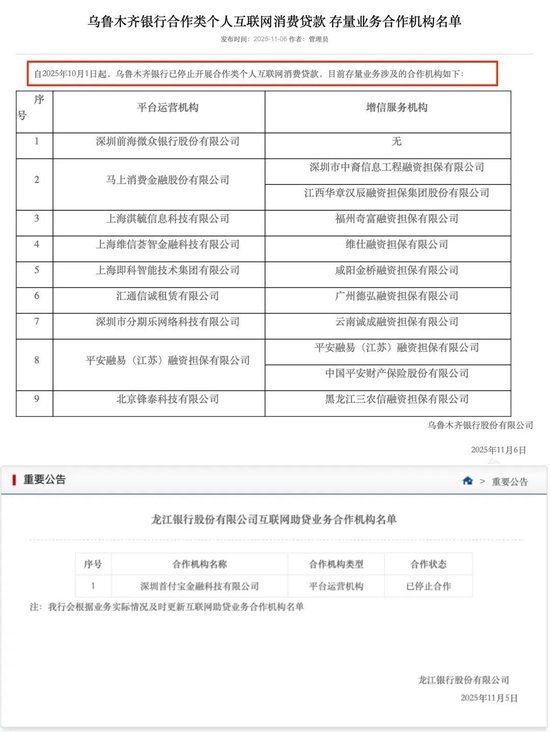
Core Viewpoint - The implementation of the "New Regulations on Internet Lending by Commercial Banks" since October 1 has led to significant adjustments in the internet lending business of commercial banks, shifting from broad cooperation to stringent selection of partners [1][4]. Group 1: Changes in Cooperation - Several regional banks, including Urumqi Bank, Longjiang Bank, and Guiyang Bank, have announced the suspension of new internet lending partnerships, indicating a trend towards reducing the number of cooperative institutions [1][2]. - Jilin Yilian Bank has significantly reduced its number of cooperative institutions from 56 to 10 over the past year, reflecting a broader trend of "thinning" partnerships in the industry [3]. - Some banks, like Jiangxi Yumin Bank, have increased the number of cooperative institutions while still making selective adjustments to their partnerships [3]. Group 2: Regulatory Environment - The regulatory environment for internet lending has tightened, with several banks facing penalties for non-compliance with regulations [5][6]. - The new regulations require banks to implement a list management system for cooperative institutions, emphasizing the importance of careful selection and management of partners [6][8]. Group 3: Strategic Shifts - The new regulations are seen as a challenge for banks, particularly smaller ones that heavily relied on internet lending, pushing them to refocus on core business and improve internal capabilities [4][7]. - Industry experts suggest that banks should develop core competencies to reduce reliance on lending partners, including enhancing customer acquisition and risk management capabilities [8]. Group 4: Future Outlook - The future of internet finance is expected to focus on scenario-based finance, small and micro finance, and enhancing data asset operations, with AI playing a crucial role in improving risk management [9].
告别流量依赖 握紧风控自主权中小银行与助贷机构合作逻辑生变
Zhong Guo Zheng Quan Bao· 2025-11-18 20:05
Core Viewpoint - The implementation of the "New Regulations on Internet Lending by Commercial Banks" since October 1 has led to significant adjustments in the internet lending business of commercial banks, with a shift from broad cooperation to stringent selection of partners [1][2][3]. Summary by Sections Adjustments in Lending Partnerships - Several regional banks, including Urumqi Bank, Longjiang Bank, and Guiyang Bank, have announced the suspension of new internet lending partnerships, indicating a trend towards reducing the number of cooperative institutions [1][2]. - Urumqi Bank has stopped its cooperative personal internet consumer loan business, affecting nine platform operators and eight credit enhancement service providers [1]. - Longjiang Bank has ceased its only partnership with Shenzhen Shoufu Bao Financial Technology Co., Ltd., while Guiyang Bank has not renewed its internet platform business partnerships [2]. Regulatory Impact and Compliance - The new regulations require banks to implement a list management system for platform operators and credit enhancement service providers, which has led to a tightening of partnerships [3][4]. - The recent regulatory environment has resulted in penalties for banks like Ping An Bank and SPDB for improper management of internet lending activities [4]. - The regulations emphasize that banks must not outsource core functions such as loan issuance and risk control, pushing them to enhance their internal capabilities [5]. Risk Management and Strategic Shifts - The new regulations are seen as a catalyst for banks, especially smaller ones, to improve their risk management and operational capabilities, moving from passive reliance on lending partners to active collaboration [5][6]. - Analysts suggest that smaller banks should focus on building their own customer acquisition and brand development capabilities while diversifying their partnerships to mitigate risks [5]. - The future of internet finance is expected to focus on scenario-based finance, small and micro finance, and enhanced data asset management, with AI playing a crucial role in improving risk control [6].
洪偌馨:中小银行,「断尾」助贷
Xin Lang Cai Jing· 2025-11-10 00:53
Core Viewpoint - An increasing number of small and medium-sized banks are withdrawing from the internet lending market due to regulatory pressures and diminishing profitability of such operations [1][5]. Group 1: Bank Actions - Urumqi Bank announced the cessation of cooperative personal internet consumer loans effective October 1, 2025 [2][3]. - Guizhou Bank stated that it has completed its cooperation with internet banks and is focusing on managing existing business rather than expanding into new internet platform collaborations [2]. - Longjiang Bank has only one cooperative institution listed, which has also ceased collaboration, indicating a significant reduction in internet lending activities [2]. Group 2: Market Dynamics - The profitability of internet lending has decreased, leading many small banks to reduce their involvement in this sector, as personal consumer loans represent a minimal portion of their overall loan balances (less than 3% for Urumqi Bank and around 4% for Longjiang Bank) [6]. - Guizhou Bank reported a more than 70% increase in its personal comprehensive consumer loans (excluding credit cards) in Q3 2025, indicating a shift towards developing in-house digital credit capabilities [6]. Group 3: Regulatory Impact - The implementation of the "9th Document" has prompted banks to reassess their internet lending strategies, as it imposes stricter compliance requirements and limits on interest rates and fees [5][9]. - The document requires banks to consider all potential service fees and costs in their pricing, which has made it challenging for many lending platforms to maintain profitability [9]. Group 4: Industry Trends - The market for internet lending is becoming increasingly competitive, with major players like Ant Group and ByteDance dominating the landscape, holding a 76% share of the market by 2024 [9]. - The shift in focus towards compliance and risk management has led to a contraction in the number of cooperative platforms available to smaller banks, which may struggle to adapt to the new regulatory environment [12][15]. Group 5: Future Outlook - The future for small and medium-sized banks appears challenging, as they will need to rely on their own capabilities rather than partnerships with larger platforms to remain competitive [16].
119家金融机构已披露助贷合作方名单 中互金:存在四大问题
Xin Jing Bao· 2025-11-06 04:50
Core Points - The China Internet Finance Association (CIFA) released an announcement summarizing the disclosure status of 119 domestic financial institutions' internet lending business cooperation partners as of October 31 [1] - CIFA identified four major issues regarding the non-compliance and inaccuracies in the disclosure of lending partners by financial institutions [1] Group 1: Overview of Financial Institutions - The 119 financial institutions include 11 national joint-stock banks, 39 city commercial banks, 5 rural commercial banks, 16 private banks, 10 foreign banks, 30 consumer finance companies, 7 trust companies, and 1 direct bank [1] Group 2: Issues Identified by CIFA - The first issue is that the disclosure locations for lending partner lists are often obscure and lack search functionality, making them difficult to find [22] - The second issue is that the disclosure titles are merely "Announcement" and do not follow a chronological order or indicate the update time [22] - The third issue involves financial institutions updating the disclosure lists by directly overwriting the original announcement content [23] - The fourth issue is that the names of disclosed cooperation partners are not standardized, often only showing the group name or indicating that the partner has been renamed or deregistered [23] Group 3: Recommendations by CIFA - CIFA proposed three recommendations to improve the disclosure of lending business cooperation partners, emphasizing that financial institutions should disclose information in a manner that is easy for consumers to access [23]
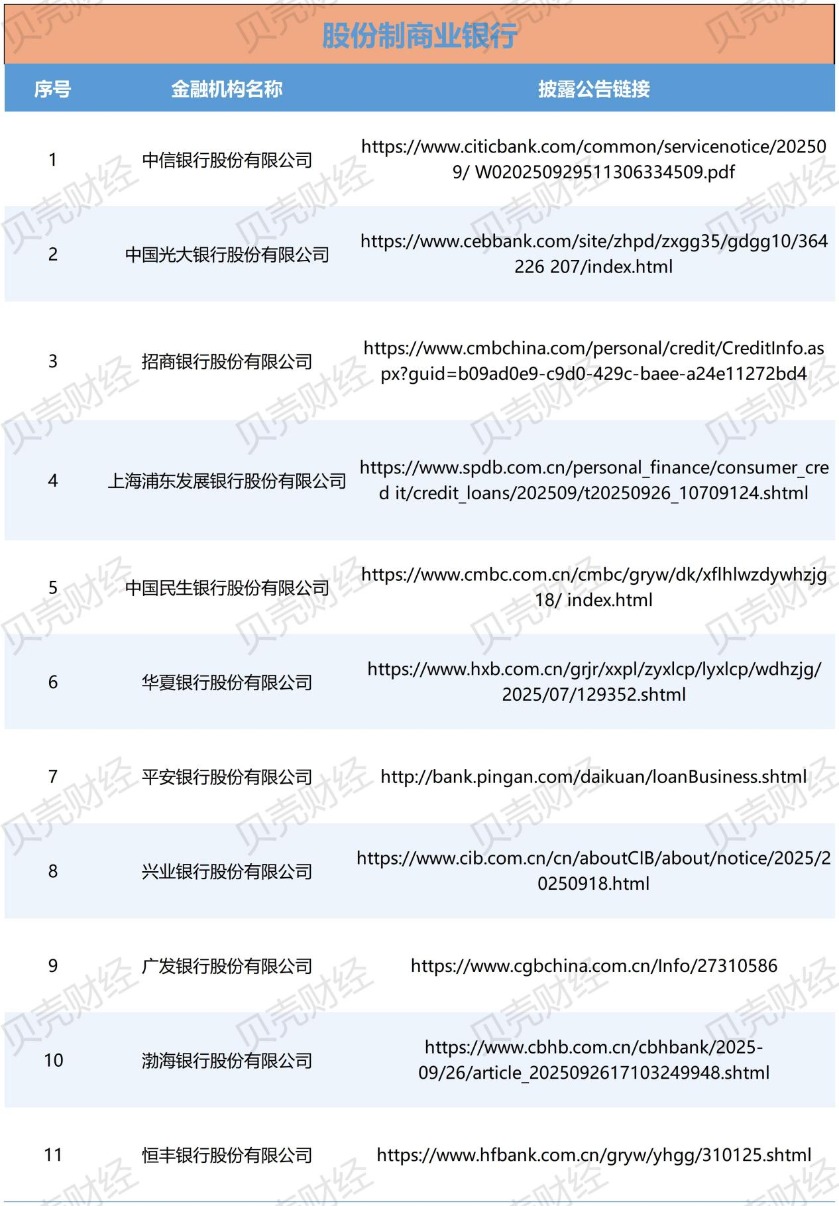
约120家金融机构已披露助贷合作“白名单” 互金协会倡议:应便于金融消费者查看
Mei Ri Jing Ji Xin Wen· 2025-11-04 15:56
Core Insights - The implementation of new regulations for self-service loans has shown significant results, with approximately 120 financial institutions disclosing their internet loan assistance business partners by the end of October, involving over 500 technology companies and other entities [1][3] Group 1: Disclosure Issues - Despite the progress, there are issues with the disclosure format, including hidden locations and lack of search functionality, making it difficult for consumers to find information [1] - The titles of disclosures are often generic, such as "announcement," and do not indicate the update time or are not sorted chronologically [1][2] - Some institutions have displayed inaccurate names of partner organizations, only showing the group name or failing to update for entities that have changed names or been deregistered [1][3] Group 2: Recommendations for Improvement - Financial institutions are encouraged to disclose information in a manner that is easy for consumers to access, such as placing it prominently on their official websites [2] - Accurate names of partner organizations should be provided, along with additional details like the type of partnership, product names, and contract periods [2] - Updates to disclosures should not simply overwrite previous announcements but should maintain a record of changes [3] Group 3: Regulatory Background - The new regulations stem from a notification issued by the National Financial Supervision Administration in April 2023, aimed at enhancing the management of internet loan assistance by commercial banks [3] - The regulations highlight the rapid growth of internet loan assistance services, which, while improving efficiency, have also revealed issues such as inadequate management, misaligned responsibilities, and insufficient consumer protection [3]
119家金融机构已披露助贷合作方名单,中互金:存在四大问题
Bei Ke Cai Jing· 2025-11-04 12:49
Core Viewpoint - The China Internet Finance Association (CIFA) has released an announcement summarizing the disclosure status of 119 domestic financial institutions' internet lending business cooperation partners as of October 31, highlighting four major issues regarding the non-standard and inaccurate disclosures by financial institutions [1][58]. Group 1: Overview of Financial Institutions - The 119 financial institutions include 11 national joint-stock banks, 39 city commercial banks, 5 rural commercial banks, 16 private banks, 10 foreign banks, 30 consumer finance companies, 7 trust companies, and 1 direct bank [2]. Group 2: Issues in Disclosure - CIFA identified four main issues in the disclosure practices of financial institutions: 1. The disclosure of cooperation partners is often placed in a hidden location and lacks a search function, making it difficult to find [59]. 2. The disclosure titles are merely "announcement" without chronological order or indication of update time [60]. 3. When updating the disclosure list, financial institutions often overwrite the original announcement without retaining previous versions [61]. 4. The names of disclosed cooperation partners are not standardized, often showing only the group name or including entities that have been renamed or deregistered [62]. Group 3: Recommendations for Improvement - CIFA has made three recommendations to improve the disclosure of cooperation partners in internet lending: 1. Financial institutions should disclose information in a manner that is easy for consumers to access, such as placing "latest announcements" or "important announcements" prominently on their homepage [63]. 2. Disclosure titles should clearly indicate "internet lending business cooperation partner list" or similar wording [63]. 3. Financial institutions should ensure that the information is updated in a transparent manner [63]. Group 4: Cooperation Partners Overview - The disclosed cooperation partners include over 500 technology companies, financing guarantee companies, and property insurance companies, with nearly 4,000 instances of disclosures recorded [56].
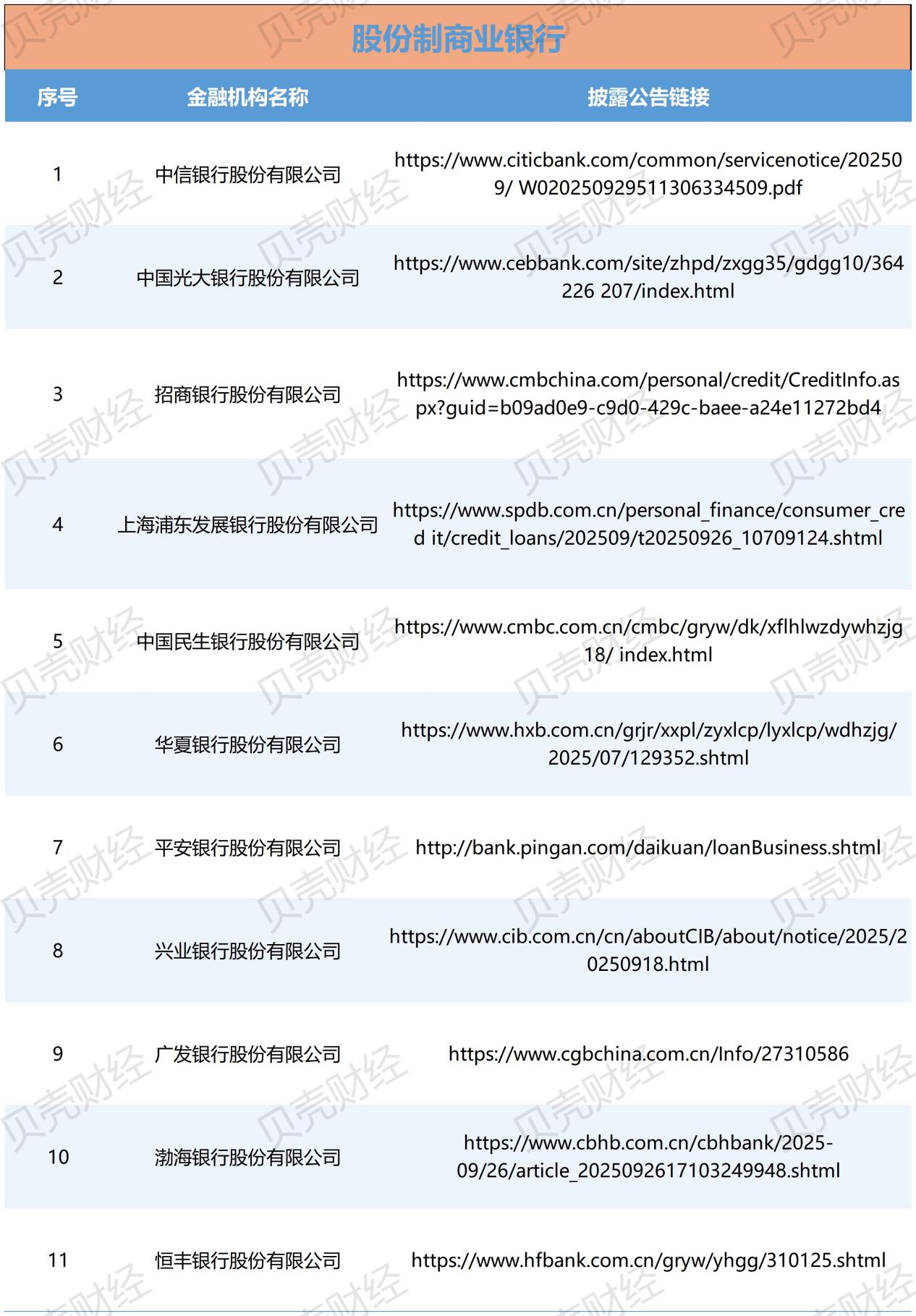
金融机构密集披露助贷“朋友圈” 行业合作迈向规范化
Zheng Quan Ri Bao Wang· 2025-10-15 13:09
Core Viewpoint - Financial institutions are responding to regulatory requirements by disclosing their partner institutions for internet lending, focusing on leading internet companies and listed fintech firms [1][2]. Group 1: Regulatory Changes - The National Financial Supervision Administration issued a notice on October 1 to enhance the management of internet lending by commercial banks, which has led to multiple banks disclosing their partner institutions [2]. - The notice mandates that banks implement a list management system for partner institutions, ensuring that only those on the list can engage in internet lending collaborations [4]. Group 2: Partner Institutions - Major internet companies such as Ant Group, Baidu, JD.com, and Meituan frequently appear on the disclosed "white lists" of partner institutions for banks and consumer finance companies [2][3]. - Specific consumer finance companies like Zhaolian Consumer Finance, Postal Savings Bank of China, and JD Consumer Finance have also released their lists of partner institutions, indicating a broad range of collaboration types including marketing, credit enhancement, and collection services [2][3]. Group 3: Industry Trends - The collaboration between financial institutions and lending partners is evolving from simple lead generation to comprehensive services including risk control and credit enhancement [3][4]. - Experts suggest that future collaborations will focus on compliance, ecosystem development, and restructuring relationships with leading lending platforms, emphasizing a shift from scale expansion to value cultivation [4][5].


消金公司晒出千家“伙伴清单”
Jin Rong Shi Bao· 2025-10-15 02:17
Core Viewpoint - The implementation of the new regulatory framework for internet lending by commercial banks aims to enhance the quality and efficiency of financial services, requiring banks to manage platform operators and credit enhancement service providers through a list management system [1] Group 1: Regulatory Changes - The Financial Regulatory Bureau issued a notice on October 1, mandating commercial banks to disclose lists of platform operators and credit enhancement service providers [1] - Licensed consumer finance companies have begun to disclose their partner lists in compliance with the new regulations during a six-month transition period [1] Group 2: Partner Disclosures - As of September 30, 31 consumer finance companies have disclosed a total of 1,133 partner institutions, including lending, credit enhancement, and collection service providers [3] - Notable disclosures include JD Finance's partnerships with 5 internet loan operators and 3 post-loan service providers, and Citic Consumer Finance's collaboration with 19 platform operators and 15 credit enhancement service providers [2][3] Group 3: Diverse Collaboration Paths - The disclosed partner lists show a diverse range of platform operators, including internet giants like Ant Group and JD, as well as specialized fintech companies and other licensed financial institutions [4] - Different consumer finance companies exhibit varying strategies in partner selection based on their unique strengths and resource endowments [4][5] Group 4: Compliance and Risk Management - The industry faces common challenges related to compliance and risk, particularly concerning consumer complaints about hidden fees and inadequate information disclosure [6] - The new regulations increase compliance costs for consumer finance companies, necessitating enhanced data security measures to protect sensitive information [6][7] Group 5: Strategic Partnerships - Consumer finance companies leverage partnerships with lending platforms to enhance efficiency and share risks, with lending platforms acting as outsourced financial service providers [7] - The collaboration between licensed financial institutions and lending platforms aims to combine funding advantages with effective online customer acquisition and risk management capabilities [7]