清洁能源技术创新

Search documents
迪森股份(300335) - 2026年3月10日投资者关系活动记录表
2026-03-11 08:16
Group 1: Company Overview - The company focuses on green development and integrates into the global energy transition with a core business in comprehensive energy services [2] - It aims to build a modern energy service system centered on clean energy through innovation and industrial upgrades [2][3] Group 2: Product Offerings - The product matrix includes electric boilers, waste heat boilers, biomass boilers, commercial boilers, natural gas boilers, hot water boilers, RTO furnaces, and industrial heat pumps, catering to diverse market needs [3] - The company has a complete high-end qualification certification system, including A-level boiler manufacturing and A2-level pressure vessel design licenses [3] Group 3: B-end Operations - The core driver for business development is "carbon reduction," focusing on user needs and enhancing operational efficiency through multi-energy complementary heating and intelligent heating models [3] - Customized clean energy solutions are provided for industrial and commercial users, integrating energy supply with energy-saving optimization [3] Group 4: C-end Products - The company utilizes wall-mounted boilers, air source heat pumps, and other systems to create a comfortable home environment, emphasizing energy efficiency and smart technology [4] - The AI adaptive condensing boiler M100, launched in 2025, achieves a thermal efficiency of 109%, enhancing market competitiveness [4] Group 5: Market Strategy and Challenges - The company maintains stable and growing gross margins through brand recognition, quality assurance, and optimized channel layouts [5] - It is expanding into international markets with customized products and local partnerships, particularly in Europe [6] Group 6: Future Plans - The company plans to conduct systematic research in 2026 to deepen market understanding in Europe and will continue to monitor the goodwill from the acquisition of Chengdu Century New Energy Co., Ltd. [7]

多元拓展清洁能源终端替代
Jing Ji Ri Bao· 2025-11-21 22:41
Core Viewpoint - The development of clean energy is crucial for achieving the "dual carbon" goals, ensuring energy security, and promoting a comprehensive green transformation of the economy and society [1][2]. Group 1: Achievements in Clean Energy Development - Since the "14th Five-Year Plan," China's clean energy sector has rapidly advanced, achieving significant milestones. Compared to the end of the "13th Five-Year Plan," renewable energy generation capacity and output have increased by approximately 18% and 10%, respectively. Nuclear power capacity and annual generation have risen by about 30%, while new energy storage capacity has grown nearly 30 times [2]. Group 2: Challenges in Clean Energy Sector - Despite rapid expansion, the clean energy sector faces deep-rooted challenges, including the contradiction between the rapid increase in installed capacity and insufficient consumption. There is a low proportion of non-electric utilization scenarios, and new energy storage and hydrogen energy have yet to establish stable and reliable business models. Additionally, the clean energy transition in end-use faces dual constraints of inadequate technical adaptability and high transformation costs [2]. Group 3: Strategies for Clean Energy Development - To address these challenges, a systematic approach is needed, focusing on supply, consumption, market, technology, and international cooperation. This includes enhancing the multi-supply of clean energy, accelerating the construction of clean energy storage and transportation networks, and optimizing the layout of the industrial chain to prevent excessive competition [3][4]. Group 4: Expanding Clean Energy Applications - The strategy involves diversifying clean energy applications in various sectors. In industry, there is a push for high-energy-consuming industries to relocate to areas rich in clean energy. In transportation, the development of clean energy transport corridors and integrated charging stations is emphasized. In buildings, existing structures are encouraged to install photovoltaic systems, and new public buildings are to fully utilize clean energy [4]. Group 5: Innovation and International Cooperation - Accelerating technological innovation in clean energy is essential, focusing on key technologies such as perovskite photovoltaics and floating offshore wind power. The establishment of a clean energy intellectual property operation center and high-value patent pool is also highlighted. Furthermore, international cooperation is encouraged, particularly in the context of the Belt and Road Initiative, to enhance cross-border electricity interconnection and international power market development [5].
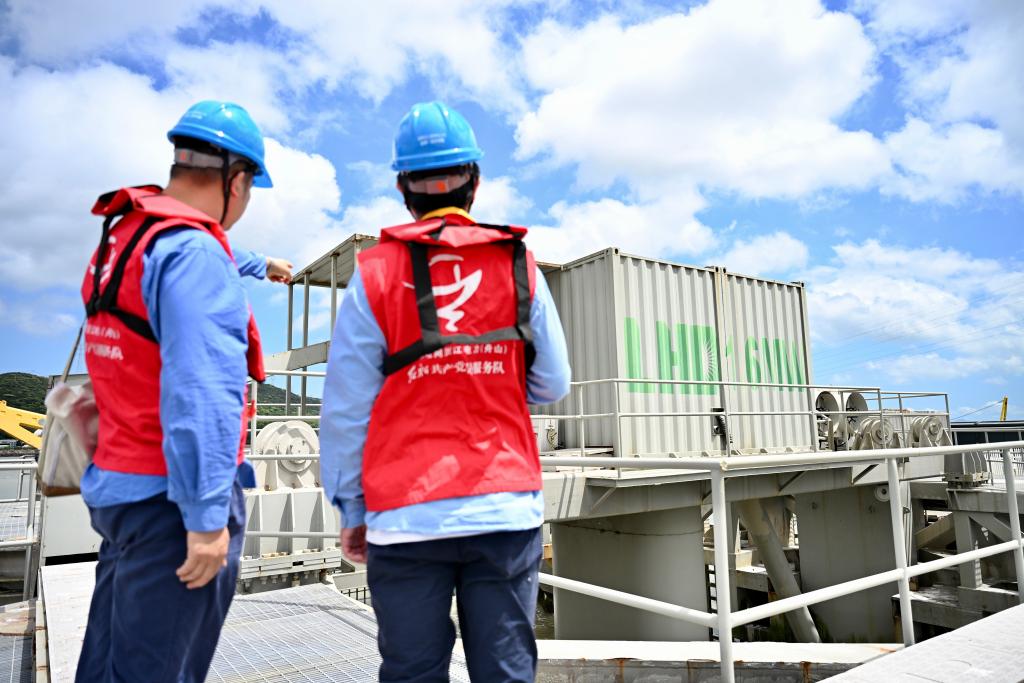
活力中国调研行丨“潮涌”变“绿电” 浙江舟山兆瓦级潮流能发电工程稳定运行超八年
Xin Hua Wang· 2025-08-07 23:47
Core Insights - The Zhejiang LHD Ocean Tidal Energy Project has been operational for over eight years, converting tidal energy into green electricity, contributing to local industrial development and environmental sustainability [1][2]. Group 1: Project Overview - The project utilizes tidal currents to generate electricity, similar to underwater wind turbines, and has been continuously operational since its first units were deployed in 2016 [1]. - The project has successfully generated over 783 million kilowatt-hours of electricity since its grid connection, equivalent to reducing the use of 3,132 tons of standard coal and cutting carbon dioxide emissions by 7,811 tons [2]. Group 2: Technological Advancements - The engineering team has overcome significant technical challenges over eight years, including efficient turbine design and marine corrosion resistance, leading to the development of a 3.4 megawatt modular tidal energy generator system [1]. - The project exemplifies the potential for clean energy technology innovation beyond traditional sources like wind and solar power [2]. Group 3: Environmental Considerations - Future tidal energy projects will focus on minimizing environmental impacts by selecting appropriate sites to avoid sensitive marine ecosystems and important shipping routes [4]. - The development of tidal energy is seen as a promising industry with significant growth potential, emphasizing the importance of scientific and environmentally friendly practices [4].