港股退市

Search documents
2025年港股加快生态优化 62家公司离场 强制退市占半
Zheng Quan Ri Bao· 2026-01-07 17:05
Group 1 - In 2025, the Hong Kong Stock Exchange (HKEX) saw a vibrant new stock market with 117 new listings and total fundraising exceeding 285.8 billion HKD [1] - The market experienced accelerated "survival of the fittest," with 62 companies delisted, a significant increase from 49 in 2024 [1] - The delisting included 29 companies voluntarily withdrawing, 31 companies being forcibly delisted, and 2 SPACs failing to complete mergers within the stipulated time [1] Group 2 - In 2025, 50% of the delisted companies were forcibly removed, indicating HKEX's zero tolerance for continuous suspension, financial violations, and misleading disclosures [2] - Since the introduction of the "fast-track delisting" mechanism in 2018, the pace of clearing "poor-quality stocks" has significantly accelerated, with 219 companies forcibly delisted from 2020 to 2025 [2] - Notable cases of forced delisting include Chongqing Hongjiu Fruit Co., Ltd. and China Evergrande Group, both facing severe financial issues and regulatory violations [2] Group 3 - As of December 31, 2025, there were 378 Hong Kong companies with a market capitalization below 100 million HKD, prompting 29 companies to choose privatization as a strategic move [4] - Privatization methods typically include tender offers, agreements, and mergers, with notable cases like the privatization of Guangdong Environmental Power Co., Ltd. by Hanlan Environment [4] - The privatization of Kangji Medical Holdings was completed at a cash price of 9.25 HKD per share, representing a 9.9% premium over the last closing price before suspension [5] Group 4 - The privatization process is seen as a way to provide strategic flexibility and cost optimization for companies, with a focus on maximizing shareholder value [5] - The success of privatization often hinges on the premium offered, which must be deemed "fair and reasonable" to avoid shareholder rejection [6] - Concerns exist regarding potential harm to minority shareholders during privatization, with calls for regulatory scrutiny to prevent price manipulation and conflicts of interest [7] Group 5 - As of December 31, 2025, 81 companies were on the brink of delisting due to prolonged suspension, with 9 already approved for delisting [7] - The overall trend of delisting reflects a necessary cleansing of the market, showcasing HKEX's commitment to enhancing regulatory oversight and market quality [7] - The ongoing improvement of delisting mechanisms and market ecology is expected to solidify a healthy cycle of "entry and exit" in the Hong Kong stock market [7]
正式生效,又一港股私有化退市,周五摘牌
Zhong Guo Ji Jin Bao· 2025-08-27 22:36
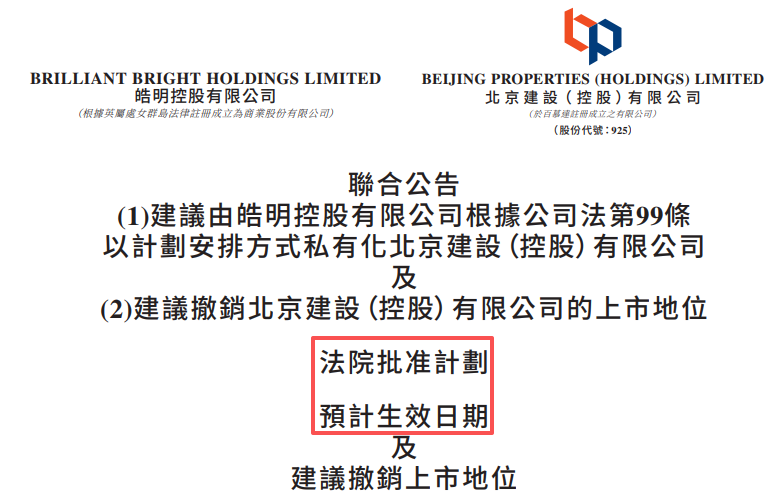
Core Viewpoint - Beijing Construction has successfully completed its privatization and delisting process, which is seen as a win-win situation for both the controlling shareholders and minority shareholders [3][6]. Group 1: Privatization Details - The privatization plan was approved by the court and the shareholders' meeting, becoming effective on August 27, with shares delisted from the Hong Kong Stock Exchange on August 29 [1][3]. - The controlling shareholder, North Control Group, holds significant stakes in Beijing Construction, with North Control Real Estate (Hong Kong) owning 36.26% and Haoming Holdings 22.35% [7]. - The privatization offer was made at HKD 0.14 per share, representing a 250% premium over the pre-suspension price of HKD 0.04 [7][8]. Group 2: Financial Context - Beijing Construction has faced continuous losses and a stock price that has remained below net asset value, limiting its ability to raise funds from the capital markets [3][8]. - The company has experienced low liquidity, making it difficult for investors to sell shares at favorable prices, thus the privatization offers an attractive exit opportunity for public shareholders [8]. Group 3: Market Trends - A total of 36 companies have delisted from the Hong Kong Stock Exchange this year, with 17 through privatization and 17 through cancellation of listing status [10]. - The real estate sector has seen the highest number of delistings, with eight companies, including notable cases like China Evergrande [10][11].

又有港股公司主动退市
Shang Hai Zheng Quan Bao· 2025-08-15 01:06
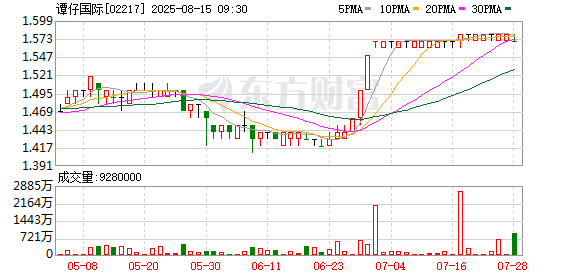
Core Viewpoint - Tan Zai International, known as "Hong Kong Rice Noodle King," is set to be privatized by its controlling shareholder, with plans to delist from the Hong Kong Stock Exchange after the market closes on August 19, 2023 [2][10]. Group 1: Company Overview - Tan Zai International primarily engages in investment holding, food procurement, and trading, with over 90% of its revenue generated from Hong Kong [7]. - The company operates two major brands: "Tan Zai Yunnan Rice Noodle" and "Tan Zai San Ge Rice Noodle," with its first restaurant opening in Hong Kong in 1996 [7]. - The company was listed on the Hong Kong Stock Exchange in 2021 at an issue price of HK$3.33 per share, becoming a "star" IPO in the restaurant sector that year [7]. Group 2: Financial Performance - The company's revenue for the fiscal years from 2022 to 2025 is projected to be HK$22.75 billion, HK$25.95 billion, HK$27.48 billion, and HK$28.43 billion, respectively [8]. - Net profits for the same period are expected to decline from HK$2.03 billion in 2022 to HK$798.43 million in 2025, indicating a decreasing profit margin from 8.9% to 2.8% [8][9]. Group 3: Market Context - Tan Zai International will be the 36th company to delist from the Hong Kong Stock Exchange in 2023, and the 18th to do so through privatization [5][11]. - The number of companies delisting has increased compared to the previous year, reflecting a faster "metabolism" in the Hong Kong stock market [12][14]. - Despite the delisting trend, the IPO market remains robust, with 53 new listings in the first seven months of the year, raising approximately HK$127 billion, a year-on-year increase of over six times [5].