港股18C

Search documents
400亿狂热追逐:具身智能2025投资战事|商业头条No.112
Sou Hu Cai Jing· 2026-02-12 03:28
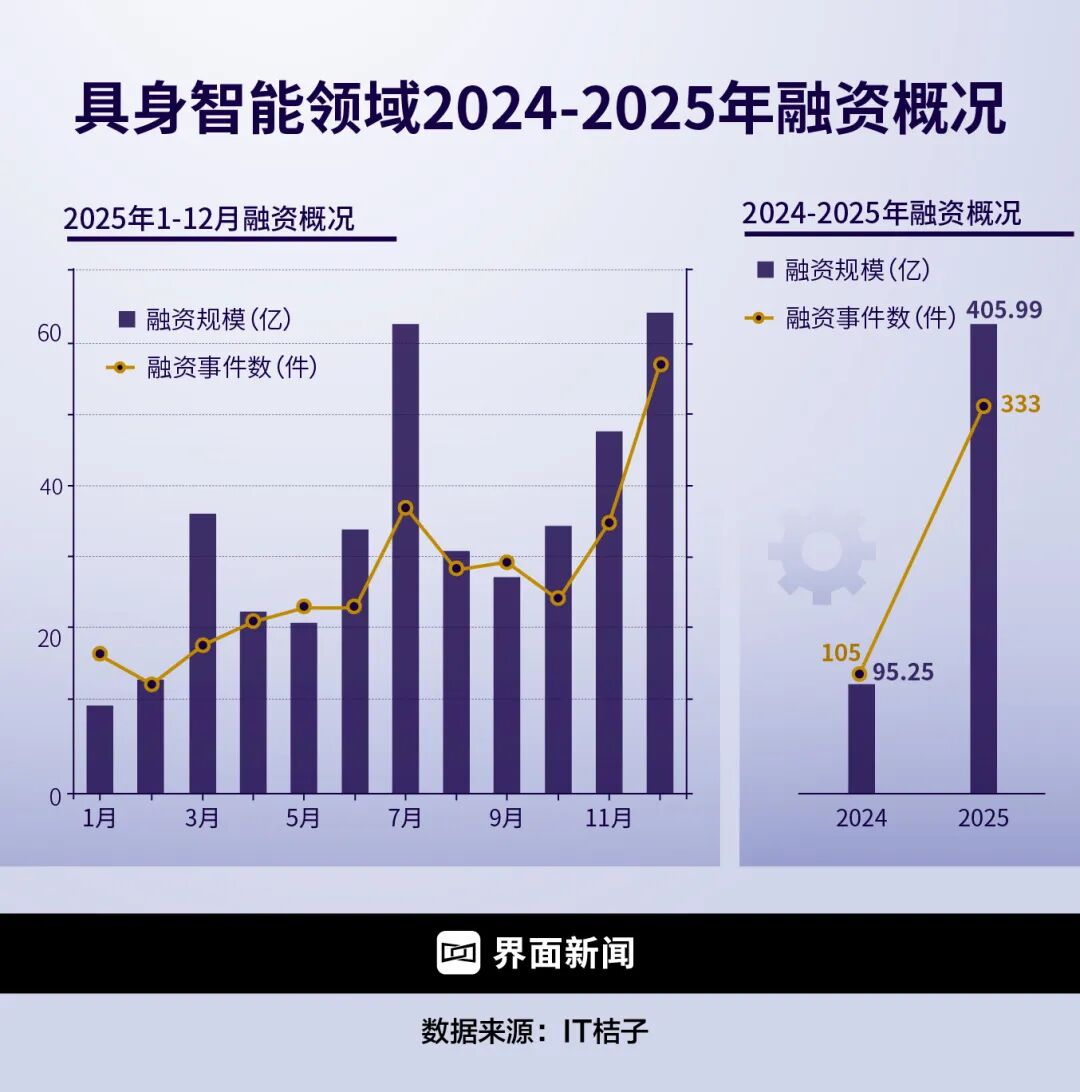
Core Insights - The industry of embodied intelligence is expected to reach a pivotal moment akin to GPT-2 by the first half of 2026, although this view is not universally accepted within the sector [5][6] - The investment landscape has dramatically shifted, with a significant increase in both the number of financing events and the total amount raised in 2025 compared to 2024 [9][12] - The valuation of early-stage projects has surged, with average increases of 50%-100% in single-round valuations, indicating a speculative environment driven by investor urgency [12][13] Investment Trends - The number of financing events in the embodied intelligence sector rose from 105 in 2024 to 333 in 2025, with total financing amounts increasing from 9.525 billion to 40.599 billion yuan, representing growth rates of 217% and 326% respectively [9][12] - Early-stage projects are seeing inflated valuations, with some companies achieving record funding rounds shortly after their establishment [12] - Investors are increasingly willing to pay high valuations due to a fear of missing out on potential opportunities, leading to a speculative bubble [12][13] Market Dynamics - The competition for investment has intensified, with established investors increasing their stakes and new investors rushing to enter the market [8][9] - The industry lacks a clear valuation model, often relying on the willingness of other investors to set prices, which can lead to inflated valuations [13] - The current investment climate is characterized by a mix of rational and irrational factors, with some investors driven by past experiences of missing out on successful projects [12][14] Technological Outlook - Despite the excitement surrounding embodied intelligence, there are concerns about the actual technological advancements and commercial viability, with some experts suggesting that the industry is not progressing as quickly as anticipated [20][21] - The VLA (Vision-Language-Action) model is seen as a potential breakthrough, but its current capabilities are viewed as limited compared to expectations [20] - The industry is at a critical juncture where companies must balance technological development with commercial deployment to avoid being outpaced by competitors [20][21] Future Considerations - The ability to secure commercial orders and achieve mass production will be key indicators for investors in the coming years, with a target of producing a thousand units seen as a significant milestone [25][26] - The competition for talent and funding will remain central to the success of companies in the embodied intelligence sector, with a focus on effective marketing and brand promotion [23][25] - The investment community is divided on the future of the sector, with some believing in its potential while others caution against the risks of overvaluation and technological stagnation [27][28]


400亿狂热追逐:具身智能2025投资战事
3 6 Ke· 2026-02-12 01:46
Core Insights - The industry is approaching a pivotal moment for embodied intelligence, with expectations that it will reach a "GPT-2" stage by mid-2026, although this view is not universally accepted within the sector [2][3] - The investment landscape has dramatically shifted, with a significant increase in funding and valuations for embodied intelligence projects, indicating a growing urgency among investors to capitalize on early-stage opportunities [4][6] Investment Trends - The number of financing events in the embodied intelligence sector surged from 105 in 2024 to 333 in 2025, with total funding increasing from 95.25 billion to 405.99 billion, marking a 217% and 326% rise respectively [6] - Early-stage project valuations have risen significantly, with average single-round valuation increases estimated between 50% and 100% over the past year [9][10] - Notable companies like Yujing Technology achieved record-breaking funding rounds, raising $120 million and $122 million in angel and angel+ rounds within six months of establishment [9] Market Dynamics - The competition for investment has intensified, with established investors increasing their stakes and new investors rushing to enter the market, seeking the next "OpenAI" of the GPT-1 era [4][5] - The valuation models for embodied intelligence projects remain undefined, often resembling a "mystical" approach where valuations depend heavily on what other investors are willing to pay [10] Technological and Commercialization Challenges - Despite the capital influx, the actual technological advancements and commercialization of embodied intelligence are perceived to be lagging behind expectations, with concerns about the practical applications of current models [17][25] - The industry is experiencing a dichotomy where capital is flowing in, but the technological progress and market readiness are not as advanced as anticipated, leading to potential risks for investors [17][24] Future Outlook - The competition in the embodied intelligence sector is expected to focus on securing funding and talent, with commercial orders and revenue scale being critical indicators of a company's strength [21][23] - The industry is at a crossroads, with differing opinions on whether the current valuation trends are sustainable or indicative of a bubble, as many investors are eager to participate in what they perceive as a lucrative opportunity [25][26]
商业头条No.112|400亿狂热追逐:具身智能2025投资战事
Sou Hu Cai Jing· 2026-02-12 01:38
Core Insights - The industry is approaching a pivotal moment akin to the "GPT-2" stage in embodied intelligence, with expectations for significant advancements by mid-2026 [2][3] - There is a divergence in opinions within the industry, with some believing it has not yet reached the "GPT-1" stage, impacting investment decisions [3][8] - The valuation of embodied intelligence projects has surged dramatically, with financing events increasing from 105 in 2024 to 333 in 2025, and total financing amounts rising from 9.525 billion to 40.599 billion yuan, representing increases of 217% and 326% respectively [9][11] Investment Trends - Early-stage project valuations are rising, with significant increases in funding amounts for companies like Shizhi Hang, which raised $120 million and $122 million in angel rounds within six months [11] - The average valuation increase for projects in the past year is estimated to be between 50% and 100%, indicating a robust market for high-potential companies [11][12] - There is a notable urgency among investors to enter the market, with many previously cautious investors now actively seeking opportunities in the embodied intelligence sector [8][13] Market Dynamics - The competition for funding has intensified, with established investors increasing their stakes and new investors rushing to find promising projects [8][9] - The industry is experiencing a shift in perception, with companies that were once overlooked now commanding high valuations due to market interest [9][12] - The rise of embodied intelligence has led to a significant increase in visibility and demand, particularly following high-profile events like the Spring Festival Gala, which boosted sales for leading companies [21][22] Challenges and Considerations - Despite the capital influx, there are concerns about the sustainability of high valuations and the lack of a clear valuation model in the industry [12][28] - The technological advancements in embodied intelligence are perceived to be lagging behind market expectations, with some experts cautioning against overestimating the current capabilities [17][28] - The industry faces a critical test in 2026 regarding its ability to scale production and meet commercial demands, with a focus on achieving significant production milestones [27][20]