激发内需

Search documents
“稳中求进”基调不变 重点转向激发内需与修复工业品价格
Jing Ji Guan Cha Wang· 2025-11-21 14:27
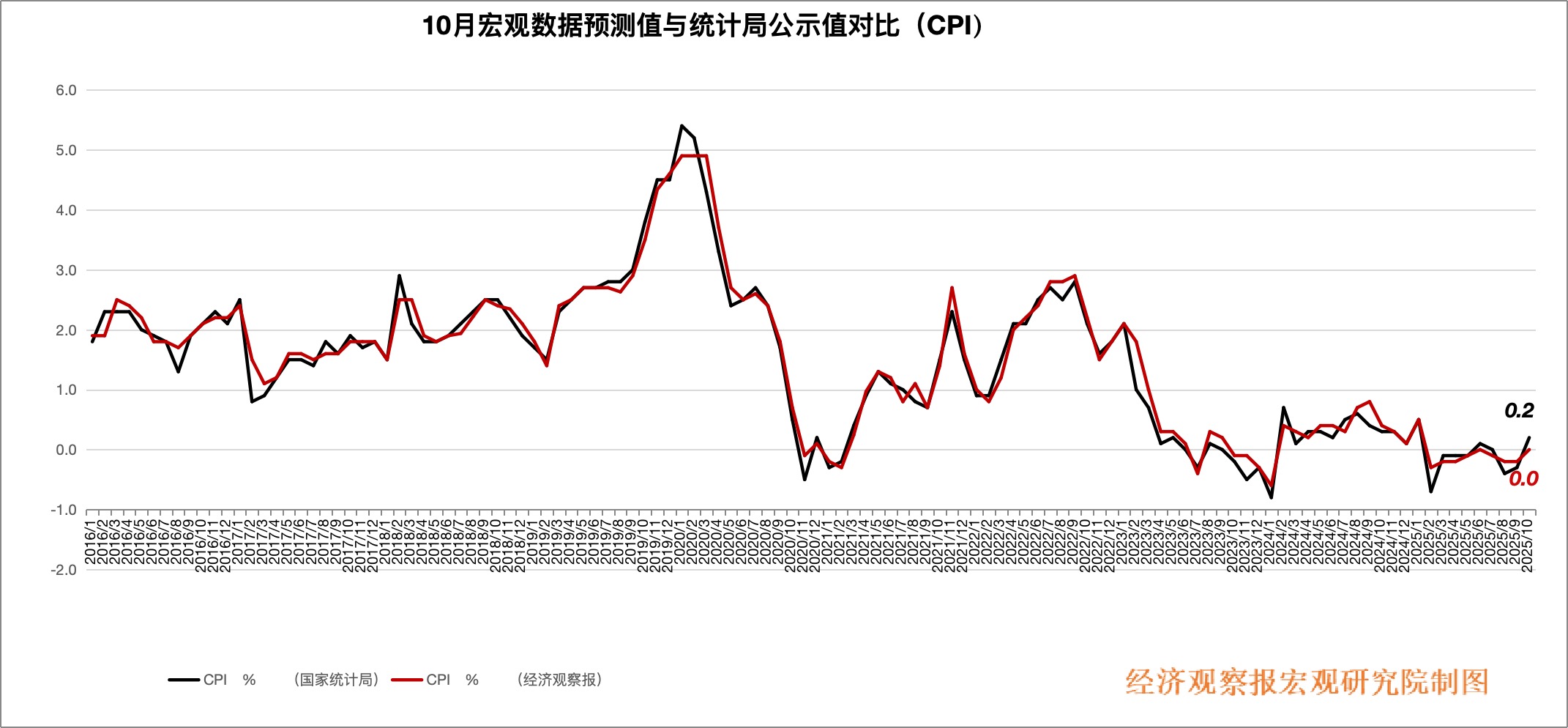
Core Insights - The macroeconomic data for October indicates a short-term increase in economic downward pressure, with adjustments in policies focusing on stimulating domestic demand and repairing industrial product prices [1] CPI - The Consumer Price Index (CPI) rose from -0.3% to 0.2% year-on-year, marking a 0.5 percentage point increase from the previous month [4] - The month-on-month CPI increased by 0.2%, influenced by rising prices of fruits and vegetables, with food prices showing a higher growth rate compared to historical values [4] PPI - The Producer Price Index (PPI) decreased by 2.1% year-on-year, but saw a month-on-month increase for the first time this year, supported mainly by the mining industry [7] - Prices for production materials rose by 0.1%, with mining prices increasing by 1% [7] PMI - The Manufacturing Purchasing Managers' Index (PMI) fell to 49% from 49.8%, indicating a contraction in manufacturing activity [10] - The decline in PMI is attributed to high inventory levels, a significant drop in new export orders, and weakened investment demand due to debt repayment acceleration [10] Fixed Asset Investment - Fixed asset investment (FAI) decreased by 1.7% year-on-year, with construction and real estate investments showing significant declines [14] - Factors contributing to the low performance in infrastructure include accelerated debt repayment, insufficient project reserves, and seasonal construction slowdowns [14] Credit - New credit issuance in October was 220 billion yuan, a decrease of 280 billion yuan compared to the previous year [17] - The total social financing (TSF) increased by 815 billion yuan, but the growth rate has slowed down [17] M2 - The M2 money supply grew by 8.2% year-on-year, a slight decrease from the previous month's growth rate of 8.4% [21] - The decline in M2 growth is influenced by a slowdown in social financing and an increase in fiscal deposits [21]

提振内需,需找准并疏通消费堵点
2 1 Shi Ji Jing Ji Bao Dao· 2025-08-26 22:42
Core Insights - The overall trend of China's consumption market is stable, with a retail sales total of 3.88 trillion yuan in July, a year-on-year growth of 3.7%, which is 1 percentage point higher than the same period last year [2] - The phenomenon of high savings and low consumption reflects that the internal demand engine has not been fully activated, highlighting issues in the "can consume," "dare to consume," and "easy to consume" dimensions [3][4] - The need for systematic identification and resolution of key bottlenecks to effectively stimulate domestic demand through institutional reforms and the establishment of a fair and smooth long-term mechanism [10] Consumption Market Performance - In the first seven months, the total retail sales of consumer goods reached 28.42 trillion yuan, with a year-on-year growth of 4.8% [2] - The retail sales of services grew by 5.2%, while the combined retail of goods and services increased by approximately 5% [2] High Savings and Low Consumption - By mid-2025, household deposits increased by 10.77 trillion yuan to 162.02 trillion yuan, with a growth rate of 7.42%, while the retail sales growth rate was only 5% [3] - The contribution of final consumption expenditure to GDP growth remains below 60%, indicating a significant gap between savings and consumption [3] Key Mechanisms for Stimulating Consumption - The framework of "can consume, dare to consume, easy to consume" is essential for activating internal demand [3] - "Can consume" relates to material basis and actual purchasing power, "dare to consume" pertains to psychological safety and future expectations, and "easy to consume" involves the efficiency of converting willingness into actual behavior [3][4] Recommendations for Enhancing Purchasing Power - Deepening income distribution reform to increase labor remuneration and strengthen the role of taxes and social security in income redistribution [4] - Stabilizing social expectations and reducing precautionary savings through improved macro policy stability and social security systems [4] - Ensuring timely and adequate income for key groups, particularly migrant workers, through various measures [5] Enhancing Consumer Confidence - Increasing investment in public welfare to alleviate burdens in education, healthcare, and elderly care [6] - Strengthening consumer rights protection to address concerns over privacy breaches and misleading advertising [7] Improving Consumption Environment - Promoting institutional openness and facilitating cross-border consumption [8] - Enhancing service quality and creating friendly consumption scenarios through policy guidance and support for new business models [9] Long-term Mechanisms for Consumption Monitoring - Establishing a "consumption facilitation index" to evaluate the consumption environment and continuously optimize policies [9] - Implementing a systematic approach to identify and address common consumption bottlenecks [10]