
物流标准化

Search documents
中创物流近期动态:政策利好、高管变动与业绩关注
Jing Ji Guan Cha Wang· 2026-02-11 10:34
Industry Policy and Environment - The "Key Work Plan for Modern Logistics Standardization" was jointly released by the State Administration for Market Regulation and other departments on December 31, 2025, which may provide long-term support for the cross-border logistics business of Zhongchuang Logistics [1] Executive Changes - On December 29, 2025, the company announced the appointment of Li Tao as the deputy general manager, which may influence future operational strategies [2] Performance and Operating Conditions - The latest financial report available is for the third quarter of 2025, and investors should pay attention to subsequent periodic reports, such as the 2025 annual report, to assess the stability of performance [3]

景气指数创新高 | 2026年1月物流仓储暨基础设施投资发展报告
Sou Hu Cai Jing· 2026-01-23 13:11
Core Insights - The logistics and e-commerce indices reached new highs in December 2025, driven by standardization efforts that support high-quality supply chain development [3][5][9] Group 1: Industry Performance - The warehousing index in December 2025 was 52.4%, an increase of 2 percentage points from the previous month, marking the highest level since February of the previous year [5][8] - The logistics industry prosperity index for December 2025 was 52.4%, reflecting a continuous recovery in demand for logistics services across various sectors, including manufacturing and e-commerce [8][9] - The express delivery index reached 466.8 in December, with an estimated business volume of around 18 billion packages, indicating stable market conditions supported by promotional activities [8][9] Group 2: Investment Trends - The cold chain logistics sector saw increased investment activity, with funds concentrating on high-value areas such as pharmaceutical cold chains, leading to successful IPOs like that of Hongxing Cold Chain on the Hong Kong Stock Exchange [21][26] - Multiple high-end cold chain and logistics hub projects are underway, including a 20 billion yuan investment in the Luzhong Cold Chain Logistics Industrial Base, aimed at enhancing cold chain services in the region [23][25] Group 3: Policy Developments - A series of policies aimed at standardization, green transformation, and financial support have been introduced to address industry pain points and promote high-quality development in the logistics sector [10][11][12] - The implementation of the "Green Supply Chain" initiative encourages companies to adopt national standards for carbon footprint evaluation, promoting a comprehensive green development approach [11][12] Group 4: Market Dynamics - The average rental price for warehousing in Guangzhou was 23.14 yuan per square meter per month in December, showing a slight decline, while the vacancy rate decreased to 16.40% [14][17] - The logistics sector is experiencing a shift towards immediate logistics infrastructure, with major players like Taobao and Meituan investing heavily in front warehouse networks to enhance delivery capabilities [13][18] Group 5: REITs and M&A Activity - Recent trends indicate a pullback in warehousing logistics REITs, with significant declines in market valuations, prompting a rise in small equity mergers and acquisitions [27][28] - Pre-REITs funds are being established to nurture quality assets and facilitate connections to public REITs markets, indicating a strategic shift in capital deployment within the logistics sector [27][28]

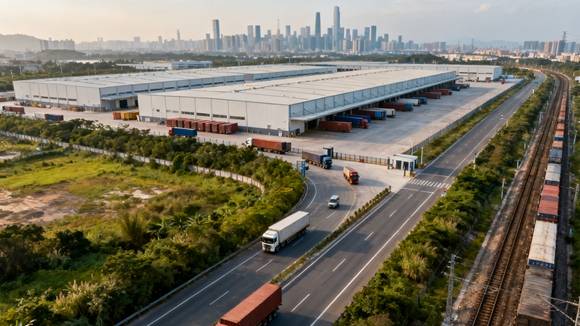
六部门发文推动现代物流标准化建设 引领物流企业数字化转型
Zheng Quan Ri Bao Wang· 2025-12-30 11:27
Core Viewpoint - The issuance of the "Key Work Plan for Modern Logistics Standardization (2025-2027)" by six government departments is a significant step towards the high-quality development of China's logistics industry and digital transformation [1][2]. Group 1: Logistics Infrastructure Enhancement - The Work Plan emphasizes the development of standards for key logistics infrastructures such as national logistics hubs, logistics parks, and warehousing and distribution centers, aiming to improve connectivity and establish a modern logistics operation system [1]. - Standards for national logistics hubs are expected to clarify indicators for multi-modal transport efficiency and emergency material storage capacity, enhancing logistics timeliness and flexibility [1]. Group 2: International Competitiveness - The standardization of logistics infrastructure is crucial for China's logistics industry to align with international standards, thereby improving its competitiveness in the global logistics market [2]. - The Work Plan is anticipated to enhance the overall competitiveness of the logistics industry and facilitate its integration into the global logistics system, providing new development opportunities for logistics companies [2]. Group 3: Quality Improvement in Logistics Services - The Work Plan aims to accelerate the development of standards related to cold chain logistics, pharmaceutical logistics, multi-modal transport, and safety standards for hazardous goods, thereby supporting the resilience and safety of supply chains [3]. - The emphasis on digital transformation and the adoption of advanced technologies like big data, AI, and blockchain is expected to enhance operational efficiency and reduce costs for logistics companies, making them more attractive to investors [3].
六部门联合印发《现代物流标准化重点工作计划(2025—2027年)》
Zheng Quan Ri Bao Wang· 2025-12-29 12:55
Core Viewpoint - The National Market Supervision Administration, along with several other government bodies, has issued the "Modern Logistics Standardization Key Work Plan (2025-2027)" to enhance the logistics sector and support the construction of a unified national market. Group 1: Logistics Infrastructure - The plan focuses on improving logistics infrastructure functionality, targeting national logistics hubs, logistics parks, and warehousing and distribution centers, with an emphasis on developing standards for infrastructure design, service capacity, and digital evaluation to enhance connectivity [1][2] - The goal is to establish a modern logistics operation system characterized by "channels + hubs + networks" [1] Group 2: Logistics Equipment Innovation - The initiative aims to develop a comprehensive standard system for logistics equipment such as pallets, turnover boxes, containers, and loading devices, promoting the circular use of logistics loading tools and facilitating efficient connections across different transportation modes [1][2] Group 3: Logistics Data Interconnectivity - The focus is on creating standards for logistics data infrastructure, data interaction and sharing, and data management for logistics enterprises, enhancing the application of information collection technology standards like barcodes and QR codes in logistics to support digital transformation and intelligent upgrades [1][2] Group 4: Quality Improvement in Logistics Services - The plan emphasizes accelerating the development of standards related to cold chain logistics, pharmaceutical logistics, multimodal transport, and mandatory national standards for hazardous goods transportation, thereby enhancing the resilience and safety of supply chains [2] Group 5: Strengthening Logistics Industry Foundation - The initiative includes improving standards for logistics documentation, enterprise classification and capability assessment, and industry statistical monitoring, while also focusing on the training of logistics standardization professionals to elevate the overall standardization level in the logistics sector [2] Group 6: Recent Achievements - Since the 14th Five-Year Plan, the National Market Supervision Administration has released 207 national standards in the logistics field, covering key areas such as logistics parks, multimodal transport, green packaging for express delivery, traceability of imported cold chain food, electronic data exchange for containers, and cargo drones [2] Group 7: Future Implementation - The National Market Supervision Administration will collaborate with relevant departments to implement the "Modern Logistics Standardization Key Work Plan (2025-2027)" and continue to upgrade the logistics standard system to ensure effective implementation of the standards [2]
六部门联合印发现代物流标准化重点工作计划
Yang Shi Wang· 2025-12-29 11:44
Core Viewpoint - The article discusses the joint issuance of the "Modern Logistics Standardization Key Work Plan (2025-2027)" by several Chinese government agencies, aiming to enhance the logistics sector through the development of national standards across five major areas and 101 tasks, supporting the construction of a unified national market [1][2]. Group 1: Logistics Infrastructure - The plan focuses on improving logistics infrastructure functionality, targeting national logistics hubs, logistics parks, and warehousing and distribution centers, with an emphasis on developing standards for infrastructure design, service capabilities, and digital evaluation [1]. - The goal is to enhance the connectivity of logistics infrastructure and establish a modern logistics operation system characterized by "channels + hubs + networks" [1]. Group 2: Logistics Equipment Innovation - The initiative aims to establish a comprehensive standard system for logistics equipment such as pallets, turnover boxes, containers, and loading devices, promoting the circular use of logistics loading tools and facilitating efficient connections across different transportation modes [1][2]. Group 3: Data Interconnectivity - The focus is on developing standards for logistics data infrastructure, data interaction and sharing, and data management for logistics enterprises, which will support the digital transformation and intelligent upgrade of logistics [1]. Group 4: Service Quality Improvement - The plan emphasizes accelerating the development of standards related to cold chain logistics, pharmaceutical logistics, multimodal transport, and mandatory national standards for the transportation of hazardous goods, enhancing the logistics sector's role in improving the resilience and safety of supply chains [2]. Group 5: Industry Foundation Enhancement - The initiative includes improving standards for logistics documentation, enterprise classification and capability assessment, and industry statistical monitoring, while also strengthening the training of logistics standardization talent to elevate the overall standardization level in the logistics industry [2]. Group 6: Recent Achievements - Since the 14th Five-Year Plan, the market regulatory authority has released 207 national standards in the logistics field, covering key areas such as logistics parks, multimodal transport, green packaging for express delivery, traceability of imported cold chain food, electronic data exchange for containers, and cargo drones [2]. - The next steps involve the implementation of the "Modern Logistics Standardization Key Work Plan (2025-2027)" and continuous upgrades to the logistics standard system to ensure effective application of these standards [2].