现制茶饮市场扩张

Search documents
现制茶饮进入“高增长 + 多品牌共存”新阶段
QYResearch· 2026-02-26 02:10
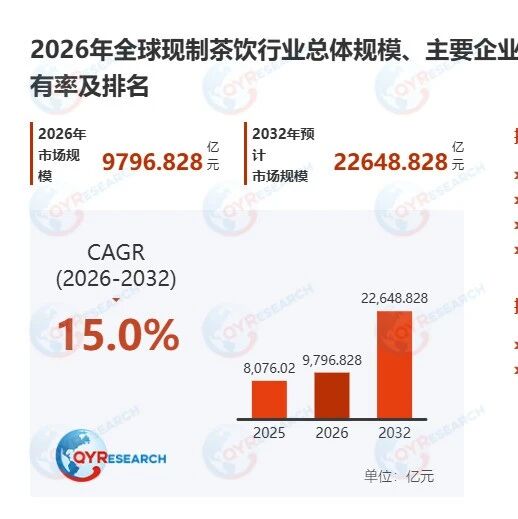
Core Insights - The Freshly Made Tea market is experiencing rapid expansion and structural evolution driven by global consumption upgrades, changes in the young population structure, and the rise of "instant gratification consumption" [2] - The market size is measured by Gross Merchandise Value (GMV), which reflects the total transaction amount paid by end consumers for freshly made tea products over a certain period [2] - The global GMV of the freshly made tea market is projected to reach $118.77 billion by 2025 and grow to $333.14 billion by 2032, with a compound annual growth rate (CAGR) of 14.99% from 2026 to 2032, significantly outpacing the overall soft drink and ready-to-drink tea markets [2] Long-term Growth Drivers - The growth is primarily driven by three factors: 1. The Asian new tea beverage model is rapidly expanding globally, with a high-frequency, low-ticket, and fast product innovation model being replicated [4] 2. Increased consumer preference for fresh, low-alcohol, or non-alcoholic beverages, giving freshly made tea an advantage in health perception and emotional consumption [4] 3. The maturity of digital ordering, delivery platforms, and chain supply chains significantly enhances the GMV ceiling for individual stores [4] Product Structure and Category Evolution - The freshly made tea market consists of multiple subcategories, with milk tea being the largest category, accounting for 45.08% of the global GMV in 2025 [5] - Fruit tea has reached a 40.86% share, becoming the fastest-growing segment, while pure tea accounts for 9.88% and other categories (like coffee blends and functional teas) make up 4.18% [6] - Overall, while category boundaries are blurring, milk tea and fruit tea remain the dominant contributors to the market's GMV, influencing the raw material structure, store layout, and brand competition [6] Competitive Landscape - The freshly made tea industry is characterized by a highly fragmented competitive structure, with the top three brands holding only 15.41% of the global GMV market share in 2025 [7] - The leading brand, Mixue Ice Cream & Tea, holds an 8.47% market share, followed by brands like Bawang Chaji (3.66%), Gu Ming (3.28%), and Chabaidao (2.71%) [7] - Other brands such as Hu Shang Ayi, Nayuki, Heytea, CoCo, Yihotang, and others compete in various regions and price segments, creating differentiated competition [7] Regional Expansion and Globalization Path - The Asia-Pacific region remains the core source of GMV for freshly made tea, with China leading in brand incubation, supply chain maturity, and consumption frequency [9] - Southeast Asia, the Middle East, and North America are emerging as important growth areas for international expansion, although overseas market store GMV and profit models are still adjusting due to differences in rent, labor costs, and consumer habits [9] - The industry is transitioning from a "single brand explosion" to a "multi-region, multi-brand, long-cycle coexistence" development phase [10] Future Trends and Challenges - The freshly made tea industry is expected to exhibit three major trends: 1. GMV will continue to be driven by store numbers and digital efficiency rather than just price increases [11] 2. The pace of product innovation will accelerate, but the lifecycle of blockbuster products will shorten [13] 3. Brand competition will shift from marketing-driven to supply chain and organizational efficiency competition [13] - The industry faces challenges such as raw material price fluctuations, intensifying homogenization competition, and uncertainties in overseas expansion [11]