现金流通

Search documents
5角纸币的拒收困局
Bei Jing Shang Bao· 2025-12-25 16:02
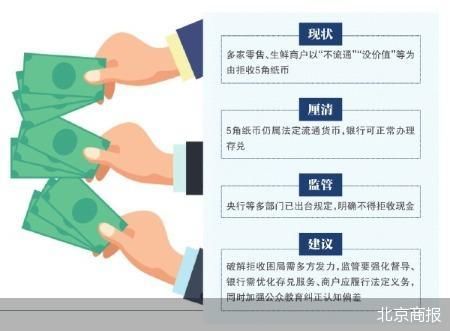
Core Viewpoint - The increasing rejection of 50-cent banknotes by merchants highlights a significant issue regarding cash payment rights and consumer protection in the context of growing mobile payment adoption [1][3][4] Group 1: Merchant Behavior - A survey of 15 merchants revealed that only 5 were willing to accept 50-cent banknotes, while 10 either outright refused or provided excuses such as "not in circulation" or "no one wants it" [3][4] - Many merchants, particularly individual business owners, lack awareness of regulations prohibiting the refusal of cash payments, leading to widespread rejection of small denomination banknotes [4][5] - The perception that small denomination banknotes are no longer valuable or in circulation is prevalent among merchants, which conflicts with their legal obligation to accept them [4][5] Group 2: Consumer Impact - The refusal to accept 50-cent banknotes disproportionately affects vulnerable groups, such as the elderly and rural residents, who rely on cash for transactions [5][6] - Consumers report accumulating 50-cent banknotes but facing difficulties spending them, as many merchants claim they are not accepted [4][5] Group 3: Regulatory Response - The People's Bank of China, along with other regulatory bodies, has issued new regulations to ensure cash payment rights, which will take effect on February 1, 2026 [9][10] - The regulations mandate that businesses maintain adequate cash reserves and cannot refuse cash payments, emphasizing the legal status of cash as a medium of exchange [9][10] - Regulatory measures will include penalties for businesses that refuse cash and initiatives to improve public awareness of cash payment rights [9][10] Group 4: Recommendations for Improvement - Experts suggest that banks should enhance the supply and circulation of small denomination cash, while community organizations should educate merchants about the legal status of cash [8][10] - A multi-faceted approach involving regulatory oversight, banking services, and merchant compliance is necessary to resolve the cash rejection issue and ensure the smooth circulation of small denomination banknotes [10]

不得拒收现金!2026年2月起新规施行
21世纪经济报道· 2025-12-20 05:34
Core Viewpoint - The new regulation issued by the People's Bank of China, along with the National Development and Reform Commission and the Financial Regulatory Bureau, aims to protect the legal status of the Renminbi and prevent the refusal of cash payments, effective from February 1, 2026 [1][4]. Summary by Sections Regulation Overview - The regulation consists of 19 articles focusing on prominent issues in cash payment services, establishing targeted norms [2]. Payment Choice Protection - A key highlight is the guarantee of payment choice, mandating that all service providers must accept cash payments unless in legally defined special circumstances. This includes high-frequency consumption scenarios such as supermarkets, restaurants, and schools, which can no longer refuse cash under the pretext of only accepting mobile payments [3]. Special Circumstances and Financial Services - For special scenarios like unattended services and card management, the regulation requires self-service devices to accommodate cash payments in cases of mobile payment failures. Additionally, locations using card systems must provide convenient cash recharge and refund services without charging conversion fees [3]. Consumer Rights and Complaints Mechanism - The regulation enhances consumer rights by allowing the public to file complaints with local branches of the People's Bank of China if they encounter cash refusal or discriminatory practices. Relevant authorities will investigate and publicly disclose penalties [4]. Response to Current Issues - The regulation addresses the growing issue of cash refusal, particularly as mobile payments become more prevalent. Instances of cash refusal have caused significant inconvenience for specific groups, such as the elderly, who may not be familiar with digital payment methods [4]. Public Feedback in Regulation Development - During the drafting process, the regulatory bodies received 25 valid feedback submissions, most of which were incorporated into the final regulation. Key public concerns included clarifying terms like "without justifiable reason" and detailing requirements for cash acceptance in essential sectors like dining and transportation [5].