生成对抗网络(GANs)

Search documents
观察| 杨立昆离职:我们不在AI泡沫中,但在LLM泡沫中
未可知人工智能研究院· 2025-11-21 03:02
Core Viewpoint - The article emphasizes that the current obsession with Large Language Models (LLMs) is misguided, equating LLMs to a mere "slice of bread" while neglecting the broader and more complex landscape of artificial intelligence (AI) [1][2][4]. Group 1: AI History and Development - The essence of AI is to enable machines to think and act like humans, and it has never been dominated by a single technology like LLMs [5]. - Since the inception of AI in 1956, various technologies have contributed to its evolution, including perceptrons, expert systems, and advancements in machine learning and computer vision [6][8]. - LLMs are a recent development in the long history of AI, and their prominence should not overshadow other significant advancements in the field [8][9]. Group 2: Innovation and Market Trends - True innovation often occurs in overlooked areas rather than in the spotlight, as evidenced by historical technological breakthroughs [10][11]. - The current trend in AI focuses excessively on the scale of LLMs, leading to a competitive environment where companies prioritize parameter counts over meaningful advancements [14][15]. - Future opportunities in AI may lie in areas such as Agentic AI, model compression, and neuro-symbolic AI, which address practical challenges rather than merely expanding LLM capabilities [15][16]. Group 3: Concerns in China's AI Landscape - The rapid establishment of AI colleges in China has led to a narrow focus on LLMs, sidelining other critical areas like machine vision and reinforcement learning [17][18]. - This one-size-fits-all educational approach risks creating a talent shortage in essential AI fields, as the industry increasingly demands diverse skill sets [18][19]. - The article warns that an overemphasis on LLMs could stifle innovation and limit the development of alternative AI pathways, which are crucial for future advancements [19][20]. Group 4: Conclusion and Future Directions - While LLMs represent a significant milestone in AI, they are not the endpoint; a comprehensive approach involving various AI technologies is necessary for true progress [23][24]. - Companies should focus on their specific needs rather than blindly following LLM trends, as practical applications like machine vision in manufacturing may yield better results [24]. - The future of AI will belong to those willing to explore uncharted territories and challenge the prevailing notion that LLMs are synonymous with AI [25][26].


OpenAI的“新突破”:通用验证器
Hu Xiu· 2025-08-05 07:04
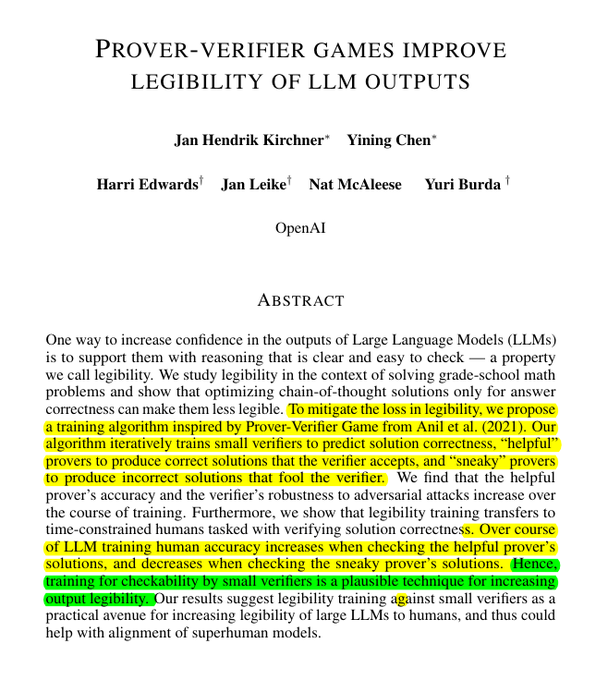
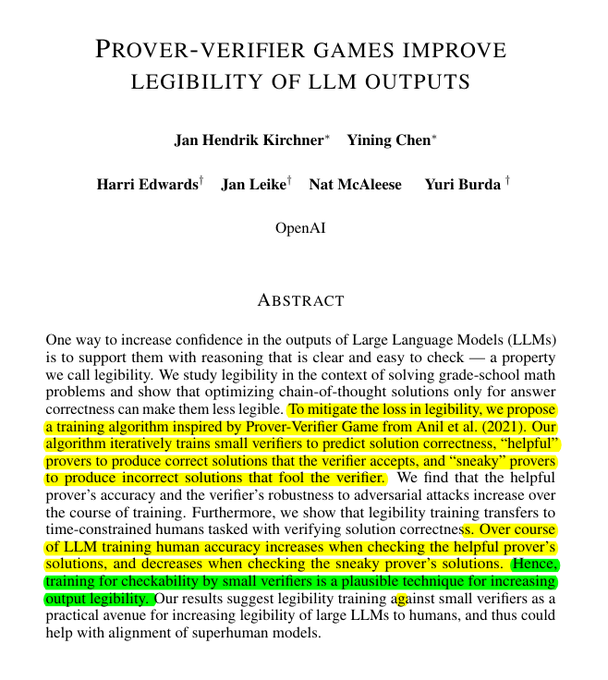
Core Insights - OpenAI's "Universal Validator" technology is expected to enhance the market competitiveness of the upcoming GPT-5 model, addressing key challenges in AI commercialization, particularly in terms of reliability and credibility [2][12]. Group 1: Technology Overview - The "Universal Validator" operates through a "prover-verifier game," where one AI model acts as a verifier to assess the outputs of another model, systematically improving output quality through internal feedback [2][4]. - This technology is designed to overcome limitations in reinforcement learning (RL) in subjective areas like creative writing and complex mathematical proofs [2][13]. - The mechanism is likened to Generative Adversarial Networks (GANs), where a discriminator helps distinguish between real and AI-generated data, pushing the generator to improve [5]. Group 2: Development and Team Dynamics - The technology is considered a legacy of OpenAI's former "Super Alignment" team, which was focused on controlling future superintelligence but was disbanded after key members left [9][10]. - Despite the dissolution of the team, the technological advancements have been integrated into OpenAI's core product development, addressing alignment and reliability issues [11]. Group 3: Market Expectations and Competitive Landscape - There is heightened anticipation for GPT-5, with indications that a self-critique system trialed in GPT-4 has been officially incorporated into GPT-5, raising expectations for its performance [12]. - OpenAI's CEO, Sam Altman, has publicly endorsed GPT-5, claiming it surpasses previous models in intelligence, intensifying market interest [12]. - Competitors like xAI and Google are also investing heavily in reinforcement learning as a key technology path, making the competitive landscape increasingly intense [12]. Group 4: Challenges Ahead - The "Universal Validator" is noted for its versatility, aiding OpenAI models in both easily verifiable tasks and more subjective domains, indicating a shift in AI capabilities [13]. - However, the development of GPT-5 faces significant challenges, including a scarcity of high-quality training data and diminishing returns from large-scale pre-training [13]. - Performance degradation from internal testing to public deployment remains a concern, as evidenced by the drop in performance of the "o3" model in real-world applications [13].
大模型下一个飞跃?OpenAI的“新突破”:通用验证器
Hua Er Jie Jian Wen· 2025-08-05 06:07
Core Insights - OpenAI's new technology, the "Universal Validator," is expected to enhance the market competitiveness of the upcoming GPT-5 model [1][8] - The "Universal Validator" operates through a "prover-verifier game," improving the output quality of AI models by allowing one model to validate the answers generated by another [1][2] - This technology aims to address the challenges of verifying outputs in subjective fields like creative writing and complex mathematical proofs [1][9] Group 1: Technology Overview - The "Universal Validator" was detailed in a paper published by OpenAI in July 2024, which describes an internal adversarial training framework [2] - The framework involves two roles: the "prover," which generates answers, and the "verifier," which learns to distinguish between correct and incorrect solutions [2][3] - This mechanism is similar to Generative Adversarial Networks (GANs), where a discriminator helps improve the generator's output [2] Group 2: Team Dynamics and Legacy - The technology is considered a legacy of OpenAI's former "Super Alignment" team, which was disbanded after key members left the company [6] - Despite the team's dissolution, the technology has been integrated into OpenAI's core product development to address alignment and reliability issues [6] Group 3: Expectations for GPT-5 - There is heightened anticipation for GPT-5, with indications that self-critique systems tested in GPT-4 have been incorporated into the new model [7][8] - OpenAI's CEO, Sam Altman, has publicly endorsed GPT-5, claiming it is "smarter in almost every way," which has further fueled market expectations [8] Group 4: Breakthroughs and Challenges - The "Universal Validator" is noted for its versatility, improving AI performance in both objective and subjective domains [9] - Recent achievements in complex mathematical competitions are attributed to advancements from the "Universal Validator" technology [9] - However, challenges remain, including the scarcity of high-quality training data and performance degradation from internal testing to public deployment [9]