生物演化

Search documents
奋蹄前行!从我国科研视角看马的演化传奇
Xin Hua She· 2026-02-17 07:31
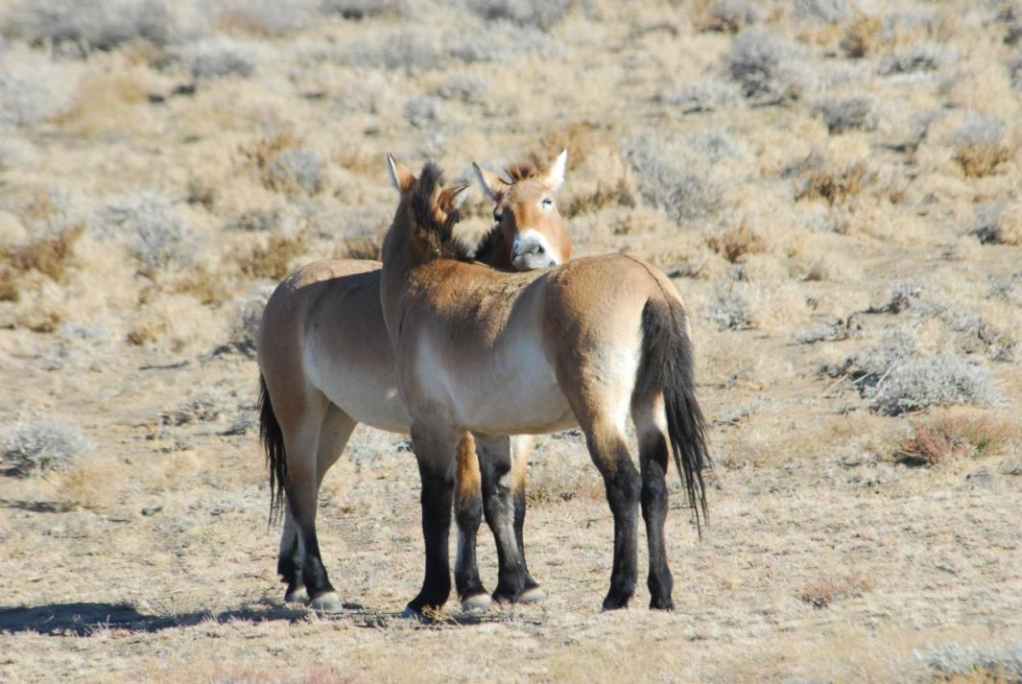
Core Viewpoint - The evolution of horses, particularly the three-toed horse and the Przewalski's horse, reflects resilience and adaptability in the face of environmental changes, highlighting the importance of biodiversity conservation in China [2][3][6]. Group 1: Three-Toed Horse Evolution - The three-toed horse has shown remarkable species diversity and adaptability through cross-continental migration over millions of years, with significant fossil evidence found in China [2]. - Key discoveries from the Chinese Academy of Sciences have clarified the evolutionary history of the three-toed horse, including its arrival in East Asia 11.5 million years ago [2]. - Research indicates that the three-toed horse adapted to various environments, demonstrating strong environmental adaptability, particularly in arid Asian regions and moist European forests [2]. Group 2: Przewalski's Horse Conservation - Przewalski's horse, the only remaining wild horse species, has a 60 million-year evolutionary history and is closely related to domestic horses [3]. - Due to overhunting, Przewalski's horse became extinct in the wild by 1969, with current populations being descendants of a few remaining individuals [3]. - China initiated a long-term "Return of the Wild Horse" program in 1985, leading to successful breeding and rewilding efforts, with the population exceeding 900 individuals by the end of 2025 [4][3]. Group 3: Broader Implications - The stories of the three-toed horse and Przewalski's horse symbolize resilience and the importance of biodiversity conservation, resonating with contemporary themes of ecological protection in China [6]. - The cultural significance of horses in Chinese society reflects values of strength and perseverance, aligning with national efforts in scientific exploration and ecological conservation [6].

500斤重的巨袋鼠怎么跳起来
Huan Qiu Wang Zi Xun· 2026-01-23 01:32
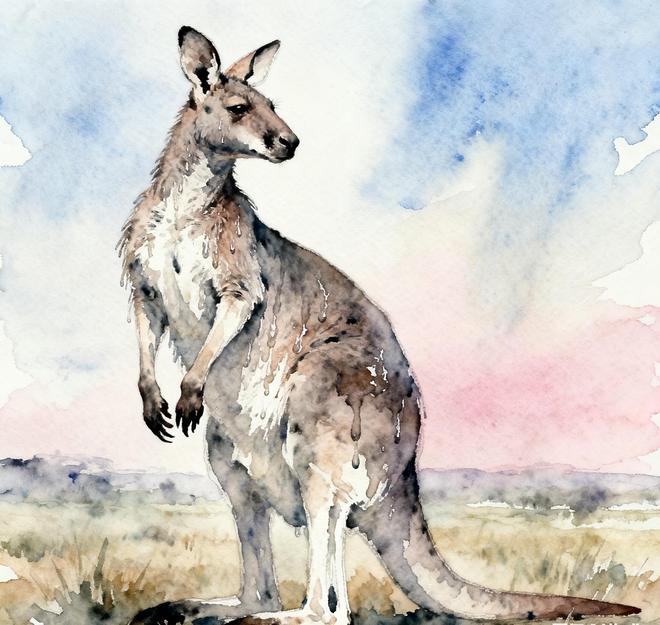
Core Insights - The article discusses the discovery of the giant kangaroo, a prehistoric species that could reach heights of over two meters and weigh up to 250 kilograms, significantly larger than today's red kangaroo [1][3]. Group 1: Research Findings - Scientists from the University of Manchester and the University of Bristol analyzed a "skeletal evidence database" comprising 63 existing kangaroo species and 40 fossil samples of extinct giant kangaroos, focusing on the strength of their fourth metatarsal bones [3]. - The research revealed that even the largest species, weighing close to 250 kilograms, had metatarsal bones that were "sturdy and resilient," capable of withstanding the stress of jumping [3][4]. - The study also examined the efficiency of the tendons and bones involved in jumping, concluding that the giant kangaroo had a robust anatomical structure suitable for powerful leaps [4]. Group 2: Behavioral Insights - The article suggests that the giant kangaroo likely employed a "hybrid" movement strategy, walking in a more energy-efficient manner most of the time and only jumping explosively in emergencies, such as when escaping predators [4]. - This behavior mirrors that of smaller mammals today, which use occasional bursts of jumping to evade threats, indicating a complex survival strategy in prehistoric ecosystems [4].
多学科证据破译熊蜂觅食分工机制
Huan Qiu Wang Zi Xun· 2026-01-19 08:55
Core Insights - The study provides a new perspective on the foraging division of labor in bumblebees, highlighting the impact of microstructural differences in functional organs on group behavior [1][2] - The research reveals that the queen bumblebee stops foraging not only due to behavioral or hormonal changes but also due to physical limitations imposed by body structure [2] Group 1: Research Findings - A multidisciplinary team from Nanjing Institute of Geology and Palaeontology, Sun Yat-sen University, and Beijing Institute of Technology conducted the study, published in the Proceedings of the National Academy of Sciences [1] - The queen bumblebee typically forages intensively only during the early nesting period and then shifts to laying eggs and nest activities [1] - The study introduces fluid dynamics, morphology, and ecology as new angles to understand the foraging division of labor [1] Group 2: Structural Analysis - The bumblebee's specialized mouthpart, the "labrum," performs rapid reciprocating movements to capture nectar, with thousands of fine hairs aiding in this process [1] - The spacing of hairs on the queen's labrum is maintained at 40 to 50 micrometers, independent of body size, while worker bees have a spacing of 15 to 45 micrometers based on their size [1] Group 3: Efficiency and Limitations - Despite the queen's larger size and longer tongue, her nectar filling rate is lower compared to worker bees due to larger hair spacing, resulting in lower foraging efficiency [2] - The study introduces dimensionless numbers, Bond number and Capillary number, to measure the interactions of gravity, capillary forces, and viscosity during nectar transport [2] - The research establishes a theoretical framework to match individual structure with function, predicting foraging behavior, and offers insights for engineering applications in liquid transport systems [2]
【科技日报】发掘百万年前“古生物化石宝藏”
Ke Ji Ri Bao· 2025-11-14 01:38
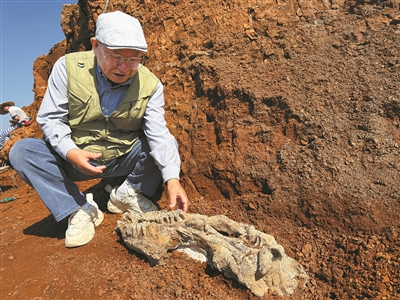
Core Viewpoint - The excavation and research of the Camel Mountain paleontological site in Dalian has entered a new phase, integrating fossil protection and development with the region's tourism resources, aiming to establish a world-class cultural tourism IP in Northeast Asia [2][8]. Group 1: Excavation and Research Progress - The Camel Mountain site has yielded over ten thousand vertebrate fossil specimens, covering more than 120 species of mammals, including newly discovered species like the Dalian post-mole and Jinpu American leopard [5][6]. - The research team has established a high-resolution biostratigraphic framework for the late Cenozoic era in Northeast China, publishing over 30 papers in core journals [6][8]. - The excavation site, known as Jinyuan Cave, has a unique geological and biological significance, with a stratigraphic record spanning from 3.6 million to 300,000 years ago, documenting five major geological and biological events [4][6]. Group 2: Fossil Analysis and Findings - Fossils discovered include a complete specimen of a giant camel, which lived 1.8 million years ago, providing insights into the evolution of this species and its environment [5][6]. - Analysis of fossilized dung has revealed a complete food chain from 1.6 million years ago, indicating a diverse ecosystem with intermingled coniferous and broadleaf forests [6][8]. - The research has identified five significant biological turnover events that correspond with global climate fluctuations, such as a cooling event around 2.6 million years ago that led to the emergence of cold-adapted species like the woolly mammoth and woolly rhinoceros [6][8]. Group 3: Collaboration and Future Development - The collaboration between the Dalian Jinpu New Area and the Chinese Academy of Sciences has established a national-level research platform, ensuring professional scientific research while promoting fossil resource protection and utilization [8]. - The ongoing excavation and research efforts are expected to continue for at least another 50 years, with the current generation only beginning to uncover the site's potential [8].
中国科学院×中山大学合作发表最新Cell论文
生物世界· 2025-11-08 08:00
Core Insights - The article discusses a significant research study on gibbons, revealing their evolutionary history, population dynamics, and conservation status through extensive genomic sequencing [2][4][9]. Group 1: Research Findings - The research team constructed the most comprehensive gibbon genome dataset to date, covering 18 extant gibbon species and successfully obtaining mitochondrial genomes from three extinct samples, including the "Junzi gibbon" [4]. - The study clarified the controversial evolutionary relationships among the four genera of gibbons: Hylobates, Nomascus, Symphalangus, and Hoolock, resolving a century-old classification issue [4][7]. - Phylogenetic analysis based on ancient mitochondrial DNA placed the extinct Junzi gibbon within the Nomascus genus, negating its status as a separate genus [4][7]. Group 2: Genetic and Ecological Insights - The research indicated that historical changes in gibbon population sizes and habitat suitability were consistent with past climate changes [5]. - Comparative genomics and transgenic mouse experiments identified a deletion of 205 base pairs in the Sonic Hedgehog (SHH) gene, which is linked to the elongated limbs characteristic of gibbons [6][7]. Group 3: Implications for Conservation - The findings advance the understanding of gibbon evolution, biology, and conservation efforts, providing critical information for the protection of threatened gibbon species [9].

改写生命演化史 我国学者发现4.5亿年前最古老轮藻化石
Zhong Guo Qing Nian Bao· 2025-05-31 11:49
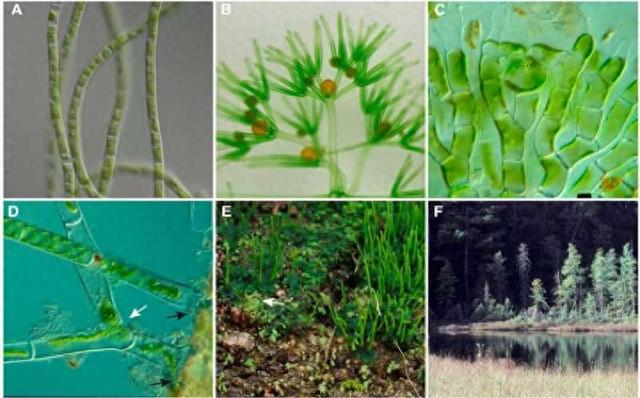
Core Insights - The article discusses the discovery of the earliest known charophyte fossils in the Tarim and Ordos basins of China, which pushes back the geological record of charophytes by approximately 28 million years to the Late Ordovician period, providing crucial fossil evidence for the hypothesis that land plants originated from charophytes [1][2][9]. Group 1: Discovery and Significance - The research published in "Nature Plants" reveals that charophyte fossils were found in carbonate rock layers from the Early Late Ordovician, indicating a significant evolutionary step towards land plants [1][7]. - This discovery challenges previous assumptions about the timeline of land plant evolution and supports the hypothesis that land plants originated from freshwater charophytes [1][2][9]. Group 2: Research Background - The lead researcher, Liu Lijing, began her investigation into these fossils in 2010 while pursuing her PhD, initially studying various algal fossils from the Tarim and Ordos basins [9][14]. - Over the years, Liu and her team conducted extensive research, analyzing over 10,000 carbonate thin sections and documenting around 100,000 images of algal fossils, which laid the groundwork for identifying the charophyte fossils [9][14]. Group 3: Evolutionary Implications - The findings indicate that key morphological innovations, such as multicellular branching and oospore reproduction, had already emerged before the Early Late Ordovician, highlighting the evolutionary link between charophytes and land plants [9][14]. - The research team confirmed the evolutionary relationship between land plants and charophytes through phylogenetic analysis of 62 traits across 13 groups of land plants and charophytes [7][9].