电动交通转型

Search documents
德国:延长电动汽车免税政策
中国能源报· 2025-12-06 05:33
Group 1 - Germany's federal parliament has extended the electric vehicle tax exemption policy until December 31, 2035, which was originally set to expire at the end of 2030 [1] - The tax exemption applies to all electric vehicles registered before the end of 2030, allowing for up to ten years of tax relief for vehicles registered this year [1] - The extension is expected to result in a tax revenue loss of one billion euros, which is considered acceptable by some lawmakers as it supports the transition to electric transportation and benefits the automotive industry and its supply chain [1] Group 2 - The Social Democratic Party views the extension as a clear incentive for early transition to electric vehicles [1] - The only party opposing the policy, the Alternative for Germany, criticized it as a reckless financial decision [1] - The President of the German Automotive Industry Association stated that the regulation is an effective purchase incentive and will significantly impact the further adoption of electric vehicles [1]


德国将电动汽车免税政策延长至2035年
Zhong Guo Xin Wen Wang· 2025-12-05 13:47
Core Viewpoint - The German Federal Parliament has extended the tax exemption policy for electric vehicles until December 31, 2035, which was originally set to expire at the end of 2030 [1] Group 1: Tax Exemption Details - The tax exemption applies to all electric vehicles registered before the end of 2030, allowing vehicles registered this year to enjoy up to ten years of tax exemption [1] - A pure electric vehicle registered on December 31, 2030, will still receive a five-year tax exemption [1] Group 2: Government and Political Reactions - Social Democratic Party (SPD) member Ingo Vogel stated that this is a "clear incentive for an early transition" [1] - The Federal Government estimates that extending the tax exemption will result in a tax revenue loss of one billion euros [1] - Christian Democratic Union (CDU) member Stefan Kölbach believes the financial cost is acceptable as it promotes the transition to electric transportation and supports the automotive industry and its supply chain [1] - The Alternative for Germany (AfD) party was the only group to vote against the policy, with member Hauke Fink expressing that the government is "throwing money out the window" [1] Group 3: Industry Impact - The President of the German Automotive Industry Association (VDA), Hildegard Müller, stated that this regulation is an effective purchasing incentive and will have a significant impact on the further popularization of electric vehicles [1]
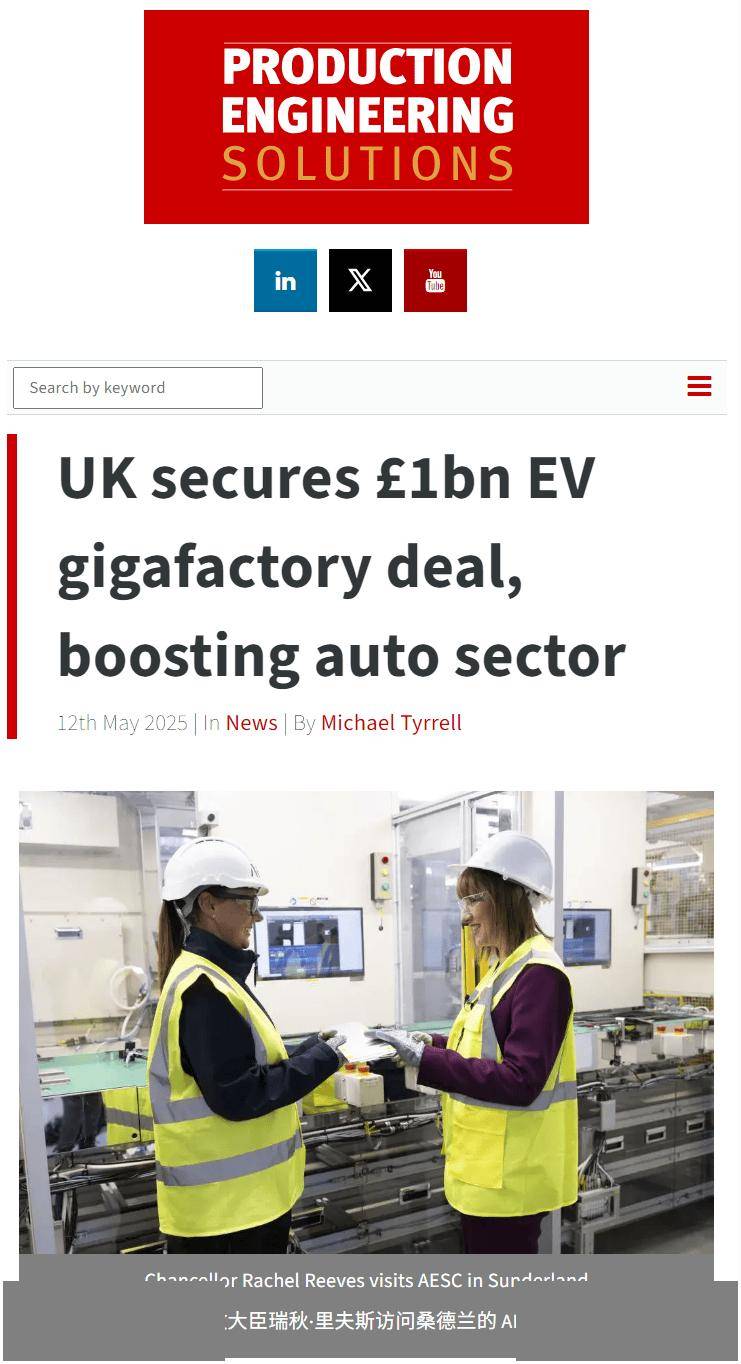
英国投资 10 亿英镑建设电动车电池工厂,中国远景动力负责运营
Sou Hu Cai Jing· 2025-05-13 10:13
Core Insights - The UK government is investing £1 billion (approximately 94.99 billion RMB) in the electric vehicle sector, with Chinese battery technology company AESC set to build a new super factory in Sunderland to support the transition to electric transportation [1][6] Group 1: Investment and Production - AESC will operate the new factory in Sunderland, which is expected to employ around 1,000 people and produce batteries capable of powering 100,000 electric vehicles annually [6] - This factory will expand the UK's battery manufacturing capacity sixfold, enhancing the competitiveness of domestic electric vehicles in both local and global markets [6] Group 2: Financial Support and Partnerships - The UK government, through the National Wealth Fund and UK Export Finance, is providing guarantees of up to £680 million (approximately 64.59 billion RMB) for the project [6] - Participating banks in the financing include Standard Chartered, HSBC, Sumitomo Mitsui Financial Group, BNP Paribas, and Spain's BBVA, while AESC will raise the remaining funds through private loan institutions [6] Group 3: Strategic Goals and Market Trends - AESC's CEO, Masashi Matsumoto, stated that this investment marks a significant milestone in supporting the UK's decarbonization process and the expansion of the electric vehicle market [6] - The UK’s electric vehicle market share reached 20.4% in April, with registrations increasing by 31% year-on-year, while demand for fuel vehicles has decreased by nearly a quarter [6]