畜牧业绿色发展

Search documents
我们吃掉了全球30%的肉?官方:是真的!
Sou Hu Cai Jing· 2026-02-10 18:20
Core Insights - China's meat production is projected to exceed 100 million tons in 2025, marking a significant milestone in the country's agricultural development [1] - The total meat consumption in China accounts for nearly one-third of the global total, reflecting the country's substantial demand and production capabilities [1] Group 1: Pork Industry - Pork constitutes 59.38 million tons of the total meat production, representing nearly 60% of the overall output [4] - Technological advancements have significantly improved the efficiency and controllability of pig farming, with companies like Muyuan Foods utilizing over 1.9 million smart devices to enhance production efficiency by over 35% [4][6] - The breeding system has been modernized, with over 95% of pork produced from three main breeds, supported by a comprehensive breeding system [6] Group 2: Beef Industry - Beef production has increased from approximately 6.13 million tons in 2013 to 7.53 million tons in 2023, with an annual growth rate of about 2.1% [10] - Despite domestic production growth, there remains a significant supply-demand gap, leading to a 73% increase in beef imports from 2019 to 2024 [10][12] - The Chinese government has initiated trade relief investigations to stabilize the domestic beef market, implementing measures to protect local producers while ensuring market supply [12] Group 3: Sheep and Poultry Industries - Sheep meat production is stable, with an output of 5.18 million tons in 2024, contributing to dietary diversity and farmer income [10] - Poultry meat production is projected to reach 28.37 million tons in 2025, with a 6.7% year-on-year increase, playing a crucial role in stabilizing overall meat prices [14] - The poultry industry benefits from high efficiency and continuous improvements in breeding and disease control, with a 90% share of intensive farming practices [15] Group 4: Animal Disease Control - The stability of the meat industry is underpinned by a robust animal disease prevention system, which has effectively controlled major animal disease outbreaks [22] - The government has implemented a comprehensive regulatory framework to enhance disease monitoring and response capabilities, achieving a high compliance rate in mandatory vaccinations [19][21] - The focus on sustainable practices has led to significant reductions in feed usage and antibiotic application, contributing to the green development of the livestock sector [22]

第三届绿色牧场开放日聚焦生物多样性保护
Zhong Guo Xin Wen Wang· 2025-08-24 07:45
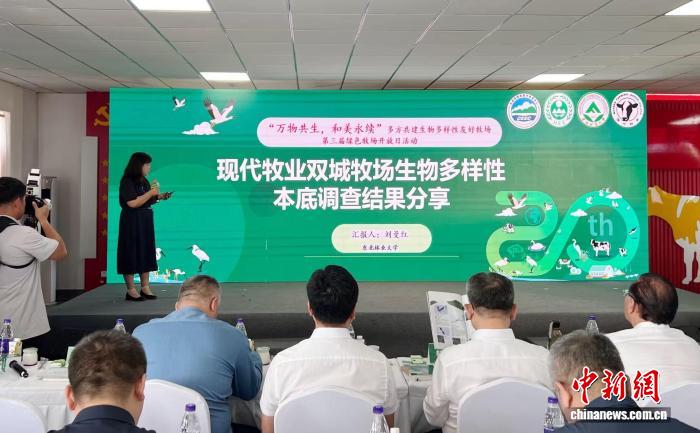
Core Viewpoint - The third Green Pasture Open Day event emphasizes the theme of "coexistence of all things and sustainable beauty," focusing on the construction of biodiversity-friendly pastures and the green transformation of China's livestock industry [1][3]. Group 1: Event Overview - The event took place on August 23 in Harbin, Heilongjiang, and involved deep practice and exchange around the theme of biodiversity-friendly pasture construction [1]. - Experts highlighted the importance of multi-party collaboration in driving high-quality development within the livestock sector [1]. Group 2: Research Findings - Liu Manhong, an associate professor from Northeast Forestry University, presented a biodiversity baseline survey report for the Shuangcheng Pasture, detailing a systematic investigation of plant, insect, and bird species [1][3]. - The report quantifies the harmonious coexistence of large-scale pastures with natural ecosystems, marking a significant step in understanding biodiversity levels [1]. Group 3: Ecological Advantages - The Shuangcheng Pasture benefits from its proximity to the Songhua River, which provides critical habitats for fish, amphibians, and waterfowl, enhancing regional ecological functions and biodiversity levels [3]. - The event showcased the collaborative efforts of academic institutions, enterprises, and social organizations in promoting ecological sustainability [3]. Group 4: Future Directions - The Shuangcheng Pasture has been designated as a pilot unit for biodiversity-friendly pasture projects, aiming to transition the livestock industry from traditional farming to an "ecology + farming" integrated model [5]. - Experts recommend that future livestock development should focus on the integrity and connectivity of ecosystems, emphasizing the need for scientific ecological design based on local environmental and biological characteristics [5].