
动物疫病防控

Search documents
我们吃掉了全球30%的肉?官方:是真的!
Sou Hu Cai Jing· 2026-02-10 18:20
Core Insights - China's meat production is projected to exceed 100 million tons in 2025, marking a significant milestone in the country's agricultural development [1] - The total meat consumption in China accounts for nearly one-third of the global total, reflecting the country's substantial demand and production capabilities [1] Group 1: Pork Industry - Pork constitutes 59.38 million tons of the total meat production, representing nearly 60% of the overall output [4] - Technological advancements have significantly improved the efficiency and controllability of pig farming, with companies like Muyuan Foods utilizing over 1.9 million smart devices to enhance production efficiency by over 35% [4][6] - The breeding system has been modernized, with over 95% of pork produced from three main breeds, supported by a comprehensive breeding system [6] Group 2: Beef Industry - Beef production has increased from approximately 6.13 million tons in 2013 to 7.53 million tons in 2023, with an annual growth rate of about 2.1% [10] - Despite domestic production growth, there remains a significant supply-demand gap, leading to a 73% increase in beef imports from 2019 to 2024 [10][12] - The Chinese government has initiated trade relief investigations to stabilize the domestic beef market, implementing measures to protect local producers while ensuring market supply [12] Group 3: Sheep and Poultry Industries - Sheep meat production is stable, with an output of 5.18 million tons in 2024, contributing to dietary diversity and farmer income [10] - Poultry meat production is projected to reach 28.37 million tons in 2025, with a 6.7% year-on-year increase, playing a crucial role in stabilizing overall meat prices [14] - The poultry industry benefits from high efficiency and continuous improvements in breeding and disease control, with a 90% share of intensive farming practices [15] Group 4: Animal Disease Control - The stability of the meat industry is underpinned by a robust animal disease prevention system, which has effectively controlled major animal disease outbreaks [22] - The government has implemented a comprehensive regulatory framework to enhance disease monitoring and response capabilities, achieving a high compliance rate in mandatory vaccinations [19][21] - The focus on sustainable practices has led to significant reductions in feed usage and antibiotic application, contributing to the green development of the livestock sector [22]

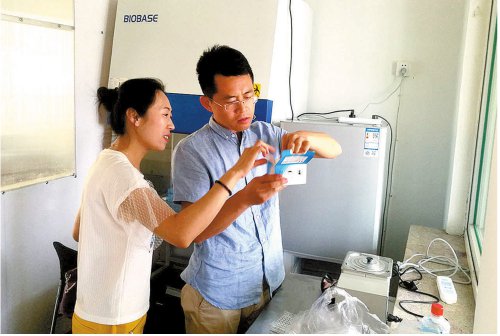
王志强:防动物疫病 护一方平安
Xin Lang Cai Jing· 2026-02-01 23:26
Core Viewpoint - The article highlights the dedication and professional commitment of Wang Zhiqiang, a veterinary expert and representative, in combating animal epidemics and ensuring public health safety through hands-on efforts and policy implementation [2][3][4]. Group 1: Professional Commitment - Wang Zhiqiang has been actively involved in animal epidemic prevention for nearly 20 years, emphasizing the importance of veterinary work in safeguarding both livestock farmers' livelihoods and public food safety [2][3]. - He has taken on significant responsibilities during major animal epidemic outbreaks, demonstrating leadership and a proactive approach to crisis management [3][4]. Group 2: Practical Experience and Skill Development - Wang has accumulated extensive practical experience through direct engagement in various veterinary roles, which has enhanced his ability to respond effectively to animal health crises [5][6]. - He has developed a systematic approach to blood sampling and disease detection, improving safety and efficiency in veterinary practices [6][7]. Group 3: Community Engagement and Legislative Role - As a representative, Wang Zhiqiang actively engages with grassroots veterinary personnel to understand their challenges and advocate for improvements in the animal epidemic prevention system [8][9]. - He has also shown a commitment to cultural heritage preservation, linking historical significance to community responsibility and legislative action [8][9].
海关准入更新:暂停巴西6家禽肉厂和12家西班牙猪厂输华
Sou Hu Cai Jing· 2025-12-02 07:44
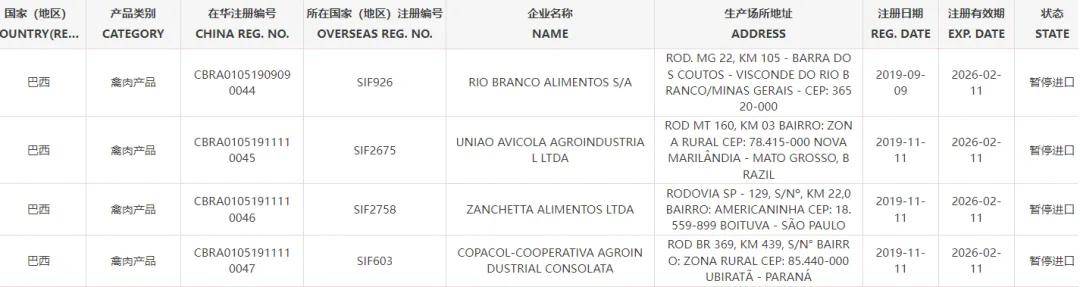
Group 1 - The General Administration of Customs of China has updated the registration information for overseas production enterprises of imported food, suspending the acceptance of import declarations for poultry products from six Brazilian companies starting from November 28, 2025 [1] - As of November 29, 2025, there are a total of 59 registered Brazilian poultry factories eligible for export to China, with 44 currently valid, 0 expired, and 15 under import suspension [1] Group 2 - The suspension of import declarations also applies to 12 Spanish pork enterprises due to two reported cases of African swine fever in the province of Barcelona [2][5] - The suspension is limited to the province of Barcelona, as an agreement on regional management of African swine fever has been reached between China and Spain, with other regions not affected [5]
通讯丨中国农业专家助力莫桑比克筑牢动物疫病防线
Xin Hua Wang· 2025-11-09 04:39
Core Insights - Chinese agricultural experts are significantly enhancing Mozambique's animal disease prevention capabilities through training and technology transfer [1][2][3] Group 1: Training and Capacity Building - Chinese veterinary experts have conducted multiple training sessions on common cattle diseases, parasite control, and vaccination protocols, improving local livestock health management [1] - The introduction of advanced detection methods and equipment has empowered local technicians to perform their own sampling and testing, fostering independence in disease management [1] - Training on "vaccine filling and semi-automated techniques" has doubled the vaccine production efficiency, increasing daily output from 6,000 bottles to approximately 12,000 bottles [2] Group 2: Technology Transfer and Localization - Collaboration between Chinese experts and local technicians has led to the optimization of disease detection processes, enhancing accuracy and efficiency [2] - The transition from traditional manual filling to semi-automated operations in vaccine production represents a significant leap forward for local capabilities [2] - The focus on technology transfer and personnel training aims to establish a self-sufficient and reliable disease prevention system in Mozambique's livestock sector [3]
海关总署办公厅主任张宝峰会见罗马尼亚农业与区域发展部国务秘书维奥雷塔·穆沙特
Zheng Quan Shi Bao Wang· 2025-09-18 11:08
Core Points - The meeting between Zhang Baofeng, Director of the General Administration of Customs, and Violeta Musat, Secretary of State for the Romanian Ministry of Agriculture and Rural Development, focused on enhancing customs inspection and quarantine cooperation [1] - Discussions included animal disease prevention and promoting healthy development of bilateral agricultural and food product trade [1] - The Romanian Ambassador to China, Maxim, also attended the meeting, indicating the importance of diplomatic engagement in trade discussions [1]
时隔7年重启 中日韩签联合公报
Zhong Guo Ji Jin Bao· 2025-08-12 15:14
Core Points - The fourth China-Japan-Korea Agricultural Ministers' Meeting was held in Incheon, South Korea, marking the first meeting in seven years since November 2018 in Beijing [1] - The ministers discussed six core topics: food security, animal disease prevention, sustainable agriculture, rural revitalization, cooperation on global important agricultural cultural heritage, and global collaboration [1] - The three countries reached a consensus on the importance of information sharing and joint responses to complex challenges in agriculture, including climate crisis, cross-border disease transmission, and supply chain instability [1] - There was an agreement to expand complementary cooperation in areas such as smart agriculture, green low-carbon agriculture, and training new farmers [1] - The Chinese Minister expressed a willingness to engage in candid dialogue with Japan and Korea to build a new framework for agricultural cooperation that is more resilient, broader in scope, and richer in content [1] Summary of Agreements - The ministers signed a joint communiqué and agreed to hold regular, institutionalized meetings [2] - The next China-Japan-Korea Agricultural Ministers' Meeting is scheduled to take place in Japan [2]
中日韩农业部长会议在韩国召开
Xin Hua She· 2025-08-12 08:05
Core Points - The fourth China-Japan-South Korea Agricultural Ministers' Meeting was held in Incheon, South Korea, marking the resumption of discussions after a seven-year hiatus since the last meeting in November 2018 in Beijing [1] - The ministers discussed six core topics including food security, animal disease prevention, sustainable agriculture, rural revitalization, cooperation on globally significant agricultural cultural heritage, and global collaboration [1] - The three countries reached a consensus on the importance of information sharing and joint responses to complex challenges in agriculture, such as climate crises, cross-border disease transmission, and supply chain instability [1] - There was an agreement to expand complementary cooperation in areas like smart agriculture, green low-carbon agriculture, and the cultivation of new farmers [1] - The Chinese Minister expressed a willingness to engage in open dialogue and collective action to promote a new framework for agricultural cooperation among the three countries, aiming for a more resilient, broader, and closer collaboration [1] Summary of Agreements - The ministers signed a joint communiqué and agreed on the regular and institutionalized holding of meetings [2] - The next China-Japan-South Korea Agricultural Ministers' Meeting is scheduled to be held in Japan [2]