
监察工作信息公开

Search documents
3月这些新规即将落地
Ren Min Ri Bao· 2026-02-28 02:35
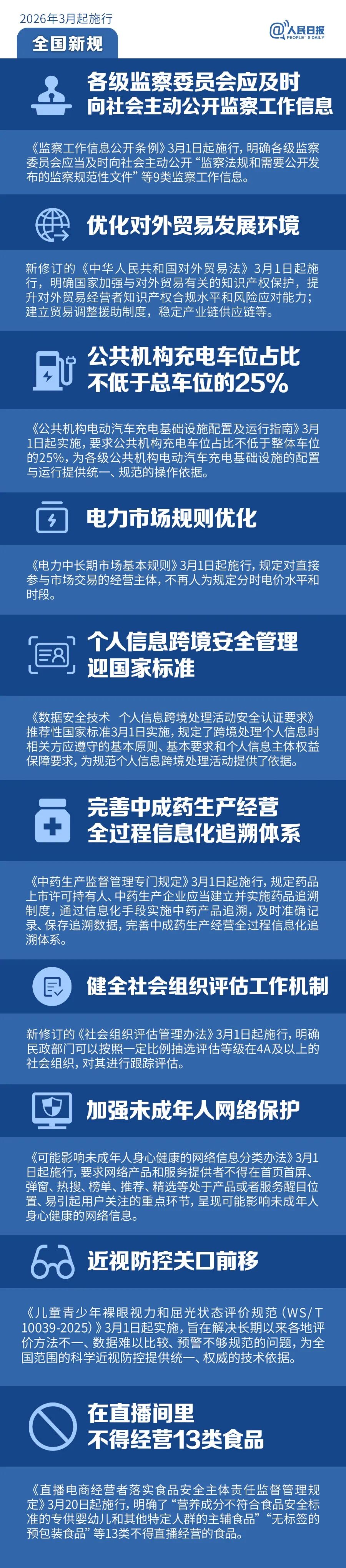
Group 1 - The new regulations for public institutions require that at least 25% of total parking spaces be designated for electric vehicle charging [4] - The revised Foreign Trade Law emphasizes the protection of intellectual property rights related to foreign trade and establishes a trade adjustment assistance system to stabilize supply chains [3] - The new guidelines for the electric power market eliminate artificial pricing for time-based electricity rates, allowing market participants to set their own prices [6] Group 2 - The new regulations for personal information cross-border processing establish basic principles and requirements for safeguarding individual rights during data handling [7] - The updated regulations for traditional Chinese medicine production mandate the establishment of a traceability system for drug products, enhancing the information management throughout the production process [8] - The revised Social Organization Evaluation Management Measures allow for the tracking and evaluation of social organizations with a rating of 4A and above [10] Group 3 - The new regulations for the protection of minors online prohibit the display of harmful content in prominent areas of online products and services [11] - The new standards for evaluating children's vision aim to standardize assessment methods and improve the effectiveness of myopia prevention efforts [12] - The new regulations in Shanghai promote the development of the cruise economy by encouraging cruise companies to use Shanghai as a home port [16] Group 4 - The new financial regulations in Chongqing require local financial organizations to protect consumer rights and manage consumer information responsibly [18] - The new measures in Shanxi allow flexible employment individuals to prepay pension insurance fees, providing options for payment frequency and amounts [19] - The new regulations in Henan streamline administrative services to enhance the business environment, promoting efficiency in processing applications [21]

弹窗、热搜不得呈现影响未成年人身心健康内容
Xin Lang Cai Jing· 2026-02-27 19:29
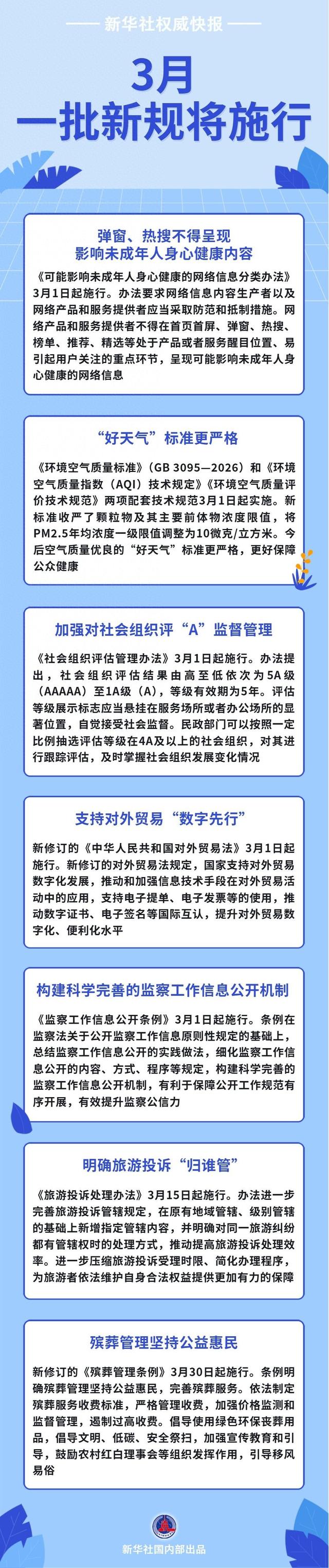
Group 1 - The new regulations effective from March 1 aim to prevent the dissemination of online information that may affect the physical and mental health of minors, requiring content producers and service providers to take preventive measures [1] - The revised "Good Weather" standards under the new Environmental Air Quality Standards (GB 3095—2026) set stricter limits on particulate matter, adjusting the annual average PM2.5 concentration limit to 10 micrograms per cubic meter, enhancing public health protection [2] - The new Social Organization Evaluation Management Measures will implement a grading system for social organizations, ranging from 5A to 1A, with a validity period of five years, promoting transparency and accountability [3] Group 2 - The revised Foreign Trade Law supports the digital transformation of foreign trade, encouraging the use of electronic documents and international recognition of digital signatures, thereby enhancing the efficiency of trade activities [4] - The new Regulations on the Disclosure of Supervision Work Information aim to establish a comprehensive mechanism for publicizing supervision work, enhancing the credibility of oversight efforts [5] - The Tourism Complaint Handling Measures, effective from March 15, introduce new jurisdictional rules to improve the efficiency of handling tourism complaints, ensuring timely resolution for travelers [6] Group 3 - The revised Funeral Management Regulations emphasize public welfare and the improvement of funeral services, establishing standards for service fees and promoting the use of environmentally friendly funeral products [7]
3月份,这些新规将影响你我生活
Xin Lang Cai Jing· 2026-02-27 03:59
Group 1 - New regulations affecting social and public life will take effect on March 1, 2026, impacting travel, living, and consumption [1] - The National Internet Information Office and other departments have issued guidelines to prevent platforms from displaying harmful information to minors [1] - The revised Environmental Air Quality Standards will tighten limits on particulate matter, setting the annual PM2.5 concentration limit to 10 micrograms per cubic meter [3] Group 2 - The revised Social Organization Evaluation Management Measures will simplify eligibility criteria for evaluations, allowing for more organizations to participate [5] - The updated Foreign Trade Law will support the digital transformation of foreign trade, promoting the use of electronic documents and international recognition of digital signatures [6] - New regulations on traditional Chinese medicine production will prohibit the repackaging of herbal products without proper labeling [7] Group 3 - The new Supervision Work Information Disclosure Regulations will allow for the public disclosure of significant supervisory actions after a comprehensive assessment [8] - The Tourism Complaint Handling Measures will enhance jurisdictional clarity and efficiency in handling tourism-related complaints, effective March 15, 2026 [9] - The revised Funeral Management Regulations will emphasize the public welfare aspect of funeral services, aiming to reduce the financial burden on families [10]

3月份一批新规将施行,涉网络热搜内容、旅游投诉等
Xin Hua She· 2026-02-27 01:40
Group 1 - New regulations will prohibit the display of online information that may affect the physical and mental health of minors on prominent sections such as homepages, pop-ups, and hot searches starting March 1 [9][10] - The "good weather" standard for air quality will be stricter, with the annual average PM2.5 concentration limit adjusted to 10 micrograms per cubic meter, aimed at better protecting public health [3][10] - The new "Social Organization Evaluation Management Measures" will implement a grading system for social organizations, ranging from 5A to 1A, with a validity period of five years, and organizations will be subject to social supervision [3][10] Group 2 - The revised "Foreign Trade Law of the People's Republic of China" will support the digital development of foreign trade, promoting the use of electronic bills, invoices, and international recognition of digital certificates and electronic signatures [3][10] - The "Regulations on the Public Disclosure of Supervision Work Information" will establish a scientific and complete mechanism for public disclosure of supervision work, detailing the content, methods, and procedures for information disclosure [3][10]
《监察工作信息公开条例》公布,自2026年3月1日起施行
Xin Lang Cai Jing· 2026-01-19 23:20
Core Viewpoint - The National Supervisory Commission of China has announced the "Regulations on the Public Disclosure of Supervisory Work Information," which will take effect on March 1, 2026, aimed at enhancing the transparency and credibility of supervisory work [1][2]. Group 1: Regulations Overview - The regulations are designed to strengthen and standardize the public disclosure of supervisory work information, ensuring that citizens, legal entities, and other organizations can access this information legally [3]. - The regulations emphasize that supervisory agencies must adhere to principles of legality, accuracy, safety, and efficiency in disclosing information [4]. Group 2: Information Disclosure Requirements - Supervisory agencies are required to proactively disclose specific types of information, including supervisory regulations, organizational structure, investigation information, and contact details for reporting [5][6]. - The regulations specify that information related to significant public interest can be disclosed by higher supervisory agencies [4]. Group 3: Disclosure Procedures - The process for disclosing information involves the responsible department proposing a disclosure plan, conducting confidentiality reviews, and obtaining necessary approvals before public release [8][9]. - Supervisory agencies must utilize various channels for information dissemination, including official websites and media outlets, to ensure timely access for the public [10][11]. Group 4: Monitoring and Accountability - The regulations mandate that supervisory agencies monitor public sentiment regarding disclosed information and address any misinformation that may disrupt social stability [11]. - Special supervisory personnel are tasked with overseeing the compliance of supervisory agencies with these disclosure regulations and providing feedback for improvements [12].
监察工作信息公开条例》自2026年3月1日起施行
Jin Rong Jie· 2026-01-19 23:17
Group 1 - The National Supervisory Commission announced the release of the No. 3 notice on January 20, which includes the "Regulations on the Public Disclosure of Supervisory Work Information" [1] - The new regulations will come into effect on March 1, 2026 [1]
关于《监察工作信息公开条例(征求意见稿)》公开征求意见的通知
Zhong Yang Ji Wei Guo Jia Jian Wei Wang Zhan· 2025-10-28 00:37
Core Viewpoint - The National Supervisory Commission has drafted the "Regulations on the Public Disclosure of Supervisory Work Information (Draft for Comments)" to enhance and standardize the public disclosure of supervisory work information, in accordance with the Supervision Law of the People's Republic of China [1][2]. Group 1: Objectives and Principles - The purpose of the regulations is to strengthen and standardize the public disclosure of supervisory work information, enhance supervision over supervisory agencies, and ensure that citizens, legal persons, and other organizations can legally access supervisory work information [3]. - The principles for public disclosure include legality, accuracy, safety, standardization, efficiency, and convenience [4]. Group 2: Disclosure Mechanism - Supervisory agencies are required to establish a sound mechanism for the public disclosure of supervisory work information, with the office responsible for coordinating and guiding daily disclosure work [4]. - Higher-level supervisory agencies must strengthen leadership over lower-level agencies in the public disclosure of supervisory work information, guiding and correcting issues as they arise [4]. Group 3: Information to be Disclosed - Supervisory committees at all levels must proactively disclose specific types of supervisory work information, including supervisory regulations, organizational structure, responsibilities of supervisory officials, and case investigation information [5][6]. - Information that is of high public interest or has significant social impact can be disclosed by higher-level supervisory agencies after comprehensive assessment and approval [6]. Group 4: Disclosure Methods and Procedures - Supervisory agencies can use various methods for public disclosure, including official websites, press conferences, and media publications [9]. - The process for public disclosure involves drafting a specific disclosure plan, conducting confidentiality reviews, and following approval procedures before publication [10][11]. Group 5: Restrictions on Disclosure - Certain information is prohibited from being disclosed, including state secrets, work secrets, personal privacy, and information that could affect national security or public order [12]. Group 6: Oversight and Accountability - Special supervisory personnel are tasked with monitoring the compliance of supervisory agencies with the public disclosure responsibilities and can suggest improvements [14]. - Violations of the regulations can lead to corrective actions and potential penalties for responsible personnel [15].