殡葬管理

Search documents
弹窗、热搜不得呈现影响未成年人身心健康内容
Xin Lang Cai Jing· 2026-02-27 19:29
Group 1 - The new regulations effective from March 1 aim to prevent the dissemination of online information that may affect the physical and mental health of minors, requiring content producers and service providers to take preventive measures [1] - The revised "Good Weather" standards under the new Environmental Air Quality Standards (GB 3095—2026) set stricter limits on particulate matter, adjusting the annual average PM2.5 concentration limit to 10 micrograms per cubic meter, enhancing public health protection [2] - The new Social Organization Evaluation Management Measures will implement a grading system for social organizations, ranging from 5A to 1A, with a validity period of five years, promoting transparency and accountability [3] Group 2 - The revised Foreign Trade Law supports the digital transformation of foreign trade, encouraging the use of electronic documents and international recognition of digital signatures, thereby enhancing the efficiency of trade activities [4] - The new Regulations on the Disclosure of Supervision Work Information aim to establish a comprehensive mechanism for publicizing supervision work, enhancing the credibility of oversight efforts [5] - The Tourism Complaint Handling Measures, effective from March 15, introduce new jurisdictional rules to improve the efficiency of handling tourism complaints, ensuring timely resolution for travelers [6] Group 3 - The revised Funeral Management Regulations emphasize public welfare and the improvement of funeral services, establishing standards for service fees and promoting the use of environmentally friendly funeral products [7]
3月份,这些新规将影响你我生活
Xin Lang Cai Jing· 2026-02-27 03:59
Group 1 - New regulations affecting social and public life will take effect on March 1, 2026, impacting travel, living, and consumption [1] - The National Internet Information Office and other departments have issued guidelines to prevent platforms from displaying harmful information to minors [1] - The revised Environmental Air Quality Standards will tighten limits on particulate matter, setting the annual PM2.5 concentration limit to 10 micrograms per cubic meter [3] Group 2 - The revised Social Organization Evaluation Management Measures will simplify eligibility criteria for evaluations, allowing for more organizations to participate [5] - The updated Foreign Trade Law will support the digital transformation of foreign trade, promoting the use of electronic documents and international recognition of digital signatures [6] - New regulations on traditional Chinese medicine production will prohibit the repackaging of herbal products without proper labeling [7] Group 3 - The new Supervision Work Information Disclosure Regulations will allow for the public disclosure of significant supervisory actions after a comprehensive assessment [8] - The Tourism Complaint Handling Measures will enhance jurisdictional clarity and efficiency in handling tourism-related complaints, effective March 15, 2026 [9] - The revised Funeral Management Regulations will emphasize the public welfare aspect of funeral services, aiming to reduce the financial burden on families [10]


推动高质量发展 今年北京拟制定人工智能产业发展条例
Zhong Guo Xin Wen Wang· 2026-01-27 12:28
Group 1 - Beijing plans to formulate regulations for the development of the artificial intelligence industry as part of its legislative agenda for 2026, which includes 36 legislative topics [1][3] - The legislative agenda aims to support high-quality development in the capital, with a focus on various sectors including private economy and urban governance [3] - The city will also conduct research and discussions on regulations related to market competition, data management, and agricultural technology [3] Group 2 - The Beijing Municipal People's Congress is set to draft regulations for the construction of the Beijing International Commercial Arbitration Center to enhance the city's role in international dispute resolution [2] - Other proposed regulations include those for the protection of cultural heritage sites like the Great Wall and the central axis of Beijing, as well as environmental initiatives such as renewable energy development [2] - The legislative efforts also aim to address urban governance issues, including noise pollution and the management of non-motorized vehicles [2]
《殡葬管理条例》修订居民住宅禁止专用于安放骨灰
Xin Lang Cai Jing· 2026-01-07 12:05
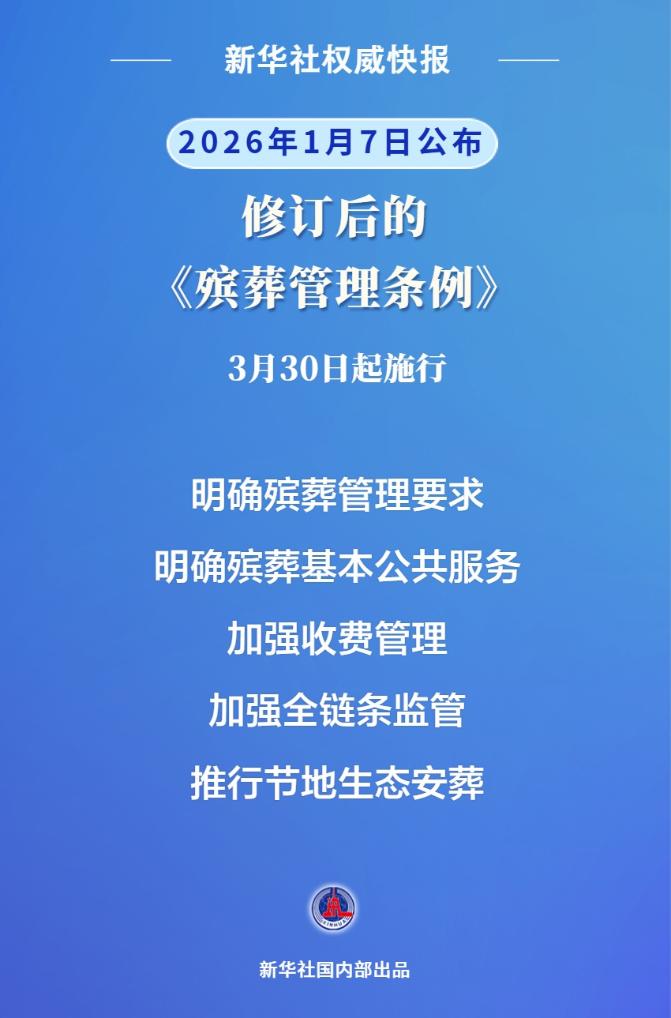
Core Viewpoint - The revised "Funeral Management Regulations" will take effect on March 30, focusing on enhancing funeral services and management standards [1] Summary by Relevant Sections General Principles - The regulations consist of 8 chapters and 73 articles, outlining the framework for funeral management [1] Funeral Facilities - The regulations clarify the requirements for funeral management and the provision of basic public funeral services [1] Funeral Services - There is an emphasis on strengthening fee management within the funeral service sector [1] Burial Services - The regulations promote ecological burial practices to encourage land-saving and environmentally friendly options [1] Funeral Activities - Enhanced supervision and management across the entire funeral service chain is mandated [1]
修订后的《殡葬管理条例》自3月30日起施行,主要包括这五方面内容
Xin Lang Cai Jing· 2026-01-07 09:57
Core Viewpoint - The revised Funeral Management Regulations, effective from March 30, 2026, aim to enhance the public welfare aspect of the funeral industry, regulate funeral service fees, and improve overall management and service quality in the sector [1][2]. Group 1: Regulatory Framework - The new regulations emphasize public welfare, clarify investment mechanisms, strengthen facility supply, reduce the financial burden on the public, and enhance convenience in services [1]. - A basic project list will be established by the state to ensure essential funeral services, including body transportation, storage, farewell ceremonies, cremation, ash storage, ecological burials, and government-provided burial services [1]. Group 2: Facility Management - Local governments at the county level and above are required to build funeral homes based on population size and distribution, while considering existing land resources and ecological principles [1]. - The establishment of for-profit funeral service institutions is prohibited, and all funeral facilities and services will be subject to unified regulatory oversight [1]. Group 3: Service Standardization - The regulations specify normative requirements for body transportation, storage, and cremation, and mandate that burial services provide graves based on necessary documentation [2]. - It is prohibited to establish projects or charge fees outside the designated list, with relevant departments responsible for formulating pricing policies and monitoring compliance [2]. Group 4: Cultural Shift and Supervision - The regulations promote a culture of civility, frugality, and ecological sustainability throughout the funeral process, advocating for green burial practices and environmentally friendly funeral products [2]. - A comprehensive regulatory system covering all aspects of funeral activities will be established, with local governments responsible for oversight and regular inspections [2].
修订后的《殡葬管理条例》自2026年3月30日起施行
Xin Hua She· 2026-01-07 09:13
Core Viewpoint - The revised "Funeral Management Regulations" will be implemented starting March 30, 2026, focusing on enhancing management and service standards in the funeral industry [2]. Summary by Relevant Sections General Principles - The regulations consist of 8 chapters and 73 articles, covering general principles, funeral facilities, funeral services, burial services, funeral activities, supervision and management, legal responsibilities, and supplementary provisions [2]. Funeral Management Requirements - The revised regulations clarify the requirements for funeral management, ensuring a standardized approach across the industry [2]. Basic Public Services - The regulations define the basic public services related to funerals, aiming to improve accessibility and quality of services provided to the public [2]. Fee Management - There will be strengthened management of fees associated with funeral services, ensuring transparency and fairness in pricing [2]. Comprehensive Supervision - The regulations emphasize comprehensive supervision throughout the entire funeral service chain, enhancing accountability and service quality [2]. Eco-friendly Burial Practices - The promotion of land-saving and eco-friendly burial practices is a key aspect of the revised regulations, reflecting a shift towards sustainable funeral options [2].