
旅游投诉处理

Search documents
弹窗、热搜不得呈现影响未成年人身心健康内容
Xin Lang Cai Jing· 2026-02-27 19:29
Group 1 - The new regulations effective from March 1 aim to prevent the dissemination of online information that may affect the physical and mental health of minors, requiring content producers and service providers to take preventive measures [1] - The revised "Good Weather" standards under the new Environmental Air Quality Standards (GB 3095—2026) set stricter limits on particulate matter, adjusting the annual average PM2.5 concentration limit to 10 micrograms per cubic meter, enhancing public health protection [2] - The new Social Organization Evaluation Management Measures will implement a grading system for social organizations, ranging from 5A to 1A, with a validity period of five years, promoting transparency and accountability [3] Group 2 - The revised Foreign Trade Law supports the digital transformation of foreign trade, encouraging the use of electronic documents and international recognition of digital signatures, thereby enhancing the efficiency of trade activities [4] - The new Regulations on the Disclosure of Supervision Work Information aim to establish a comprehensive mechanism for publicizing supervision work, enhancing the credibility of oversight efforts [5] - The Tourism Complaint Handling Measures, effective from March 15, introduce new jurisdictional rules to improve the efficiency of handling tourism complaints, ensuring timely resolution for travelers [6] Group 3 - The revised Funeral Management Regulations emphasize public welfare and the improvement of funeral services, establishing standards for service fees and promoting the use of environmentally friendly funeral products [7]
3月份,这些新规将影响你我生活
Xin Lang Cai Jing· 2026-02-27 03:59
Group 1 - New regulations affecting social and public life will take effect on March 1, 2026, impacting travel, living, and consumption [1] - The National Internet Information Office and other departments have issued guidelines to prevent platforms from displaying harmful information to minors [1] - The revised Environmental Air Quality Standards will tighten limits on particulate matter, setting the annual PM2.5 concentration limit to 10 micrograms per cubic meter [3] Group 2 - The revised Social Organization Evaluation Management Measures will simplify eligibility criteria for evaluations, allowing for more organizations to participate [5] - The updated Foreign Trade Law will support the digital transformation of foreign trade, promoting the use of electronic documents and international recognition of digital signatures [6] - New regulations on traditional Chinese medicine production will prohibit the repackaging of herbal products without proper labeling [7] Group 3 - The new Supervision Work Information Disclosure Regulations will allow for the public disclosure of significant supervisory actions after a comprehensive assessment [8] - The Tourism Complaint Handling Measures will enhance jurisdictional clarity and efficiency in handling tourism-related complaints, effective March 15, 2026 [9] - The revised Funeral Management Regulations will emphasize the public welfare aspect of funeral services, aiming to reduce the financial burden on families [10]


3·15当天施行!《旅游投诉处理办法》公布→
Xin Lang Cai Jing· 2026-02-25 10:46
Core Points - The Ministry of Culture and Tourism has announced the "Tourism Complaint Handling Measures," which will take effect on March 15, 2026, to ensure fair handling of tourism complaints and protect the legal rights of tourists and tourism operators [1] Group 1: Jurisdiction - Tourism complaints are under the jurisdiction of the tourism complaint handling institutions located at the county level or above, based on the operator's residence, the contract signing location, or the location of the dispute [2] - In urgent situations requiring immediate action against the tourism operator's harmful behavior, the jurisdiction lies with the institution at the dispute's location [2] - If multiple institutions have jurisdiction over the same complaint, the one that receives the complaint first will handle it [2] Group 2: Acceptance of Complaints - Tourists can file complaints for various reasons, including violations of contract terms by the tourism operator, damages to personal or property rights due to the operator's responsibility, disputes arising from force majeure, and other violations of tourists' legal rights [3] - Complaints must meet specific conditions, such as having a direct interest in the matter and a clear respondent and request [4] Group 3: Complaint Requirements - A valid complaint should include the complainant's name or title, contact information, the respondent's name and address, and details of the complaint, including the time, place, and circumstances of the dispute [5] - Complaints will not be accepted if they fall outside the jurisdiction, are filed more than 90 days after the contract's expiration, or have already been handled by other legal or administrative bodies [5] Group 4: Processing of Complaints - Upon receiving a complaint, the handling institution must decide within two working days whether to accept it [6] - If accepted, the institution will mediate the complaint, and if mediation fails, a termination notice will be issued [6] - If the respondent is a travel agency and mediation fails, the Ministry of Culture and Tourism may use the tourism service quality guarantee fund for compensation under specific circumstances [6]
《旅游投诉处理办法》公布
Xin Lang Cai Jing· 2026-02-11 23:56
Core Viewpoint - The Ministry of Culture and Tourism has revised the "Tourism Complaint Handling Measures" to enhance the efficiency and effectiveness of handling tourism complaints, which will take effect on March 15, 2026 [1][2] Group 1: Complaint Handling Regulations - The revised measures improve jurisdictional regulations for tourism complaints by adding designated jurisdiction and clarifying handling methods when multiple jurisdictions apply, aiming to enhance complaint processing efficiency [1] - The measures compress the time limits for accepting complaints and simplify the processing procedures, providing stronger protection for tourists to uphold their legal rights [1] Group 2: Administrative Enforcement and Supervision - The measures differentiate between three scenarios in complaint handling: within the agency's responsibilities, outside the agency's responsibilities, and criminal cases, refining the approach to suspected illegal activities discovered during complaint processing [1] - The revised measures establish a data-sharing mechanism among local cultural and tourism authorities and related departments, enhancing data analysis and utilization [2] - New supervisory responsibilities for cultural and tourism authorities regarding complaint handling are introduced, ensuring necessary foundational support for complaint processing institutions [2]
《旅游投诉处理办法》 3月15日起施行
Xin Lang Cai Jing· 2026-02-11 18:46
Group 1 - The core viewpoint of the article is the introduction of the new "Tourism Complaint Handling Measures" by the Ministry of Culture and Tourism, which will take effect on March 15, 2026, to address the evolving landscape of tourism complaints in China [1] - The new measures aim to guide local cultural and tourism authorities in effectively responding to the changing forms and channels of tourism complaints, ensuring efficient handling of disputes and supporting the high-quality development of the tourism industry [1] - Tourists can file complaints regarding violations of contract agreements by tourism operators, damages to personal or property rights due to the operators' responsibilities, disputes arising from force majeure affecting contract fulfillment, and other infringements on their legal rights [1] Group 2 - The measures enhance jurisdictional regulations for tourism complaints by adding designated jurisdiction provisions, which aim to improve the efficiency of complaint handling [1] - The new regulations also compress the time limits for accepting tourism complaints and simplify the processing procedures, providing stronger protection for tourists to uphold their legal rights [1]
“旅游投诉”新规颁布!如何解决旅游纠纷?速看!
Nan Fang Du Shi Bao· 2026-02-11 14:31
Core Viewpoint - The Ministry of Culture and Tourism of the People's Republic of China has announced the new "Tourism Complaint Handling Measures," which will take effect on March 15, 2026, replacing the previous measures established in 2010 [1][3]. Group 1: Background and Purpose of the New Measures - The new measures aim to effectively address tourism disputes, protect the legal rights of tourists and tourism operators, and regulate market order, which is increasingly important due to the rapid development of the tourism industry and changes in complaint handling methods [3]. - The revision of the measures is intended to guide local cultural and tourism authorities in responding to new market developments and to support high-quality growth in the tourism sector [3]. Group 2: Dispute Resolution Channels - Tourists can resolve disputes with tourism operators through four main channels: negotiation between parties, mediation by consumer associations or relevant organizations, arbitration based on agreements, and litigation in people's courts [4]. Group 3: Protection of Tourists' Rights - The new measures enhance jurisdictional provisions for tourism complaints, streamline processing times, and simplify procedures to better protect tourists' legal rights [5]. Group 4: Administrative Enforcement and Complaint Handling - The measures differentiate between complaints that fall within the agency's responsibilities, those that do not, and cases involving criminal activity, refining the handling of suspected illegal activities [6]. - The revisions aim to prevent administrative mediation from replacing administrative penalties and strengthen the enforcement of laws against violations [7]. Group 5: Supervision and Support for Complaint Handling - Local cultural and tourism authorities are required to establish data-sharing mechanisms and enhance data analysis to improve the quality of complaint handling [8]. - The new measures also impose supervisory responsibilities on cultural and tourism authorities to ensure adequate support for complaint handling institutions [8].
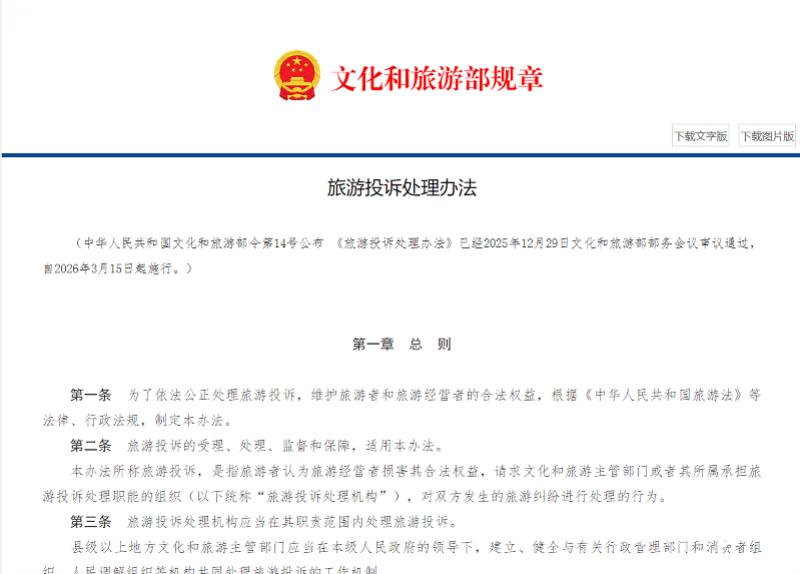
《旅游投诉处理办法》3月15日起施行
Xin Hua She· 2026-02-11 13:54
Core Viewpoint - The Ministry of Culture and Tourism of China announced the implementation of the "Tourism Complaint Handling Measures," effective from March 15, 2026, to address the evolving landscape of tourism complaints and enhance the efficiency of complaint resolution [1] Summary by Relevant Sections Complaint Handling - Tourists can file complaints regarding: 1. Violations of contract terms by tourism operators 2. Personal or property damage caused by tourism operators 3. Disputes arising from force majeure affecting contract fulfillment 4. Other issues harming tourists' legal rights [1][1][1] Jurisdiction and Efficiency - The new measures improve jurisdictional regulations by adding designated jurisdiction content and clarifying handling methods when multiple jurisdictions apply to the same tourism dispute [1] - The measures also aim to reduce the time for accepting complaints and simplify processing procedures, providing stronger protection for tourists to uphold their legal rights [1][1]
文化和旅游部公布《旅游投诉处理办法》,3月15日起实施
Bei Jing Shang Bao· 2026-02-11 11:27
Core Viewpoint - The newly approved "Tourism Complaint Handling Measures" aims to enhance the efficiency and effectiveness of handling tourism complaints, ensuring the protection of tourists' legal rights and improving the overall complaint resolution process [1][2] Group 1: Regulations and Implementation - The "Measures" will be implemented starting March 15, 2026, after being approved by the Ministry of Culture and Tourism on December 29, 2025 [1] - The new regulations introduce designated jurisdiction for tourism complaints, in addition to existing territorial and hierarchical jurisdictions, to streamline the handling of disputes [1] - The time limit for accepting tourism complaints has been further compressed, and the procedures for processing complaints have been simplified [1] Group 2: Supervision and Data Management - Local cultural and tourism authorities are required to establish a data-sharing mechanism with relevant departments to enhance the analysis and utilization of data related to tourism complaints [2] - The "Measures" impose new supervisory responsibilities on cultural and tourism authorities regarding the handling of tourism complaints, ensuring necessary support for complaint processing institutions [2] - The differentiation between mediation of tourism complaints and the investigation of illegal activities has been clarified, preventing administrative mediation from replacing legal penalties [1]
《旅游投诉处理办法》政策解读
Yang Shi Wang· 2026-02-11 11:15
Group 1 - The core viewpoint of the article emphasizes the importance of the newly released "Tourism Complaint Handling Measures" by the Ministry of Culture and Tourism in addressing tourism disputes, protecting the rights of tourists and operators, and regulating market order [1][2] Group 2 - The revision of the complaint handling measures aims to adapt to the rapid development of the tourism industry and changes in complaint forms and channels due to the widespread use of information technology [2] - Tourists can resolve disputes through four main channels: negotiation, mediation by consumer associations or relevant organizations, arbitration based on agreements, and litigation in court [3] - The new measures enhance the jurisdictional provisions for tourism complaints, streamline the complaint acceptance timeline, and simplify procedures to better protect tourists' legal rights [4] - The measures differentiate between complaints that fall within the agency's responsibilities and those that do not, ensuring that administrative mediation does not replace legal penalties for violations [5] - Local cultural and tourism departments are required to establish data-sharing mechanisms and enhance supervision responsibilities to improve the quality of complaint handling and protect the rights of both tourists and operators [6]
《旅游投诉处理办法》公布,3月15日起施行
Yang Shi Wang· 2026-02-11 11:08
Core Viewpoint - The Ministry of Culture and Tourism of China has announced the implementation of the "Tourism Complaint Handling Measures," which will take effect on March 15, 2026, aimed at ensuring fair handling of tourism complaints and protecting the rights of both tourists and tourism operators [1][22]. Group 1: General Principles - The measures are designed to handle tourism complaints legally and fairly, based on the "Tourism Law of the People's Republic of China" and other relevant regulations [1]. - The term "tourism complaint" refers to actions taken by tourists who believe their rights have been violated by tourism operators, seeking resolution from designated tourism complaint handling institutions [1]. Group 2: Jurisdiction - Tourism complaints will be under the jurisdiction of tourism complaint handling institutions located at or above the county level, based on the operator's location, the contract signing location, or the location of the dispute [3]. - In urgent cases requiring immediate action, the institution at the location of the dispute will have jurisdiction [4]. Group 3: Acceptance of Complaints - Tourists can file complaints regarding violations of contract terms, damages to personal or property rights due to the operator's actions, disputes arising from force majeure, and other violations of their rights [5][6]. - Complaints must meet specific conditions, including a direct interest in the matter and a clear identification of the respondent and the complaint request [7]. Group 4: Processing of Complaints - The complaint handling institutions will primarily use mediation to resolve complaints, ensuring that the process is based on facts and respects the rights of both parties [11]. - Institutions are required to make a decision on whether to accept a complaint within two working days of receipt [10]. Group 5: Supervision and Support - The complaint handling institutions must utilize a standardized information system and establish data-sharing mechanisms with relevant departments to enhance data analysis and utilization [17]. - Local cultural and tourism departments are responsible for providing necessary support, including personnel, funding, and training for complaint handling staff [26].