
对外贸易数字化

Search documents
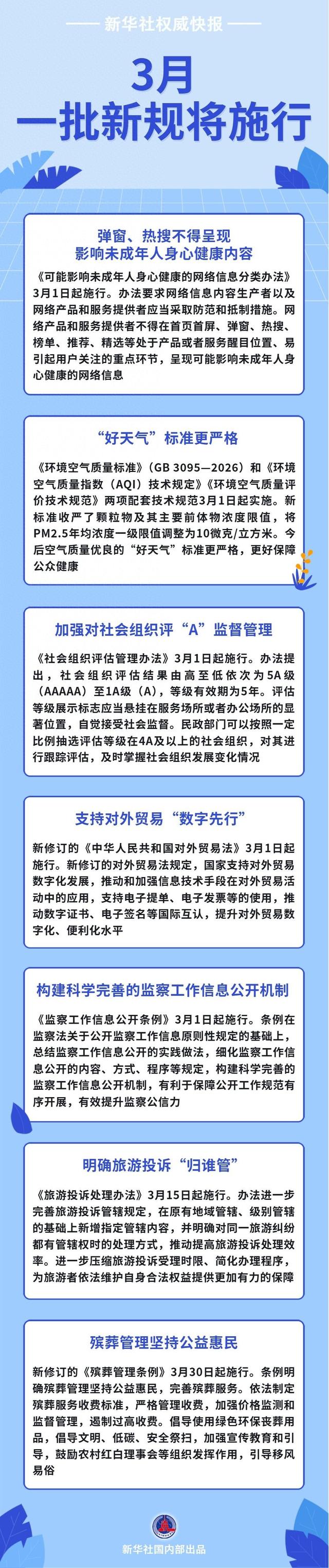
弹窗、热搜不得呈现影响未成年人身心健康内容
Xin Lang Cai Jing· 2026-02-27 19:29
Group 1 - The new regulations effective from March 1 aim to prevent the dissemination of online information that may affect the physical and mental health of minors, requiring content producers and service providers to take preventive measures [1] - The revised "Good Weather" standards under the new Environmental Air Quality Standards (GB 3095—2026) set stricter limits on particulate matter, adjusting the annual average PM2.5 concentration limit to 10 micrograms per cubic meter, enhancing public health protection [2] - The new Social Organization Evaluation Management Measures will implement a grading system for social organizations, ranging from 5A to 1A, with a validity period of five years, promoting transparency and accountability [3] Group 2 - The revised Foreign Trade Law supports the digital transformation of foreign trade, encouraging the use of electronic documents and international recognition of digital signatures, thereby enhancing the efficiency of trade activities [4] - The new Regulations on the Disclosure of Supervision Work Information aim to establish a comprehensive mechanism for publicizing supervision work, enhancing the credibility of oversight efforts [5] - The Tourism Complaint Handling Measures, effective from March 15, introduce new jurisdictional rules to improve the efficiency of handling tourism complaints, ensuring timely resolution for travelers [6] Group 3 - The revised Funeral Management Regulations emphasize public welfare and the improvement of funeral services, establishing standards for service fees and promoting the use of environmentally friendly funeral products [7]
3月份,这些新规将影响你我生活
Xin Lang Cai Jing· 2026-02-27 03:59
Group 1 - New regulations affecting social and public life will take effect on March 1, 2026, impacting travel, living, and consumption [1] - The National Internet Information Office and other departments have issued guidelines to prevent platforms from displaying harmful information to minors [1] - The revised Environmental Air Quality Standards will tighten limits on particulate matter, setting the annual PM2.5 concentration limit to 10 micrograms per cubic meter [3] Group 2 - The revised Social Organization Evaluation Management Measures will simplify eligibility criteria for evaluations, allowing for more organizations to participate [5] - The updated Foreign Trade Law will support the digital transformation of foreign trade, promoting the use of electronic documents and international recognition of digital signatures [6] - New regulations on traditional Chinese medicine production will prohibit the repackaging of herbal products without proper labeling [7] Group 3 - The new Supervision Work Information Disclosure Regulations will allow for the public disclosure of significant supervisory actions after a comprehensive assessment [8] - The Tourism Complaint Handling Measures will enhance jurisdictional clarity and efficiency in handling tourism-related complaints, effective March 15, 2026 [9] - The revised Funeral Management Regulations will emphasize the public welfare aspect of funeral services, aiming to reduce the financial burden on families [10]


3月份一批新规将施行,涉网络热搜内容、旅游投诉等
Xin Hua She· 2026-02-27 01:40
Group 1 - New regulations will prohibit the display of online information that may affect the physical and mental health of minors on prominent sections such as homepages, pop-ups, and hot searches starting March 1 [9][10] - The "good weather" standard for air quality will be stricter, with the annual average PM2.5 concentration limit adjusted to 10 micrograms per cubic meter, aimed at better protecting public health [3][10] - The new "Social Organization Evaluation Management Measures" will implement a grading system for social organizations, ranging from 5A to 1A, with a validity period of five years, and organizations will be subject to social supervision [3][10] Group 2 - The revised "Foreign Trade Law of the People's Republic of China" will support the digital development of foreign trade, promoting the use of electronic bills, invoices, and international recognition of digital certificates and electronic signatures [3][10] - The "Regulations on the Public Disclosure of Supervision Work Information" will establish a scientific and complete mechanism for public disclosure of supervision work, detailing the content, methods, and procedures for information disclosure [3][10]
对外贸易法修订草案二审增加规定推动数字证书、电子签名等国际互认
Zhong Guo Xin Wen Wang· 2026-01-23 06:38
Group 1 - The core viewpoint of the news is the proposed amendments to the Foreign Trade Law, which aim to enhance the digitalization of foreign trade and promote international recognition of digital certificates and electronic signatures to improve trade facilitation [1] - The draft amendments include provisions to support the development of green trade standards, certification, and labeling systems, as well as the establishment of a talent pool for high-quality foreign trade development [1] - The amendments clarify various service trade models, encouraging international service trade through cross-border payments, overseas consumption, commercial presence, and the movement of natural persons [1] - The draft reflects the central government's commitment to high-quality foreign trade development, emphasizing the construction of a strong trade nation and the maintenance of a fair international economic trade order [1] Group 2 - The draft amendments also consider the needs of small and micro enterprises among foreign trade operators, modifying penalty provisions to allow for flexible application of fines based on specific circumstances [2]
张晓涛:多措并举构建外贸数字化生态
Jing Ji Ri Bao· 2026-01-21 00:01
Group 1 - The newly revised Foreign Trade Law of the People's Republic of China will come into effect on March 1, 2026, explicitly stating that "the state supports the digital development of foreign trade" [1] - Legislative support for the digital development of foreign trade is a necessary choice in response to profound changes in the global trade landscape and is an inherent requirement for promoting high-quality foreign trade development [1] - The digitalization of trade documents and processes can significantly reduce search costs, performance costs, and transportation costs, enhancing competitive advantages in foreign trade [1] Group 2 - China's digital infrastructure is leading globally, with a total computing power ranking second worldwide and 4.55 million 5G base stations as of June 2025 [2] - The digitalization of the entire trade process is deepening, with smart ports optimizing through "single window" upgrades, facilitating interconnectivity among customs, logistics, taxation, and financial data [2] - There are still weaknesses in core technology autonomy, international data center layout, and legal recognition of cross-border electronic documents, which need to be addressed [2] Group 3 - Strengthening digital technology innovation is essential, focusing on high-end industrial software and core chip development, and accelerating the application of AI, blockchain, and IoT in the entire trade chain [3] - Enhancing digital infrastructure by integrating 5G, IoT, and blockchain technologies in ports, warehousing, and transportation is a priority [3] - Actively participating in global governance of digital trade and aligning with international high-standard digital trade rules is crucial for building mutually beneficial cooperation networks [3]
外贸“基本法”大修,跨境服务贸易纳入负面清单管理
Zheng Quan Shi Bao· 2026-01-11 13:22
Core Viewpoint - The newly revised Foreign Trade Law of the People's Republic of China, effective from March 1, 2026, represents a significant overhaul aimed at enhancing the legal framework for foreign trade, particularly for small and medium-sized enterprises, while also adapting to current international trade dynamics [1][2]. Group 1: Legislative Changes - The new law consists of 11 chapters and 83 articles, establishing a negative list management system for cross-border service trade, reflecting China's commitment to opening up its international service trade [2][4]. - The law elevates previously successful reform measures to a legal status, including the removal of the requirement for foreign trade operators to register, which simplifies procedures and enhances convenience [2][3]. Group 2: Support for Trade Development - The law emphasizes the promotion of cross-border financial services and digital trade, including the international recognition of digital certificates and electronic signatures, to enhance the efficiency of foreign trade [6][8]. - It introduces provisions for establishing a green trade system, encouraging the import and export of green low-carbon products, and promoting international cooperation in green trade [6][7]. Group 3: Support for SMEs - The law explicitly states that the government will support and facilitate small and micro enterprises in conducting foreign trade, providing conveniences in regulation, financing, and foreign exchange settlement [9][10]. - It also establishes a trade adjustment assistance system to support enterprises affected by trade remedy measures, enhancing their resilience against international trade challenges [10][11]. Group 4: Risk Management and Policy Stability - The law includes mechanisms for trade policy assessment to respond to changes in the international trade environment, ensuring a proactive approach to trade risks [10][11]. - By formalizing the negative list management for cross-border services, the law aims to increase policy stability and authority, thereby improving the implementation of related policies [4][5].