睡眠账户清理

Search documents
多家银行出手,清理睡眠账户
财联社· 2025-10-25 09:35
Core Viewpoint - The recent wave of cleaning dormant accounts in the banking sector is broader than before, involving various account types and driven by both regulatory requirements and internal motivations to enhance customer engagement and operational efficiency [2][9]. Group 1: Overview of Dormant Account Cleaning - Nanjing Bank announced a cleaning initiative targeting dormant accounts, including those of businesses with canceled registrations and non-verified personal accounts [1]. - Since October, over 30 banks have initiated similar cleaning announcements, with a focus on credit cards, electronic accounts, and corporate accounts [2]. - The National Financial Regulatory Administration has launched a year-long initiative to address dormant accounts, despite a general increase in the number of bank accounts and cards in recent years [2]. Group 2: Motivations Behind Cleaning Dormant Accounts - Banks are increasingly viewing the cleaning of dormant accounts as an opportunity to activate these accounts and enhance their value, rather than merely a regulatory obligation [3][9]. - The pressure from customer attrition and the need for effective performance assessments have led banks to adopt a more proactive approach to managing inactive accounts [10]. - The shift in key performance indicators (KPIs) from merely counting accounts to focusing on active and profitable customers reflects a broader trend in the banking industry [10]. Group 3: Impact on Retail Banking - The retail banking sector has faced challenges, with some banks reporting declines in personal loan balances and profitability in retail financial services [6]. - The cleaning of dormant accounts is seen as a way to improve the accuracy of data used in AI models for risk management and marketing, thereby enhancing overall operational effectiveness [12][13]. - The presence of a significant number of dormant accounts (up to one-third of total accounts) indicates both the potential for improvement and the challenges in executing these cleaning initiatives [14].


清理“睡眠账户”不应“一刀切”
Xin Hua Ri Bao· 2025-10-22 23:11
Core Viewpoint - Several banks have initiated actions to manage or clean up "sleeping accounts," with some banks setting a standard of "balances below 10 yuan, with no transactions for a year and no linked services" for management [1] Group 1: Actions by Banks - Banks claim that these measures aim to prevent accounts from being exploited by criminals and to assist in combating money laundering and fraud risks [1] - The cleanup of "sleeping accounts" is also seen as beneficial for bank management and financial security [1] Group 2: Concerns and Recommendations - The approach of a blanket policy may be considered overly simplistic, as it disregards the detailed information provided by users during account opening and the agreements signed with banks [1] - It is suggested that banks should contact account holders for careful identification, cleaning up only genuine "sleeping accounts" while notifying those that are active to protect user interests [1]
多家银行要求核实客户身份信息,涉及职业、单位地址等!不完整将被限制服务
Xin Lang Cai Jing· 2025-06-13 00:47
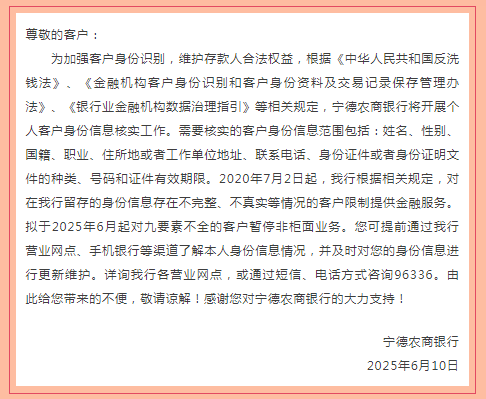
Core Viewpoint - Several banks in China, including Ningde Rural Commercial Bank, are implementing customer identity verification processes to enhance security and comply with regulatory requirements, which may restrict services for customers with incomplete or inaccurate information [1][3][7]. Group 1: Identity Verification Initiatives - Ningde Rural Commercial Bank announced a verification process for personal customer identity information, including name, gender, nationality, occupation, address, contact number, and identification document details [3]. - Other banks, such as the Bank of China Shandong branch and various rural commercial banks, have also issued similar announcements regarding customer identity verification [2][4]. - The verification process is in response to regulatory requirements, including the Anti-Money Laundering Law of the People's Republic of China [3][7]. Group 2: Service Restrictions and Account Management - Customers with incomplete or inaccurate identity information will face restrictions on financial services, with a planned suspension of non-counter services for those lacking complete information starting June 2025 [3][4]. - Some banks are also addressing the issue of "sleeping accounts," which are accounts that have not had any transactions for an extended period, leading to potential account closures [4][11]. - Continuous monthly cleaning of accounts that meet specific criteria, such as inactivity for three years and low balances, will be implemented [5][11]. Group 3: Broader Industry Trends - Over thirty banks have initiated similar identity verification and account cleaning measures since June of the previous year, indicating a broader industry trend towards enhancing customer information accuracy [11][12]. - The banking sector is experiencing a shift from rapid expansion to a focus on quality, as evidenced by a slowdown in the growth rate of bank card issuance [10][12]. - The total number of bank cards issued in China reached 9.913 billion by the end of 2024, with a growth rate of only 1.29%, significantly lower than previous years [10].