磷酸铁锂扩产

Search documents
国企入局!百万吨磷酸铁锂扩产高峰来临
起点锂电· 2026-02-25 09:46
Core Viewpoint - The article discusses the rapid expansion of the lithium iron phosphate (LFP) industry in China, particularly focusing on the new production projects and the strategic positioning of companies like Hubei Xingyuan Technology Co., Ltd. in the renewable energy materials sector [5][10]. Industry Expansion - The lithium iron phosphate industry in China is experiencing a new wave of high-intensity expansion, with significant projects being announced, such as Hubei Xingyuan's plan to produce 150,000 tons of battery-grade lithium iron phosphate annually [3][4]. - By February 2026, the total planned capacity for new and expanded lithium iron phosphate projects across China has exceeded 4.1 million tons per year, marking the most concentrated period of industry expansion since 2020 [10]. Project Details - Hubei Xingyuan's project, with a total investment of 2.3 billion yuan, aims to establish a complete local supply chain from phosphate mining to lithium iron phosphate synthesis, addressing the historical issue of "phosphorus without materials" in Central China [4][6]. - The project is strategically located in Yichang, which benefits from abundant hydropower resources and lower industrial electricity prices, providing a significant cost advantage for energy-intensive production processes [7]. Market Dynamics - Major battery manufacturers, including CATL and EVE Energy, have signed long-term contracts for lithium iron phosphate supply, ensuring stable demand for the newly added production capacity [11][12]. - The industry is shifting from low-end capacity replication to technology-driven upgrades, with a focus on high-density and long-cycle lithium iron phosphate products to meet the growing demands of energy storage and power batteries [15]. Price Trends - Prices for lithium iron phosphate have rebounded significantly, with the price for power-type lithium iron phosphate reaching 57,300 yuan per ton by January 2026, reflecting an increase of over 87% from mid-2025 lows [15]. - The overall profitability of leading companies in the lithium iron phosphate sector is expected to improve, while smaller manufacturers may face greater challenges due to the competitive landscape [16].




磷酸铁需求高增助力磷产业链景气
HTSC· 2026-02-12 02:20
Investment Rating - The report maintains an "Overweight" rating for the basic chemical industry, indicating an expectation that the industry stock index will outperform the benchmark [2]. Core Insights - The demand for iron phosphate is expected to continue growing due to rapid increases in energy storage needs and ongoing expansions in downstream lithium iron phosphate production. This growth is anticipated to improve profitability for domestic iron phosphate companies as operating rates increase [4][6]. - The price of iron phosphate has entered an upward trend since the second half of 2025, driven by rising raw material costs such as ferrous sulfate and phosphoric acid, alongside increased demand from energy storage [5]. - The report highlights that companies utilizing the iron method for production will benefit significantly from the declining prices of iron powder, leading to expanded profit margins [5]. Summary by Sections Demand and Supply Dynamics - Domestic iron phosphate production capacity reached 4.82 million tons in 2025, a year-on-year increase of 5.7%, with production estimated at 2.96 million tons, up 56% year-on-year. The demand for lithium iron phosphate is projected to grow to 5.95 million tons in 2026 and 7.67 million tons in 2027, reflecting increases of 49% and 29% respectively [4]. - New production capacities for iron phosphate are planned at 1.88 million tons and 2.58 million tons for 2026 and 2027 respectively, indicating a positive outlook for terminal demand [4]. Price Trends and Cost Factors - As of February 6, 2026, the price of iron phosphate was reported at 11,630 CNY per ton, an 11% increase from the low of 10,500 CNY per ton in September 2025. This price increase is attributed to both rising storage demand and higher raw material costs [5]. - The production methods for iron phosphate include ammonium method, sodium method, and iron method, with the iron method expected to benefit more from the current market conditions due to its lower reliance on expensive raw materials [5]. Industry Outlook - The report anticipates that the growth in iron phosphate demand will positively impact the entire phosphate industry chain, particularly for upstream products like phosphate rock, yellow phosphorus, phosphoric acid, and industrial monoammonium phosphate, which are constrained by high energy consumption and resource attributes [6]. - Companies with integrated phosphate rock resources are expected to benefit significantly from the improving market conditions as new supply is limited by policy constraints [6].
超130亿元!磷酸铁锂行业再添三个大项目
Zhong Guo Hua Gong Bao· 2026-01-07 10:38
Core Viewpoint - The lithium iron phosphate (LFP) industry is experiencing a new wave of expansion with significant investments announced despite recent challenging years [1] Group 1: Project Announcements - Bangpu Times is set to launch a new generation lithium iron phosphate project with an annual capacity of 450,000 tons by December 29, 2025, involving a total investment of 5.6 billion yuan and an expected annual output value of 14.5 billion yuan [2] - Fulin Precision plans to establish a high-end energy storage lithium iron phosphate project with an annual capacity of 500,000 tons in Inner Mongolia, with a total investment of 6 billion yuan, aimed at meeting the growing demand for high-performance lithium iron phosphate batteries [3] - Longpan Technology intends to build a production base for high-density lithium iron phosphate with an annual capacity of 240,000 tons in Jiangsu, with a planned investment of no more than 2 billion yuan [4] Group 2: Strategic Importance - The projects announced by Bangpu Times and Fulin Precision are strategically aligned with the increasing demand for high-performance lithium iron phosphate batteries in the energy storage market, which is expected to enhance their market position and production capacity [2][3] - Longpan Technology's investment in high-density lithium iron phosphate production is also aimed at optimizing its product offerings and expanding its market reach [4]



多家企业检修减产挺价 新一轮扩产项目又启动 磷酸铁锂行业“左右为难”
Shang Hai Zheng Quan Bao· 2025-12-29 19:06
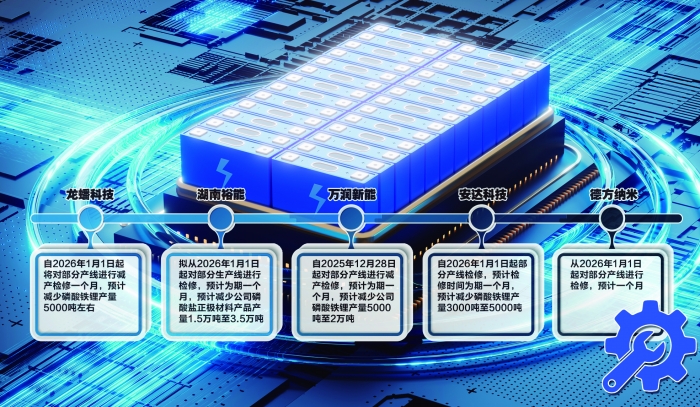
Core Viewpoint - The lithium iron phosphate (LFP) industry is facing significant operational pressure due to rising raw material costs and challenges in passing price increases to downstream battery manufacturers, leading to collective production cuts among major companies in the sector [2][4]. Group 1: Production Cuts - Five major LFP companies, including Wanrun New Energy and Hunan Youneng, announced production cuts scheduled for January 2026, with reductions ranging from 35% to 50% [2][3]. - Long-term contracts ("long orders") provide some market security for LFP companies, but challenges remain in transmitting raw material price increases [2][4]. - The collective production cuts are seen as a necessary measure to support pricing amid unfavorable market conditions [4][5]. Group 2: Market Dynamics - The average market price for LFP in November was 14,704.8 yuan per ton, while production costs ranged from 16,798.2 yuan to 17,216.3 yuan per ton, indicating a widening gap between costs and prices [5]. - Despite high demand and increased operational rates, most LFP companies are still operating at a loss, with only a few exceptions like Hunan Youneng and Fulian Precision [5][6]. - The industry is characterized as being in a "sandwich" position, squeezed by rising raw material costs and resistance from downstream customers to accept price hikes [2][5]. Group 3: Expansion Trends - A new wave of capacity expansion is emerging in the LFP sector, with companies like Ningde Times and Wanhua Chemical investing heavily in new production projects [7][8]. - Ningde Times' subsidiary, Bangpu Recycling, launched a new LFP project with an annual capacity of 450,000 tons, while Wanhua Chemical plans to build a 650,000-ton LFP project in Shandong [7][8]. - The influx of new entrants and expansion by existing players raises concerns about potential oversupply in the market, especially as the industry has not fully recovered from previous losses [7][8].