
储能需求增长

Search documents
锂电-碳酸锂产业链投资机会
2026-03-30 05:15
Summary of Key Points from Conference Call Records Industry Overview - The conference call discusses the lithium battery and lithium carbonate industry, highlighting significant investment opportunities and market dynamics for 2026 [1][2]. Core Insights and Arguments - **Lithium Demand Surge**: In Q1 2026, lithium demand is expected to explode, with overseas energy storage orders doubling and a significant increase in electric vehicle demand in Europe [1][2]. - **Electrolyte Segment**: The electrolyte segment is prioritized for investment due to successful price transmission and unit profit recovery, with EC prices rising nearly 40% in March, leading to a potential profit increase from hundreds to 1,500 yuan per ton [1][4]. - **Lithium Carbonate Price Dynamics**: The price of lithium carbonate is supported by Zimbabwe's export ban and diesel shortages in Australia, with expectations that prices could exceed 180,000-190,000 yuan per ton if the ban continues [1][6]. - **Phosphate Iron Lithium Cathodes**: Companies like Deyang Nano and Hunan Youneng are expected to benefit from rising lithium carbonate prices, with performance expectations strong despite production halts at Yongxing Materials [1][4]. - **Aluminum Supply Risks**: Middle Eastern conflicts pose risks to global aluminum supply, with Tianshan Aluminum achieving a profit of 7,000 yuan per ton in Q1, indicating high defensive value [1][13]. - **Gold Market Trends**: The gold sector is entering a third phase of trading stagnation, with valuations expected to be between 10-15 times in 2026, driven by demand from military and AI sectors [1][14]. - **Tantalum Market Opportunities**: The tantalum market shows a structural opportunity due to strong demand from military and AI sectors, with supply vulnerabilities in the Democratic Republic of Congo [1][15]. Additional Important Content - **Investment Priorities**: The electrolyte segment is highlighted as having the highest investment priority, with leading companies expected to show explosive earnings growth in 2026 [3][4]. - **Market Sentiment**: The market sentiment around lithium carbonate is shifting from supply concerns to recognizing consumer demand, which could lead to higher valuations and growth potential in the lithium sector [10]. - **Supply Chain Disruptions**: Recent disruptions in Zimbabwe and Australia are expected to significantly impact lithium carbonate supply, with potential price increases as a result [6][7]. - **Future Projections**: The second quarter of 2026 is expected to see continued price support due to high oil prices and increasing demand for new energy vehicles, with prices projected to stabilize around 150,000 yuan per ton [8][9]. - **Company-Specific Developments**: Yongxing Materials is in the process of changing its mining license, which could impact its production capacity and growth potential in the coming years [12][11]. This summary encapsulates the key points discussed in the conference call, providing insights into the lithium battery and related industries, along with potential investment opportunities and risks.
户储专家交流
2026-03-10 10:17
Summary of Key Points from the Conference Call Industry Overview - The energy storage industry is expected to experience explosive growth in overseas demand in 2026, with an overall growth rate of 30%-40%+. The U.S. large-scale storage is driven by AIDC (AI Data Center) integration, Europe by subsidies and energy independence, and the Middle East by energy transition and conflict impacts [2][4][9]. Core Insights and Arguments - **AIDC Integration Demand**: In the U.S., AIDC integration is projected to contribute an additional demand of 20-30 GWh in 2026, compared to a base of 50 GWh in 2025. The product premium is expected to be 10%-20% higher than traditional large-scale storage, with integration durations evolving towards 8 hours or more [2][12][14]. - **European Market Dynamics**: The inventory reduction in Europe is nearly complete as of 2025, with current levels at a normal three-month supply. Demand in Europe is expected to increase by 20%-30% year-on-year, driven by policies in Hungary and Australia [2][4][8]. - **Global Supply Chain Status**: The supply chain is operating at full capacity with slight upward pressure on battery cell and raw material prices. European policies require 30% of future production capacity to be localized, with leading domestic companies already establishing operations in Poland and Hungary [2][6][11]. - **Regional Competition**: The U.S. market has high entry barriers and longer certification cycles (approximately one year), with prices 20%-30% higher than in Europe. In contrast, the European market is dominated by Chinese brands, which offer significant cost advantages [2][5][13]. Additional Important Insights - **Impact of Natural Gas Prices**: The recent surge in overseas natural gas prices has led to increased demand for both household and large-scale storage, indicating a positive short-term impact on the renewable energy sector [4][9]. - **Subsidy Effects**: Subsidies and policies are positively influencing demand, particularly in Australia and Hungary, where significant incentives have been introduced [7][8]. - **Market Growth Projections**: The overall growth for 2026 is expected to be at least 30%-40%+, with the U.S. and Europe leading the charge. Emerging markets in Southeast Asia and India are also anticipated to see substantial growth, albeit from a smaller base [9][10]. - **Inventory Levels in Europe**: The inventory levels in Europe are currently at a normal state, having been reduced from a high of 6 months to 1 year during late 2023 to early 2024 [10][11]. - **AIDC Certification and Market Dynamics**: The certification process for AIDC integration is more complex and time-consuming than for household storage, with a significant focus on reliability and performance [12][13]. Conclusion The energy storage industry is poised for significant growth in 2026, driven by various regional dynamics and policy incentives. The U.S. and Europe are expected to lead in demand, while emerging markets also present substantial opportunities. The supply chain is currently under pressure but remains dynamic, with ongoing adjustments to meet the increasing demand.
锂-海外扰动再起-国内资源加大重视
2026-03-04 14:17
Summary of Key Points from Conference Call Records Industry Overview - The focus is on the lithium and nickel-cobalt sectors, with significant attention to supply chain dynamics and pricing trends in these markets. Key Insights and Arguments Lithium Market Dynamics - **Production and Consumption Trends**: In March, lithium carbonate production increased by over 20% month-on-month, significantly exceeding the seasonal average increase of 10%. Monthly consumption is estimated at approximately 130,000 to 140,000 tons, indicating a strong demand despite limited supply growth [1][3]. - **Supply Constraints**: The supply side remains tight, with Australian shipments showing a year-on-year decline. The output from overseas projects is not expected to materialize until the second half of Q2 [1][6]. - **Price Fluctuations**: Recent price movements for lithium carbonate have been driven more by market sentiment than fundamental changes. Prices surged from 130,000 CNY/ton to 180,000-190,000 CNY/ton, but concerns over regulatory risks and potential demand destruction have led to a pullback [2]. Nickel Market Insights - **Production Quotas vs. Actual Output**: Indonesia's nickel production target for 2026 is set at 210 million tons, which is lower than the previously stated quota of 260-270 million tons. This discrepancy highlights the difference between approved capacity and actual achievable output [9]. - **Market Demand and Supply Gap**: Even with the lower production target, there remains a significant demand-supply gap, with an estimated net demand of 310 million tons against the projected supply [9]. Cobalt Supply Challenges - **Export and Inspection Delays**: The cobalt export process from the Democratic Republic of Congo is hindered by complex inspection procedures, leading to a tight supply situation in the first half of 2026. Monthly demand is around 14,000 to 15,000 tons, while supply is severely constrained [10]. - **Price Potential**: Current cobalt prices are approximately 400,000 CNY/ton, significantly below historical highs, suggesting potential for price increases as supply tightens [10]. Policy and Regulatory Factors - **Zimbabwe's Export Policy**: Zimbabwe is expected to implement a ban on lithium ore exports starting January 2027, which could impact the global supply chain. Ongoing discussions among stakeholders may lead to a resolution, but uncertainty remains [7][8]. - **Middle East Tensions**: The geopolitical situation in the Middle East is affecting sentiment in the energy storage market, but actual demand has not disappeared; it is merely delayed [4]. Investment Opportunities - **Domestic Lithium Assets**: Companies like Yongxing Materials and Rongjie Co. are highlighted as potential investment opportunities due to their strong production outlook and financial health. Yongxing is expected to produce 30,000 tons in 2026, with a solid cash position [8]. - **Nickel-Cobalt Sector**: The interconnectedness of nickel and cobalt markets suggests that investments in companies like Huayou and Greenmead could be beneficial, given the supportive pricing environment [11]. Additional Important Points - **Energy Storage Demand**: The demand for energy storage is expected to grow as projects in the Northwest region commence operations and as capacity pricing regulations are implemented [5]. - **Market Sentiment and Speculation**: The market is currently experiencing volatility due to speculative trading and external geopolitical factors, which could influence future pricing trends [2][4]. This summary encapsulates the critical insights from the conference call records, focusing on the lithium and nickel-cobalt industries, their market dynamics, and potential investment opportunities.
未知机构:安克创新更新26年估值已接近历史下限分位水平冲突政策下欧洲储能需求有望-20260304
未知机构· 2026-03-04 03:05
Summary of Conference Call Notes Company Overview - The company discussed is Anker Innovations, focusing on its valuation and market dynamics in the energy storage sector. Key Points Industry and Market Dynamics - The energy storage demand in Europe is expected to exceed expectations due to ongoing conflicts and policy changes, indicating a potential growth year in 2026 for household energy storage [1][2] - Multiple countries in Europe and Australia have initiated subsidies for household energy storage devices, which may provide additional support from a policy perspective [3] Valuation Insights - Anker's current valuation for 2025 earnings is less than 19x, and for 2026 earnings, it is projected at 16x, which is below the historical lower limit of 16.6x [2] - The company has reached its valuation lower limit of 16-17x three times in the past five years, primarily due to tariff disturbances [1] Tariff and Regulatory Factors - Recent improvements in U.S. tariff factors have been noted, with an effective tariff rate decreasing by approximately 5 percentage points, which reduces the risk premium on valuation [2] - The tariff situation is characterized as a "slight step down in high tariff structure" and a shift in regulatory tools, which may stabilize valuation risks [2] Long-term Growth Potential - Anker's direct exports to the U.S. have significantly decreased to 45%, and with a global production layout, the impact of tariffs on valuation is expected to diminish further [2] - The company is positioned to benefit from the growth in energy storage demand as a leading player in the solar storage market, despite previous performance being affected by high industry benchmarks and competition [4] Future Outlook - The company is advised to be monitored for potential dual growth opportunities in 2026, driven by both tariff improvements and increased energy storage demand [1]
国泰海通:青海储能容量电价出台 2026年储能需求高增可期
Zhi Tong Cai Jing· 2026-02-27 05:57
Core Insights - Qinghai Province has introduced the first capacity price for energy storage following the implementation of Document No. 114, signaling a positive outlook for the energy storage sector as more provinces are expected to release their detailed regulations, leading to a nationwide economic viability by 2026 [1][2] Group 1: Capacity Pricing Mechanism - The capacity price mechanism in Qinghai compensates power generation systems based on their contribution, applicable to compliant coal, gas, and certain solar power plants, as well as independent energy storage stations [2] - The capacity fee calculation method is defined as: Capacity fee = declared capacity × supply-demand coefficient × compensation standard, with the 2026 compensation standard set at 165 RMB/(kW·year) [3] - The annual compensation price for a 4-hour energy storage station is calculated to be 153.77 RMB/(kW·year), indicating a favorable economic environment for energy storage systems [3] Group 2: Energy Storage Demand Growth - In January, the newly installed capacity reached 3.8 GW/10.9 GWh, representing a year-on-year increase of 62% and 106%, respectively, indicating strong demand for energy storage [4] - The sales of energy storage batteries in January amounted to 46.1 GWh, reflecting a year-on-year growth of 164.0%, further underscoring the robust demand in the sector [4] - The company anticipates a strong increase in energy storage demand, projecting a global growth rate of 50% in 2026, driven by the implementation of national capacity pricing [4]

磷酸铁需求高增助力磷产业链景气
HTSC· 2026-02-12 02:20
Investment Rating - The report maintains an "Overweight" rating for the basic chemical industry, indicating an expectation that the industry stock index will outperform the benchmark [2]. Core Insights - The demand for iron phosphate is expected to continue growing due to rapid increases in energy storage needs and ongoing expansions in downstream lithium iron phosphate production. This growth is anticipated to improve profitability for domestic iron phosphate companies as operating rates increase [4][6]. - The price of iron phosphate has entered an upward trend since the second half of 2025, driven by rising raw material costs such as ferrous sulfate and phosphoric acid, alongside increased demand from energy storage [5]. - The report highlights that companies utilizing the iron method for production will benefit significantly from the declining prices of iron powder, leading to expanded profit margins [5]. Summary by Sections Demand and Supply Dynamics - Domestic iron phosphate production capacity reached 4.82 million tons in 2025, a year-on-year increase of 5.7%, with production estimated at 2.96 million tons, up 56% year-on-year. The demand for lithium iron phosphate is projected to grow to 5.95 million tons in 2026 and 7.67 million tons in 2027, reflecting increases of 49% and 29% respectively [4]. - New production capacities for iron phosphate are planned at 1.88 million tons and 2.58 million tons for 2026 and 2027 respectively, indicating a positive outlook for terminal demand [4]. Price Trends and Cost Factors - As of February 6, 2026, the price of iron phosphate was reported at 11,630 CNY per ton, an 11% increase from the low of 10,500 CNY per ton in September 2025. This price increase is attributed to both rising storage demand and higher raw material costs [5]. - The production methods for iron phosphate include ammonium method, sodium method, and iron method, with the iron method expected to benefit more from the current market conditions due to its lower reliance on expensive raw materials [5]. Industry Outlook - The report anticipates that the growth in iron phosphate demand will positively impact the entire phosphate industry chain, particularly for upstream products like phosphate rock, yellow phosphorus, phosphoric acid, and industrial monoammonium phosphate, which are constrained by high energy consumption and resource attributes [6]. - Companies with integrated phosphate rock resources are expected to benefit significantly from the improving market conditions as new supply is limited by policy constraints [6].
广发证券:预计2025-2027年国内储能需求达154/254/337GWh
Xin Lang Cai Jing· 2026-01-15 23:24
Domestic Market - The capacity pricing mechanism is expected to be implemented in multiple provinces, marking a turning point for the economic viability of energy storage [1] - In regions like Inner Mongolia, Gansu, and Ningxia, stable supporting policies for energy storage are anticipated, with Gansu's independent energy storage IRR capital expected to reach 9.9% [1] - Domestic energy storage demand is projected to reach 154 GWh, 254 GWh, and 337 GWh in 2025, 2026, and 2027 respectively, representing year-on-year growth of 40.2%, 65.2%, and 32.5% [1] International Market - In the United States, the construction of data centers is driving rapid growth in energy storage demand, with 2025 being identified as the "demand year" for AIDC [1] - An additional 13 GW of data centers in the U.S. is expected to generate 10.7 to 25 GWh of energy storage demand in 2026 [1] - In Europe, there is a pressing need for flexible resources, improved business models, and a shift in subsidies, leading to a noticeable acceleration in large-scale energy storage development [1] Global Outlook - The global energy storage market is expected to see new installations of approximately 279 GWh, 423 GWh, and 563 GWh from 2025 to 2027, with year-on-year growth rates of 44%, 52%, and 33% respectively [1] - The recent large-scale power outages in Europe have created new demands for grid-connected energy storage, which may optimize the competitive landscape [1]

碳酸锂期货价创两年来新高后回调超3%
Mei Ri Jing Ji Xin Wen· 2026-01-15 13:35
Group 1 - The core point of the article highlights the volatility in lithium carbonate futures prices, which reached a two-year high before experiencing a pullback, with the main contract closing at 161,900 yuan/ton, down 3.53% [1][2] - The price fluctuations are attributed to strong demand from leading lithium companies, while industry experts suggest that short-term supply-demand mismatches are the primary reason for price increases, making sustained price hikes difficult [1][3] - In 2025, lithium carbonate prices saw a significant rebound after hitting a low of 59,000 yuan/ton in June, climbing to a peak of 134,500 yuan/ton by December, and further rising to 174,100 yuan/ton in early 2026 [2][3] Group 2 - The production cost of lithium iron phosphate (LFP) materials has increased due to rising lithium carbonate prices, with estimates indicating that a 10,000 yuan/ton increase in lithium carbonate raises LFP production costs by 2,550 yuan/ton [4][5] - Major LFP companies are accelerating production expansion to capture market share in response to future demand growth, with significant investments planned for new production capacity [4][5] - The competition in the overseas market is intensifying, particularly with South Korean companies expected to launch substantial LFP battery projects in the U.S., potentially increasing pressure on Chinese exports [5] Group 3 - The cost pressures from rising lithium carbonate prices are impacting energy storage projects, with projections indicating that energy storage demand could continue to grow significantly, becoming a second growth driver for lithium demand [6][7] - The recent adjustments in export tax policies for battery products may have contributed to the short-term price increases of lithium carbonate, although the long-term trend remains uncertain [6][7] - The rising costs of core materials, including lithium carbonate, are expected to affect the overall cost structure of energy storage systems, with estimates suggesting that a 10% increase in battery costs could lead to a 3% rise in EPC costs and a decrease in internal rate of return [7]
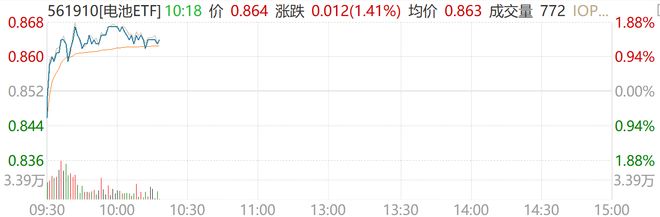
固态电池迎来0-1产业趋势,储能需求刚性提升,电池ETF(561910)盘中上涨1.41%
Jin Rong Jie· 2026-01-15 02:53
Core Viewpoint - The battery sector is experiencing fluctuations, with solid-state battery and energy storage technologies gaining attention due to their potential growth and investment opportunities [1][3][4]. Group 1: Market Performance - On January 15, major indices declined, while the lithium battery sector showed signs of recovery, particularly in solid-state battery stocks [1]. - The Battery ETF (561910) has a solid-state battery content of 45% and energy storage content of 56%, showing an increase of 1.41% [1][7]. - Key stocks such as Zhongwei New Materials surged over 9%, while others like Xiamen Tungsten and Peking University Materials rose over 4% [1]. Group 2: Industry Trends - The demand for energy storage is being driven by the construction of self-built power plants by data centers in the U.S., with EIA data indicating a projected 23% increase in average wholesale electricity prices by 2025 [3]. - The solid-state battery industry is advancing, with a focus on overcoming technological challenges and achieving mass production by 2026 [4]. - NASA's recent report highlights the development of high-performance solid-state batteries for use in space missions by 2028, indicating significant advancements in this technology [3]. Group 3: Investment Insights - Tianfeng Securities emphasizes the importance of solid-state battery technology, predicting that 2026 will see a focus on production line construction and supply chain establishment [4]. - The projected demand for power and energy storage batteries is expected to reach 1,872 GWh and 2,236 GWh in 2025 and 2026, respectively, marking year-on-year increases of 45% and 25% [5]. - The solid-state battery competition is primarily concentrated in China, Japan, South Korea, and the U.S., with small-scale production expected to begin in these regions within the next two years [4].

储能需求高增,锂电材料迎供需改善与盈利修复共振
ZHONGTAI SECURITIES· 2026-01-09 12:14
Investment Rating - The report indicates a positive outlook for the energy storage and lithium battery materials industry, highlighting significant growth potential and recovery in profitability [2]. Core Insights - The energy storage battery segment is expected to lead market growth, with global shipments projected to reach 874 GWh by 2026, representing a 46% year-on-year increase. The demand for lithium iron phosphate batteries is anticipated to strengthen, increasing its market share to 82% [3][18]. - The supply-demand dynamics for key lithium battery materials are set to improve overall, with lithium hexafluorophosphate and separators experiencing a clear recovery in supply-demand balance, while lithium iron phosphate and related materials are in a mild recovery phase [4][52]. - The lithium carbonate industry is projected to reach a critical supply-demand inflection point by 2027-2028, with demand expected to grow at a compound annual growth rate of 18% from 2025 to 2028 [8]. - The solid-state battery materials sector is entering a phase of technological breakthroughs, with significant advancements expected in commercial viability and material innovation [9]. Summary by Sections Downstream Battery Segment - Energy storage batteries are projected to be the main growth driver, with global shipments expected to reach 874 GWh in 2026, a 46% increase year-on-year. The source-side energy storage is anticipated to contribute significantly to this growth [3][10]. - The total shipments of power and energy storage batteries are expected to reach 2313 GWh by 2026, reflecting a 25% year-on-year growth [18]. Key Lithium Battery Materials - The supply-demand balance for lithium hexafluorophosphate is expected to improve, with prices projected to rise due to increased demand and supply constraints [4][25]. - The separator industry is transitioning from oversupply to a tight balance, with demand growth expected to outpace supply growth significantly [4][52]. Lithium Carbonate Industry - Global lithium carbonate demand is projected to reach 188,000 tons LCE by 2026, with a significant drop in supply growth anticipated in 2027 [8]. Solid-State Battery Materials - The solid-state battery sector is expected to see breakthroughs in technology, with a focus on addressing key engineering challenges for commercialization [9]. Phosphate Mining and Lithium Iron Phosphate - The phosphate mining sector is expected to maintain high demand, driven by both traditional agricultural needs and new energy applications, with a projected increase in demand for phosphate rock [7][60].