神经计算

Search documents
万物皆计算:重塑人类未来的五大底层逻辑
腾讯研究院· 2026-03-13 07:33
Core Viewpoint - Humanity is undergoing a paradigm revolution, particularly in the realm of artificial intelligence (AI), which is reshaping our understanding of intelligence and computation [5][7]. Group 1: Paradigm Shifts in AI - The article outlines five interconnected paradigm shifts that are influencing AI development: 1. Natural Computing: Recognizes computation as a natural phenomenon, which can drive innovations in computer science and AI [6]. 2. Neural Computing: Aims to reconstruct AI systems to mimic the brain's mechanisms, enhancing AI efficiency and unlocking its potential [6]. 3. Predictive Intelligence: Highlights that the essence of intelligence lies in evolving knowledge and statistical modeling of the future, suggesting that AI will continuously evolve like humans [10]. 4. General Intelligence: Suggests that AI capabilities are already comprehensive, capable of handling diverse cognitive tasks, indicating that "Artificial General Intelligence" (AGI) may already be here [10]. 5. Collective Intelligence: Emphasizes that intelligence is inherently social and can be enhanced through collaboration among multiple intelligent agents [10]. Group 2: Historical Context and Theoretical Foundations - The article discusses the historical context of computer science, tracing its roots back to the Turing machine and the early development of electronic computers like ENIAC, which laid the groundwork for modern computing [11][12]. - It also references John von Neumann's insights into the relationship between computation and biology, suggesting that life itself is fundamentally computational [14][17]. Group 3: Advances in AI and Machine Learning - The emergence of large language models (LLMs) has demonstrated that AI can achieve remarkable general intelligence through simple predictive tasks, challenging traditional views on intelligence [36][38]. - The article posits that LLMs can learn a wide variety of algorithms, surpassing the totality of algorithms discovered by computer scientists [36]. Group 4: Future Directions in AI - The future of AI is expected to involve a shift towards neural computing paradigms that may utilize new substrates such as photonic, biological, or quantum systems, moving away from traditional silicon-based architectures [34][35]. - The article suggests that AI models will evolve into self-constructing systems that learn dynamically from experience, rather than being static with fixed parameters [40].



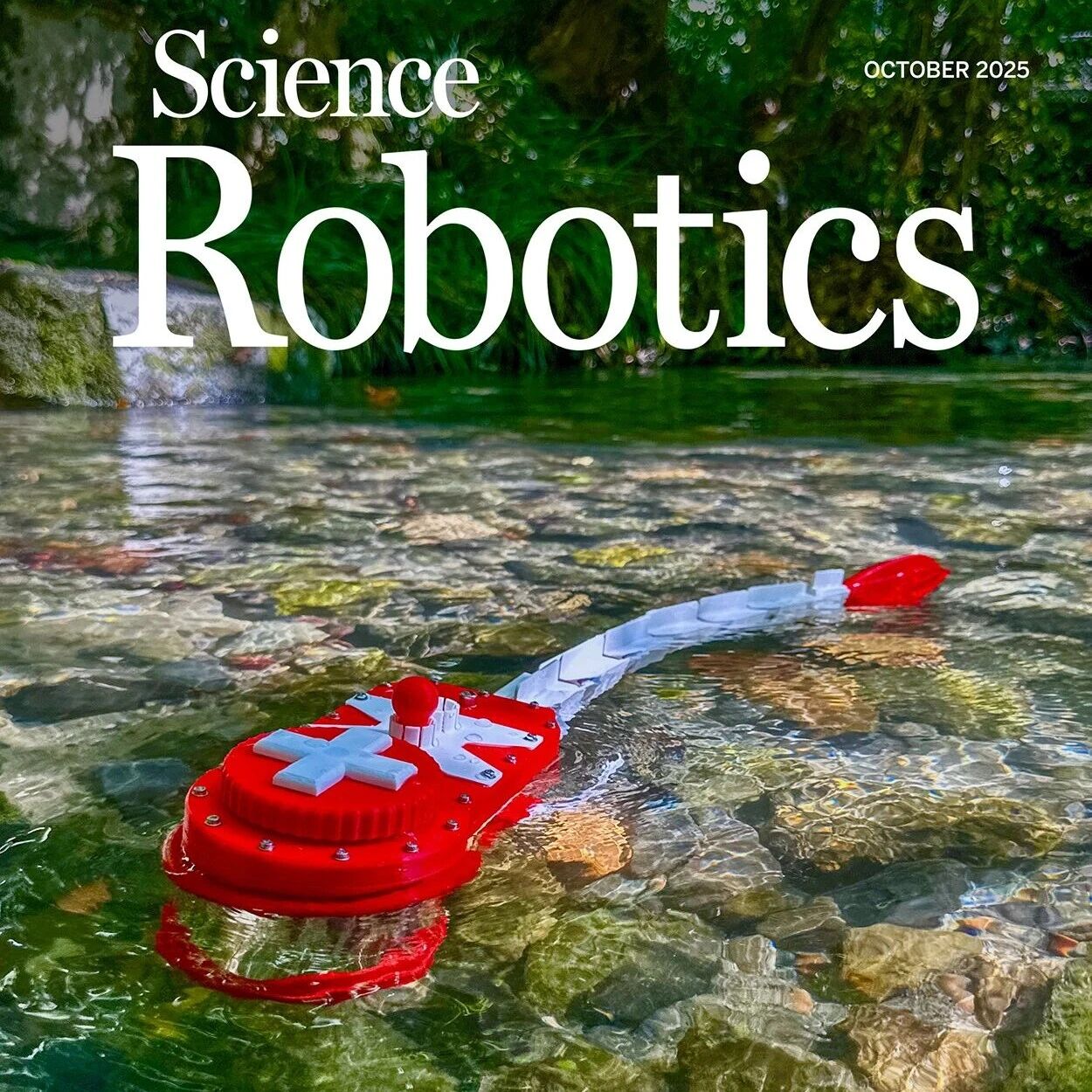
Sci.Rob.最新封面!EPFL造出复现斑马鱼视动反应的仿生机器鱼
机器人大讲堂· 2025-10-16 11:59
Core Insights - The research from EPFL and Duke University has successfully created a robotic fish capable of swimming in real rivers, showcasing advancements in understanding neural computation processes related to visual-motor responses [1][5][24]. Group 1: Research Breakthroughs - The study simulated the visual-motor neural circuits of zebrafish, leading to the development of a virtual simulation system named simZFish, which was validated on a physical robot called ZBot [3][6]. - The system demonstrated the ability to navigate autonomously in the Chamberonne River, indicating its generalization capability from laboratory to real-world environments [5][22]. - A complete neural pathway from the retina to the spinal cord was constructed, allowing for real-time sensory-motor closed-loop control at a frequency of 1000Hz [8][9]. Group 2: Optical and Neural Discoveries - The research revealed significant findings regarding the optical properties of fish eyes, showing that different focal lengths significantly affect neural activity and behavioral performance [10]. - The study identified a specific retinal connection pattern that enhances the zebrafish's optomotor response, driven primarily by the posterior ventral visual field [12][13]. Group 3: Robotic Implementation - The physical robot ZBot, measuring 80 cm and weighing 2.7 kg, retained key features of zebrafish, including dual cameras and a similar neural control network [16][22]. - In tests, ZBot maintained its position in flowing water for 57% longer than when its visual system was disabled, demonstrating the effectiveness of the neural network in real-world conditions [22]. Group 4: Future Implications - The research not only enhances understanding of brain-behavior control but also provides a blueprint for designing next-generation intelligent robots, emphasizing the power of an integrated approach combining simulation, behavioral observation, and robotic testing [24].