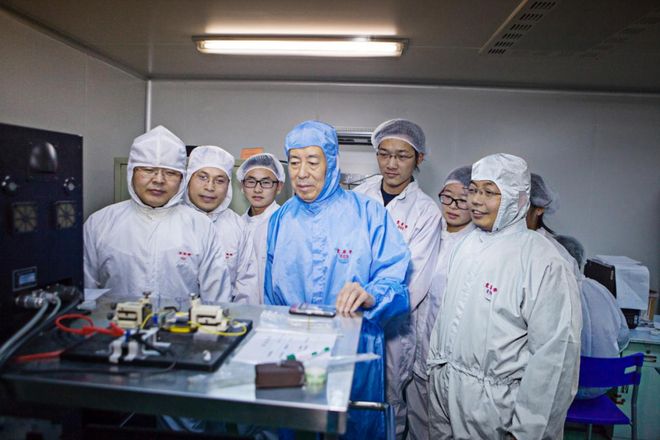
离子注入诱导成核技术

Search documents
我国攻克半导体材料世界难题
中国基金报· 2026-01-17 04:22
Core Viewpoint - The article discusses a breakthrough in semiconductor manufacturing that addresses the thermal conductivity issues caused by "island-like" structures between material layers, which have been a significant bottleneck for device performance improvement [2]. Group 1 - The research team from Xi'an University of Electronic Science and Technology, led by Academician Hao Yue and Professor Zhang Jincheng, has successfully transformed rough "island" interfaces into atomically smooth "films," significantly enhancing chip heat dissipation efficiency and device performance [2]. - This innovative achievement provides a "Chinese paradigm" for high-quality integration of semiconductor materials and has been published in prestigious journals such as Nature Communications and Science Advances [2]. - The traditional semiconductor chip's crystal nucleation layer has a rough surface that severely impacts heat dissipation, leading to "thermal bottlenecks" that can degrade chip performance or even damage devices [5]. Group 2 - The team pioneered the "ion implantation-induced nucleation" technology, which converts the random growth process into a precise and controllable uniform growth, resulting in a new structural interface thermal resistance that is only one-third of the traditional value [5]. - The GaN microwave power devices fabricated using this technology achieved output power densities of 42 watts/mm in the X-band and 20 watts/mm in the Ka-band, improving international records by 30%-40% [5]. - This advancement implies that, for the same chip area, detection distances can be significantly increased, and communication base stations can cover greater distances while being more energy-efficient [5].

性能突破性提升!我国攻克半导体材料世界难题
Huan Qiu Wang Zi Xun· 2026-01-16 12:40
Core Viewpoint - The research team from Xi'an University of Electronic Science and Technology has developed a breakthrough technology that transforms rough "island" interfaces in chip manufacturing into atomically smooth "films," significantly enhancing heat dissipation efficiency and device performance [1][3]. Group 1: Technological Breakthrough - The traditional semiconductor chip's crystal nucleation layer has uneven surfaces, which severely affects heat dissipation [3]. - The newly developed "ion implantation induced nucleation" technology allows for precise and controllable uniform growth, addressing a long-standing issue in the industry since the related nucleation technology won the Nobel Prize in 2014 [3]. - The new structural interface exhibits thermal resistance that is only one-third of that of traditional methods [3]. Group 2: Performance Improvements - Gallium nitride microwave power devices produced using this technology achieve output power densities of 42 watts/mm in the X-band and 20 watts/mm in the Ka-band, improving international records by 30% to 40% [3]. - This advancement implies that the same chip area can significantly increase detection range, allowing communication base stations to cover greater distances while being more energy-efficient [3].