科林格里奇困境

Search documents
构建生成式人工智能的安全治理新机制
Xin Hua Ri Bao· 2026-01-26 21:42
Group 1 - Generative artificial intelligence (AI) is deeply integrated into various sectors such as government information processing and media content creation, becoming a core support for the development of new productive forces [1] - The 20th Central Committee's Fourth Plenary Session emphasizes the importance of strengthening national security capabilities in emerging fields like AI, highlighting the significance of digital technologies in national security [1] - The traditional approach of "develop first, govern later" may lead to unmanageable risks and missed opportunities in global AI competition, necessitating a governance mechanism that balances resilient defense and innovation [1] Group 2 - The assessment of national security risks associated with generative AI reveals multi-dimensional and cross-sectoral challenges, particularly in political, economic, and social security [2] - In the political security domain, generative AI poses real threats through the industrialized production of false information and the subtle erosion of cultural values, with low barriers for generating misleading content [2] - Economic security concerns include job displacement due to AI and reliance on imported high-end CPUs and GPUs, which poses risks to the AI industry's supply chain and technological sovereignty [3] Group 3 - Social security risks are highlighted by AI-related fraud and privacy breaches, with AI technologies enabling new forms of crime and the potential leakage of sensitive data from large models [3] - A comprehensive governance framework for generative AI should be guided by an overall national security perspective, integrating various aspects such as ideology, social order, and cultural heritage into risk assessments [4] - The governance mechanism should focus on clear responsibilities among government, enterprises, and the public, promoting collaboration and enhancing safety awareness [6] Group 4 - The governance approach should move away from unilateral administrative regulation to a model that encourages technological solutions and industry-driven governance [6] - Legal frameworks must be established to address the unique challenges posed by generative AI, including copyright issues and specific regulations for high-risk scenarios [7] - Ethical guidelines should be practical and enforceable, with companies required to conduct risk assessments and establish ethics review committees for AI applications [7]
智能体调查:七成担忧AI幻觉与数据泄露,过半不知数据权限
2 1 Shi Ji Jing Ji Bao Dao· 2025-07-02 00:59
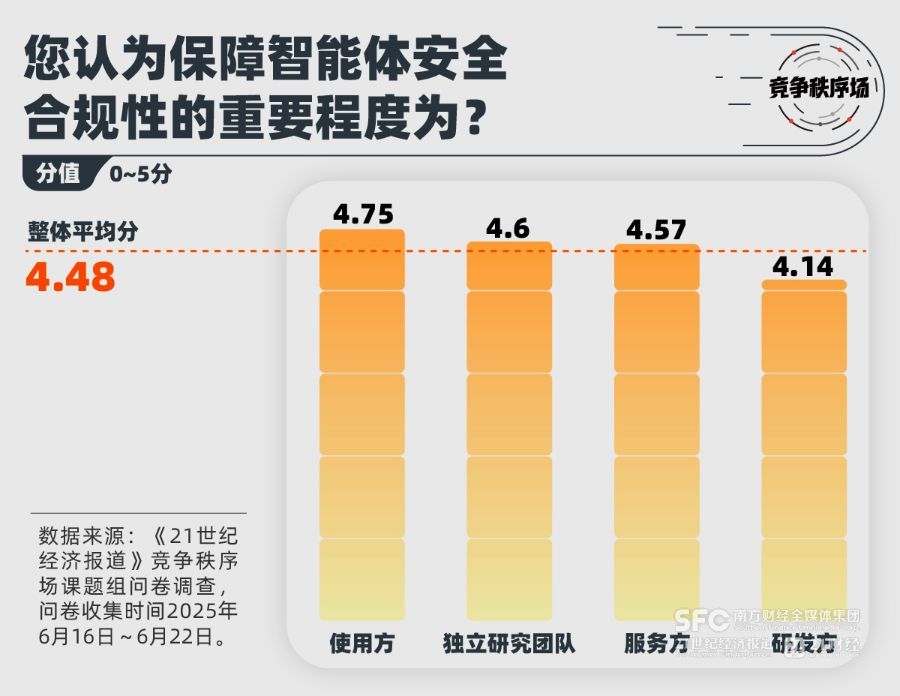
Core Viewpoint - The year 2025 is anticipated to be the "Year of Intelligent Agents," marking a paradigm shift in AI development from "I say AI responds" to "I say AI acts," with intelligent agents becoming a crucial commercial anchor and the next generation of human-computer interaction [1] Group 1: Importance of Safety and Compliance - 67.4% of industry respondents consider the safety and compliance issues of intelligent agents to be "very important," but it does not rank in the top three priorities [2][7] - The majority of respondents (70%) express concerns about AI hallucinations, erroneous decisions, and data leakage [3] - 58% of users do not fully understand the permissions and data access capabilities of intelligent agents [4] Group 2: Current State of Safety and Compliance - 60% of respondents deny that their companies have experienced any significant safety compliance incidents related to intelligent agents, while 40% are unwilling to disclose such information [5][19] - The survey indicates that while safety is deemed important, the immediate focus is on enhancing task stability and quality (67.4%), exploring application scenarios (60.5%), and improving foundational model capabilities (51.2%) [11] Group 3: Industry Perspectives on Safety - There is no consensus on whether the industry is adequately addressing safety and compliance, with 48.8% believing there is some attention but insufficient investment, and 34.9% feeling there is a lack of effective focus [9] - The majority of respondents (62.8%) believe that the complexity and novelty of intelligent agent risks pose the greatest challenge to governance [16][19] - 51% of respondents report that their companies lack a clear safety officer for intelligent agents, and only 3% have a dedicated compliance team [23] Group 4: Concerns and Consequences of Safety Incidents - The most significant concerns regarding potential safety incidents include user data leakage (81.4%) and unauthorized operations leading to business losses (53.49%) [15][16] - Different industry roles have varying concerns, with users and service providers primarily worried about data leakage, while developers are more concerned about regulatory investigations [16]