税收调节

Search documents
居民钱袋子如何更鼓,全国政协委员尹艳林:加快制定实施增收计划
21世纪经济报道· 2026-03-11 06:46
Core Viewpoint - The article emphasizes the importance of increasing residents' income as a core aspect of improving people's livelihoods and stabilizing the economy, highlighting the government's commitment to implementing a rural and urban residents' income increase plan [1]. Group 1: Promoting Income Growth for Low-Income Groups - The primary task of the "Urban and Rural Residents' Income Increase Plan" is to promote income growth for low-income groups, which includes improving the minimum wage adjustment mechanism and ensuring a balance between national guidance and regional differences [3]. - The government plans to increase the monthly minimum standard for basic pensions by 20 yuan and the per capita financial subsidy for residents' medical insurance by 24 yuan, directly benefiting urban and rural residents [4]. - Support for key groups such as those at risk of falling back into poverty and returning migrant workers will be enhanced, with a budget of 35.5 billion yuan allocated for labor-based projects by 2025 [5]. Group 2: Increasing Property Income - The second task of the income increase plan focuses on enhancing residents' property income, which includes encouraging listed companies to engage in cash dividends and share buybacks [7]. - Policies to revitalize rural resources, such as land and housing, are seen as crucial for increasing farmers' property income, with an emphasis on promoting equal exchange and flow of urban and rural factors [7]. - Improving the salary system is highlighted as a long-term guarantee for income growth, with suggestions to adjust the personal income tax threshold and explore family-based taxation [8]. Group 3: Social Security and Welfare Measures - Enhancements to the social security system are vital for increasing income, including raising the minimum standard for basic pensions and medical subsidies, as well as implementing subsidies for elderly care services [8]. - The government has initiated a childcare subsidy program, with over 33 million infants benefiting and total financial input exceeding 100 billion yuan, which is expected to alleviate family burdens and increase disposable income [8]. - Strengthening the financial capacity of local governments to ensure timely salary payments for grassroots workers is also crucial for increasing actual income [9].


完善直接税体系 更好发挥税收调节作用
2 1 Shi Ji Jing Ji Bao Dao· 2026-01-15 23:38
Core Viewpoint - The Chinese government aims to improve the local tax and direct tax systems as part of the "14th Five-Year Plan," emphasizing the need for a comprehensive reform to enhance the tax structure and promote economic and social development [1][13]. Summary by Sections Current Status of China's Direct Tax System - Direct taxes in China primarily include income taxes and property taxes, such as personal income tax, urban land use tax, and vehicle and vessel tax [2][14]. - Some taxes, like property tax, have characteristics of both direct and indirect taxes, complicating the classification [3][15]. - The current direct tax system includes 13 types of taxes, with local taxes making up a significant portion, yet the revenue from these taxes is relatively low, totaling over 800 billion yuan in 2024, which is less than half of the national tax revenue [4][16]. Recent Progress in Direct Tax System Improvement - Significant advancements have been made since 2013, including the abolition of certain taxes and the introduction of the environmental protection tax in 2018 [6][18]. - By 2024, direct tax revenue increased from 61,225.9 billion yuan in 2012 to 81,462.6 billion yuan, marking a 33.1% growth, although the proportion of direct taxes in total tax revenue decreased from 60.9% to 46.5% [7][19]. Proposed Measures for Further Improvement - The government may consider simplifying the tax system by integrating various taxes and ensuring a more rational tax burden [8][20]. - There is a need to enhance the legal framework for taxes, particularly for property tax and personal income tax, to ensure effective implementation and compliance [9][21]. - Suggestions include adjusting corporate and personal income tax structures, such as lowering the corporate tax rate from 25% to around 20% and revising personal income tax brackets and deductions [10][22]. - Expanding the scope of direct taxes by merging certain fees and taxes could significantly increase direct tax revenue, potentially raising the proportion of direct taxes in total revenue to 64.5% by 2024 [11][23]. Conclusion - The ongoing efforts to refine China's direct tax system are crucial for enhancing fiscal capacity and ensuring equitable tax distribution, which will support broader economic and social objectives [12][24].
21评论丨完善直接税体系,更好发挥税收调节作用
2 1 Shi Ji Jing Ji Bao Dao· 2026-01-15 23:13
Group 1 - The core viewpoint of the articles emphasizes the need to improve China's direct tax system as part of the broader economic and fiscal reforms outlined in the "14th Five-Year Plan" [1][12] - The current direct tax system in China primarily includes income taxes and property taxes, with a significant portion being local taxes [2][4] - The existing issues within the direct tax system include a high number of tax types, particularly local taxes, and a relatively low income scale from these taxes, which hampers government revenue and the redistributive function of direct taxes [4][5] Group 2 - Recent progress in improving the direct tax system includes the abolition of certain taxes and the introduction of new ones, such as the environmental protection tax, which reflects a shift towards more sustainable fiscal policies [5][6] - The reform of the personal income tax system in 2018 marked a significant change, transitioning to a combined assessment model that aligns with international practices [7][8] - Proposed measures for further improvement include simplifying tax types, enhancing the legal framework for tax laws, and considering pilot programs for new tax implementations [8][9] Group 3 - Specific recommendations for enhancing the direct tax system involve adjusting tax rates and deductions for corporate and personal income taxes to ensure fairness and efficiency [10][11] - The potential expansion of direct taxes could include merging certain local fees into direct tax categories, which would increase the overall share of direct taxes in total tax revenue [11][12] - Overall, the goal of these reforms is to create a more equitable and efficient tax system that supports economic and social development in China [12]
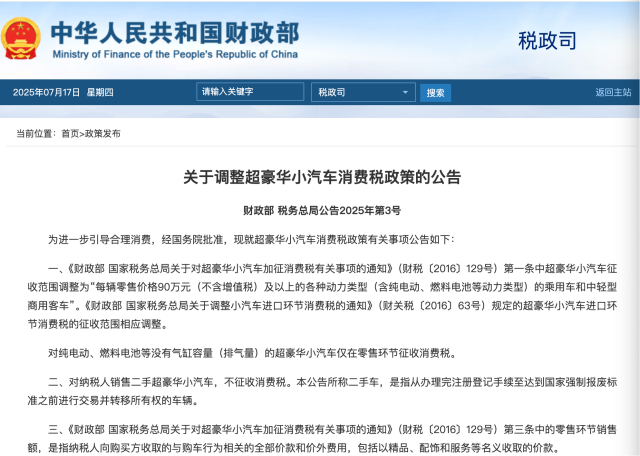
都市车界|买豪车要“加价”了?超豪华车消费税大调整:90万元成新门槛,电动车不再“例外”
Qi Lu Wan Bao· 2025-07-18 02:38
Core Viewpoint - The adjustment of the consumption tax policy for ultra-luxury cars aims to refine consumption guidance and align tax policies with the automotive industry's transition towards electrification and intelligence [2][7] Tax Policy Changes - The starting point for the consumption tax on ultra-luxury cars has been significantly lowered from 1.3 million yuan to 900,000 yuan, effective from July 20, 2025 [1][2] - The new policy covers all types of passenger cars and light commercial vehicles, including electric and fuel cell vehicles, while exempting second-hand ultra-luxury cars from consumption tax [1][2] Consumer Behavior Impact - The new tax policy increases the cost of purchasing ultra-luxury vehicles, leading potential buyers to reconsider their purchasing decisions [3][4] - There is a noticeable increase in consumer inquiries about the policy, indicating a rush to purchase before the new tax takes effect [4] Manufacturer Response - Luxury car manufacturers are facing direct impacts on their product strategies and pricing due to the new tax threshold of 900,000 yuan [4][5] - Brands are likely to adjust their product configurations and pricing strategies to remain competitive, with some considering offering more localized options or flexible packages [5][6] Market Dynamics - The luxury car market is expected to undergo structural changes, with the 800,000 to 900,000 yuan price range becoming a new battleground for high-end and entry-level ultra-luxury models [6][7] - The reduction in transaction costs for second-hand ultra-luxury cars is anticipated to enhance market liquidity and attract more players into the high-end used car market [6][7] Long-term Industry Implications - The policy adjustment is seen as a move towards more refined tax regulation in the context of national goals for carbon neutrality and common prosperity, pushing manufacturers to focus on genuine innovation and user experience rather than merely increasing product features [7]