税收返还

Search documents
'Americans Are Eager for a New Year's Reset.' Nearly Half of Adults' Finances Worsened in 2025 But Tax Season May Offer a Lifeline, Survey Says
Yahoo Finance· 2026-01-11 15:32
Core Insights - Nearly half of U.S. adults experienced financial difficulties in 2025, primarily due to unexpected expenses and decreased credit scores, according to an Intuit Credit Karma survey [1] - The upcoming tax season is expected to provide relief for struggling homeowners, with many filers anticipating increased refunds or lower balances due, potentially by as much as $1,000 [2][3] Financial Hardships - The most common reasons for financial struggles included unexpected expenses, decreased credit scores, missed payments on mortgages and credit cards, and inability to afford necessities like groceries [1] - 38% of respondents identified not saving enough money as their top financial regret over the past year [5] Tax Refund Expectations - Many filers are eager to submit their tax returns early to receive refunds sooner, with a little less than half planning to do so [3][4] - Tax expert Lisa Greene-Lewis noted that for many households, tax refunds represent the largest check they will receive all year [4] Financial Goals and Regrets - Approximately two-thirds of survey respondents have set clear financial goals for 2026 and aim to change their spending habits [5] - Common financial regrets include impulse purchases (34%), not saving money (33%), and overspending on non-essentials (31%) [7][8][9]
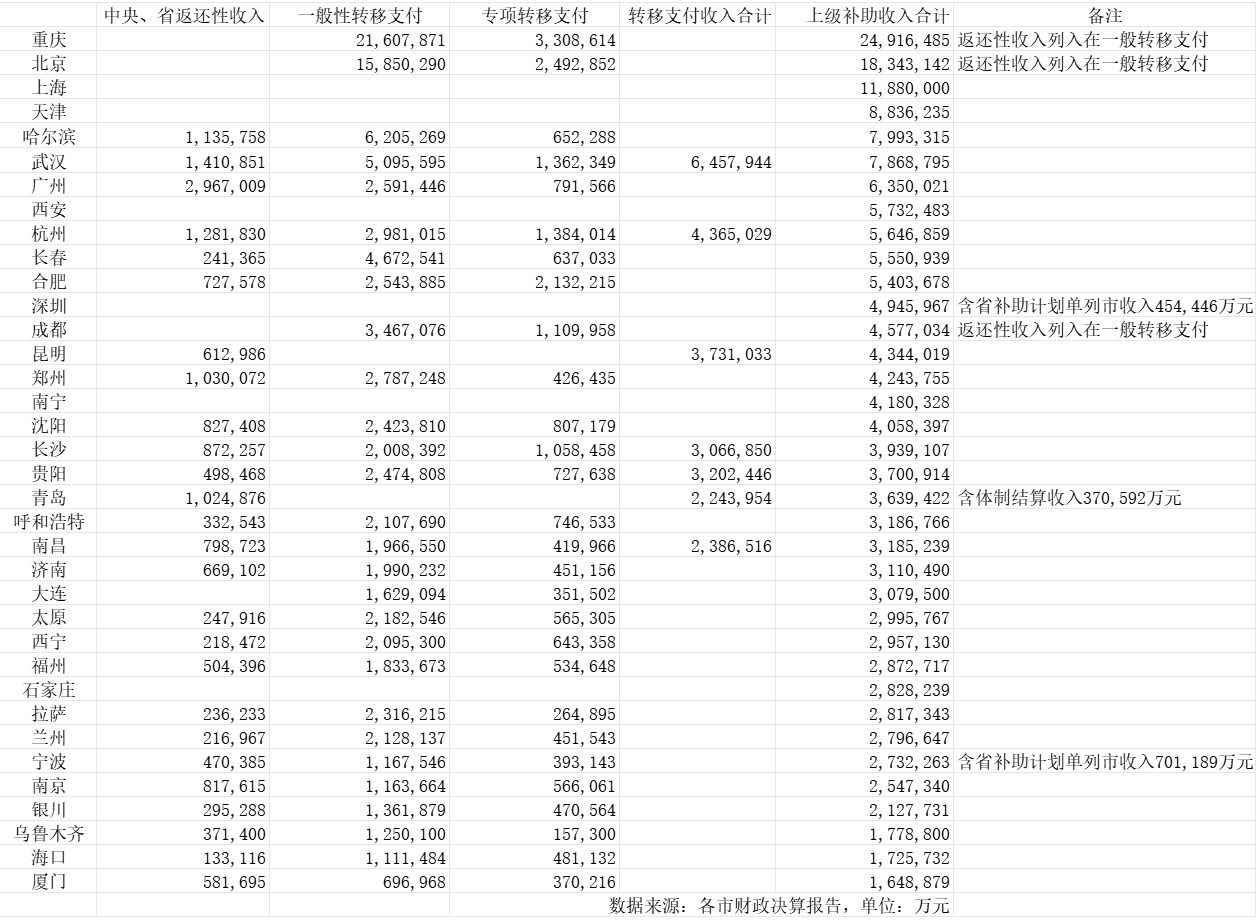
中国36个主要城市转移支付收入出炉,哪些城市获得财政支持多
Di Yi Cai Jing· 2025-11-30 22:20
Core Insights - The article discusses the fiscal support provided by central and local governments to major cities in China, specifically focusing on four direct-controlled municipalities, 27 provincial capitals, and five separately planned cities, analyzing their financial data for 2024 [2][5]. Fiscal Support Analysis - The total transfer payments received by the four direct-controlled municipalities significantly exceed those of other cities, with Chongqing leading at 2491.65 billion, followed by Beijing at 1834.31 billion, Shanghai at 1188 billion, and Tianjin at 883.62 billion [5][6]. - Seven cities received over 500 billion in upper-level subsidies, with Harbin, Wuhan, Guangzhou, Xi'an, Hangzhou, Changchun, and Hefei receiving 799.33 billion, 786.88 billion, 635 billion, 573.25 billion, 564.69 billion, 555.09 billion, and 540.37 billion respectively [7]. - The structure of transfer payments varies among cities, with Harbin, Wuhan, and Changchun relying heavily on general transfer payments, while Guangzhou received the most from tax refunds, indicating a stronger incentive for economically developed areas [7]. Transfer Payment Categories - The transfer payment system includes general and special transfer payments aimed at addressing fiscal imbalances and promoting equal access to public services [4]. - The general transfer payments are designed to balance fiscal capacity across regions, while special transfer payments are allocated for specific purposes as defined by laws and regulations [4]. Budget Execution and Adjustments - Recent years have seen an increase in transfer payments from central and provincial governments, with many cities reporting significant increases in actual transfer income compared to budgeted amounts [9]. - For instance, Shanghai's actual transfer income was 1188 billion, exceeding the budgeted 833.8 billion by 42.5%, attributed to additional central government funding for infrastructure and energy-saving projects [10]. - Wuhan's general and special transfer payments also exceeded budgeted figures, reflecting increased support from central and provincial governments for social security and industry [11].

我国36个主要城市转移支付收入出炉,哪些城市获得财政支持多
第一财经· 2025-11-30 14:53
Core Viewpoint - The article analyzes the fiscal support provided by the central and local governments to major cities in China, focusing on the financial data from 2024 fiscal reports of four municipalities, 27 provincial capitals, and five separately planned cities, highlighting the importance of these cities in regional and national economic growth [2]. Fiscal Support Analysis - The total transfer payments received by the four municipalities significantly exceed those of other cities, with Chongqing leading at 2491.65 billion yuan, followed by Beijing at 1834.31 billion yuan, Shanghai at 1188 billion yuan, and Tianjin at 883.62 billion yuan [5]. - Seven cities received over 500 billion yuan in upper-level subsidy income, with Harbin, Wuhan, Guangzhou, Xi'an, Hangzhou, Changchun, and Hefei receiving 799.33 billion, 786.88 billion, 635 billion, 573.25 billion, 564.69 billion, 555.09 billion, and 540.37 billion yuan respectively [7]. - The structure of transfer payments varies among cities, with Harbin, Wuhan, and Changchun relying heavily on general transfer payments, while Guangzhou benefits more from tax refunds, indicating a stronger incentive for economically developed regions [7]. Transfer Payment Categories - The transfer payment system includes tax refunds, general transfer payments, and special transfer payments, aimed at addressing fiscal imbalances and promoting equal access to public services across regions [4]. - In 2024, Guangzhou's tax refund income decreased by 0.4% to 296.7 billion yuan, while general transfer payments dropped by 21.7% to 259.1 billion yuan, attributed to the absence of special subsidy funds from the previous year [8]. - The overall trend shows an increase in transfer payments, with cities like Shanghai exceeding their budgeted amounts significantly, indicating a growing reliance on central government support [11]. Specific City Insights - Wuhan's general and special transfer payment revenues were budgeted at 314.1 billion and 57.3 billion yuan, respectively, but the final figures were 509.56 billion and 136.23 billion yuan, reflecting increased support from central and provincial governments [13]. - Nanjing received only 254.73 billion yuan in upper-level subsidy income, ranking 32nd among the 36 cities, while its upper-level transfer expenditures were 434.45 billion yuan, indicating a significant fiscal imbalance [8].
我国36个主要城市转移支付收入出炉,排在前列的是哪些
Di Yi Cai Jing· 2025-11-30 13:13
Core Insights - The four municipalities received significantly higher transfer payments compared to other cities, with Chongqing leading at 249.17 billion, followed by Beijing at 183.43 billion, Shanghai at 118.8 billion, and Tianjin at 88.36 billion [1][3][5] Transfer Payment Analysis - The transfer payment structure includes central and provincial return income, general transfer payments, and special transfer payments, which are crucial for addressing regional fiscal imbalances and promoting equal access to public services [3][4] - The total transfer payments for the four municipalities are substantially higher than those for other cities, with three cities exceeding 100 billion [3][5] - In 2024, seven cities received over 50 billion in upper-level subsidies, with Harbin, Wuhan, Guangzhou, Xi'an, Hangzhou, Changchun, and Hefei receiving 79.93 billion, 78.69 billion, 63.5 billion, 57.33 billion, 56.47 billion, 55.51 billion, and 54.04 billion respectively [5][6] Specific City Insights - Guangzhou's transfer income includes a significant portion from tax returns, indicating a stronger incentive for economically developed regions [5] - Nanjing's upper-level subsidy income was only 25.47 billion, ranking 32nd among the 36 cities, highlighting a disparity where its transfer expenditures far exceeded its transfer income [6] - Wuhan's general and special transfer payment revenues were significantly higher than budgeted, reflecting increased support from central and provincial governments [11]