空天时代

Search documents
再谈空天的NV链-SPACEX
2026-01-23 15:35
Summary of Key Points from the Conference Call Industry Overview - The conference call discusses the aerospace industry, particularly focusing on the increasing demand for computing power in the space era, which is expected to reach 10-15 GW in 2026 and 40-60 GW in 2027, driven by military investments, power shortages in North America, and the need for stable overseas supply chains [1][2][3]. Core Insights and Arguments - The aerospace industry's growth is beneficial for companies related to HJT production lines, such as Maiwei Co. and Yujing Co., which are expected to play significant roles in next-generation technologies, similar to opportunities in the optical module sector [1][4]. - The capital markets are responding positively to the commercial aerospace sector, with SpaceX expected to complete its IPO ahead of schedule, and domestic companies like Blue Arrow and CAS Space also in the process of filing for IPOs [1][5]. - The development of space photovoltaics is highlighted, with companies like Fivo Technology and Western Materials showing strong performance, indicating their potential to occupy important positions in the global supply chain [1][6][7]. Important but Overlooked Content - The need for substantial production line reserves in the aerospace sector is attributed to significant annual computing power investments by major U.S. companies, which have reached hundreds of billions of dollars, and the ongoing power shortages in North America [3]. - The space photovoltaic sector is crucial for satellite energy systems, with a focus on energy cost-effectiveness and lightweight solutions, relying on mass production capabilities and in-orbit testing [9]. - The S chain, particularly companies like Western Materials and Xinyi, is expected to benefit from order and performance growth, while private enterprises in the rocket sector, such as Blue Arrow and Zhongfei Aerospace, are anticipated to go public this year, positively impacting the sector [8]. Key Companies and Technologies - In the space photovoltaic industry, key companies include: - **Battery Manufacturers**: JunDa Co., Rising Sun Co., Shanghai Port Co. [10][11]. - **Equipment Suppliers**: Maiwei Co., Aotwei, and Gaoce Liancheng [11]. - **Material Suppliers**: Companies like JunDa Co. and Lens Technology are becoming increasingly important due to trends in flexible solar wings [10][11]. - The application of 3D printing technology in rocket engine manufacturing is significant, with SpaceX utilizing over 70-80% 3D printed components in its engines, which helps reduce costs and weight while shortening delivery times [12][13]. Future Trends and Developments - The future of space photovoltaics is expected to focus on improving efficiency without increasing weight or solar wing area, with companies like JunDa Co. and Shanghai Port Co. leading in perovskite technology [9]. - The increasing number of rocket launches and engines required for new models will drive demand in the aerospace sector, leading to the emergence of large-scale enterprises [13]. Conclusion - The aerospace industry is poised for significant growth, driven by technological advancements and increasing demand for space-related services. Companies that align with these trends, particularly in the areas of HJT production, space photovoltaics, and 3D printing, are likely to see substantial investment opportunities and market growth in the coming years [1][4][5][9].
计算机行业点评:空天时代最大预期差在哪
SINOLINK SECURITIES· 2026-01-11 13:39
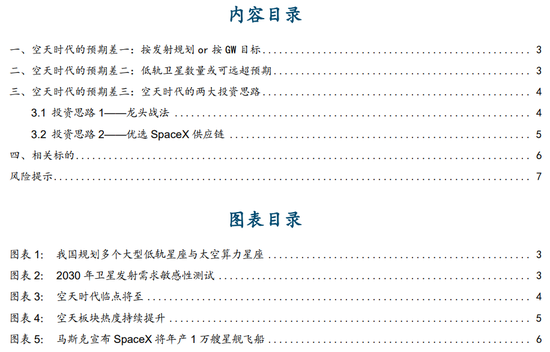
Investment Rating - The industry is rated as "Buy" with an expectation of an increase exceeding 15% over the next 3-6 months [26] Core Insights - The current space market is rapidly developing, with a focus on large low-orbit satellite constellations and space computing constellations. However, due to limited rocket resources, the actual number of satellites in orbit by December 2025 is expected to be lower than anticipated, with only 136 GW satellites and 108 Qianfan satellites [2][11] - Elon Musk announced plans to expand the Starlink V3 satellite scale and establish a space data center, aiming for an annual deployment of 100 GW of data centers within 4-5 years. This could require an astonishing scale of 500,000 to 800,000 satellites [2][12] - The report suggests that the actual capacity for low-orbit satellites may exceed expectations, with potential for up to 175,000 satellites if safety distances are reduced [3][14] - Two main investment strategies are proposed: focusing on leading companies in the space sector and selecting suppliers within the SpaceX supply chain, which is expected to benefit from significant orders as SpaceX prepares for an IPO with a target valuation of $1.5 trillion [4][21] Summary by Sections Section 1: Expected Differences in Space Era - The market space is typically estimated based on launch plans, but actual satellite deployment may fall short due to resource constraints [11] - The anticipated number of satellites in orbit is significantly lower than planned, with only 136 GW satellites and 108 Qianfan satellites expected by December 2025 [11][12] Section 2: Low-Orbit Satellite Capacity - The market generally believes that low Earth orbit can accommodate 60,000 to 100,000 satellites, but actual capacity may be much higher, potentially reaching 175,000 satellites under certain conditions [3][14] Section 3: Investment Strategies in the Space Era - Investment Strategy 1: Focus on leading companies in the space sector, which have shown a significant increase in market capitalization from 1.3% to 6.0% since November 2025 [4][18] - Investment Strategy 2: Prioritize the SpaceX supply chain, which is expected to see substantial growth as SpaceX aims for a historic IPO and ambitious production goals [4][21] Section 4: Related Companies - Companies related to the SpaceX supply chain include Xinwei Communication, Yujing Co., Maiwei Co., and Lens Technology. Other sectors include space computing, rockets, satellites, and 3D printing [5][24]
国金计算机:空天时代三大预期差,布局五大主线
Xin Lang Cai Jing· 2026-01-11 10:22
Group 1 - The core viewpoint of the article highlights the significant discrepancies in expectations regarding the space and aerospace industry, particularly in satellite launches and space computing capabilities [1][31]. - The first expectation gap is between launch planning and GW targets, with current satellite numbers falling short of projections due to limited rocket resources. As of December 2025, only 136 GW satellites and 108 Qianfan satellites are in orbit, leading to lower-than-expected market predictions for satellite launch progress [1][43]. - Elon Musk's announcement in November 2025 about expanding the Starlink V3 satellite scale and establishing a space data center aims for an annual deployment of 100 GW of data centers within 4-5 years, indicating a need for 500,000 to 800,000 satellites based on a power output of 100 kW per satellite [1][31][43]. Group 2 - The second expectation gap concerns the actual capacity for low Earth orbit (LEO) satellites, which is believed to be significantly higher than the market's common estimate of 60,000 to 100,000 satellites. Research suggests that LEO could accommodate up to 700,000 satellites under revised safety standards [2][15]. - The third expectation gap presents two major investment strategies: focusing on leading companies in the aerospace sector and selecting suppliers within the SpaceX supply chain. The commercial aerospace sector's market capitalization has increased from 1.3% to 6.0% since November 2025, indicating growing interest and investment potential [3][19]. - SpaceX is planning an IPO with a target valuation of $1.5 trillion and aims to produce 10,000 Starship spacecraft annually, which could significantly benefit its supply chain partners [3][21]. Group 3 - Related investment targets include companies in the SpaceX supply chain such as Xinwei Communication, Yujing Co., and Maiwei Co. [4][35]. - Companies involved in space computing include Shunhao Co. and Putian Technology [5][56]. - The rocket manufacturing sector includes Aerospace Power, Western Materials, and Aerospace Electromechanical [6][57]. - Satellite-related companies include China Satellite, Mingyang Smart Energy, and Shanghai Hantong [7][56].