
算法公开

Search documents
推进算法公开,新就业形态劳动者迎来“时间松绑”
Zhong Guo Jing Ji Wang· 2025-12-10 14:58
Core Viewpoint - The article discusses the recent initiative by Huolala to publicly disclose its suggested arrival time and loading punctuality algorithm rules, aiming to enhance transparency in the freight industry and improve the "time experience" for gig economy workers [1][2]. Group 1: Algorithm Transparency and Optimization - Huolala has publicly shared its algorithm rules for the fifth time this year, which is intended to make time requirements in the freight industry more transparent [1]. - The suggested arrival time is based on navigation time, with additional time added according to distance and vehicle type, allowing for longer extensions for longer distances and larger vehicles [2]. - The loading punctuality rate is only assessed for express orders and does not affect the driver's middle orders, which alleviates pressure on drivers regarding punctuality [2][3]. Group 2: Impact on Drivers - Drivers have expressed relief that the new rules reduce the pressure of meeting strict punctuality standards, allowing for better communication with users and less urgency in driving [2]. - The changes are seen as a significant improvement in the working conditions for drivers, as they can now plan their routes more effectively and feel more secure about their income despite unforeseen circumstances [2][3]. - The initiative reflects a shift in platform algorithms from prioritizing efficiency to a more human-centered approach, aiming to create a safer and fairer working environment for drivers [3]. Group 3: Future Directions - Industry experts suggest that further refinements could be made to the time rules for special scenarios such as remote deliveries and adverse weather conditions, as well as providing more lenient time mechanisms for older and new drivers [3]. - The ongoing efforts to make algorithms more considerate are seen as essential for achieving a balance between the dignity of gig workers and the growth of platform businesses [3].
货拉拉司机规则算法公开:抵达卸货地时间不影响准点率
Zheng Quan Shi Bao Wang· 2025-12-10 07:17
Core Viewpoint - The recent algorithm disclosure by Huolala focuses on the calculation of suggested arrival times and punctuality rates, aiming to enhance transparency and improve driver experience on the platform [1][2][5]. Group 1: Suggested Arrival Time - Huolala's suggested arrival time is composed of three parts: navigation base time, distance extension time, and vehicle type extension time, with longer distances and larger vehicle types resulting in longer suggested times [1][2]. - Drivers can apply for additional time through an exception reporting channel in case of unexpected situations during transit, such as vehicle breakdowns or severe traffic [5]. Group 2: Punctuality Rate - The platform will only assess the punctuality rate for fast and express orders arriving at the loading location, excluding other order types and the unloading phase from this assessment [6]. - The newly defined "loading punctuality rate" will be calculated based on the proportion of the last 40 orders that arrived on time at the loading site, with a minimum of 10 completed orders required for calculation [8]. - The punctuality rate will not affect the ability of drivers to accept orders, as the platform prioritizes driver autonomy and proximity in order allocation [6].

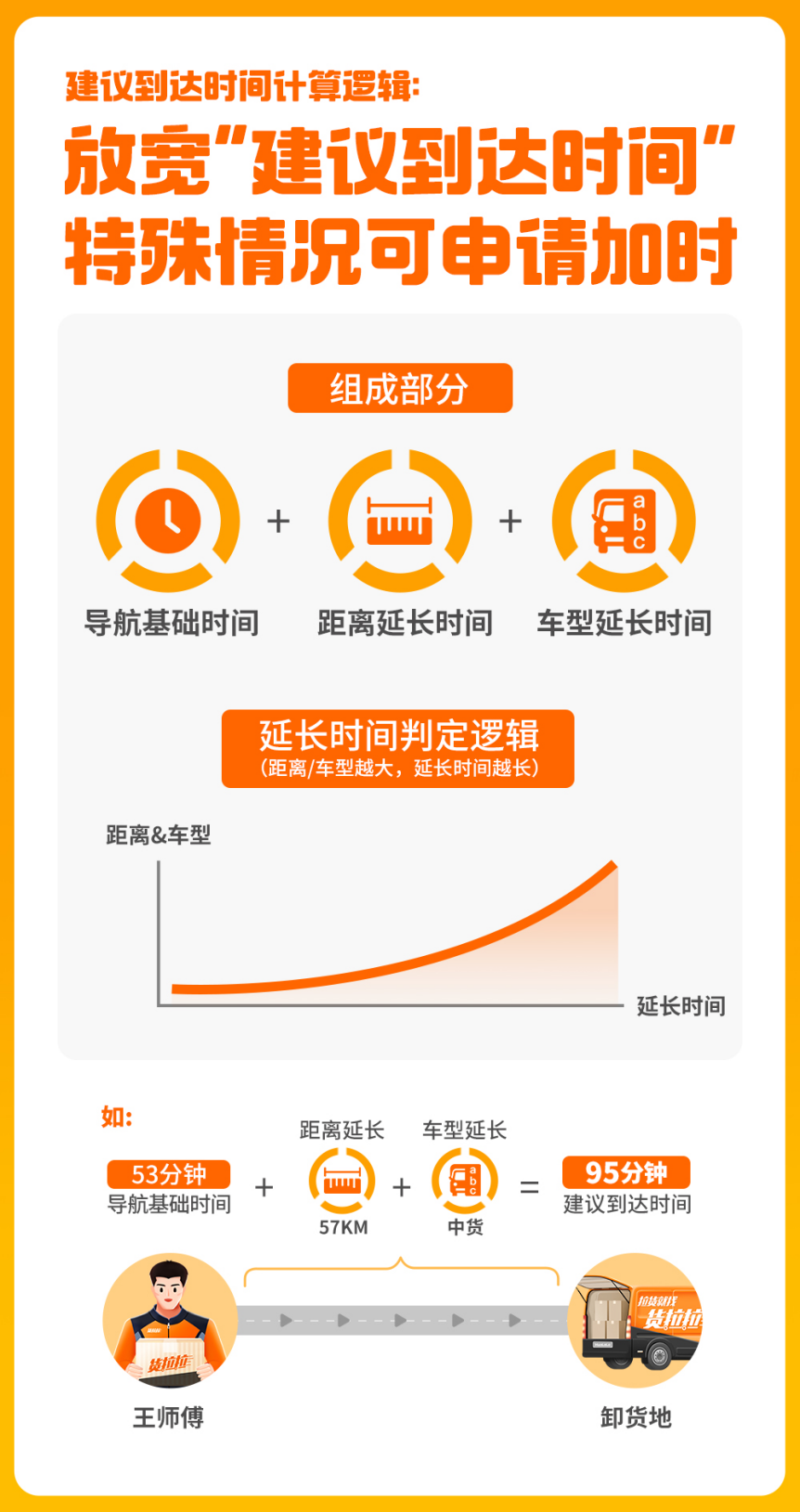
为司机时间“松绑”,货拉拉公开建议到达时间及准点率算法
Huan Qiu Wang· 2025-12-10 07:01
Core Viewpoint - The article discusses the fifth algorithm disclosure by Huolala, focusing on the calculation of suggested arrival times and punctuality rates for loading orders, aiming to enhance driver experience and safety. Group 1: Suggested Arrival Time Algorithm - Huolala's suggested arrival time is composed of three parts: navigation base time, distance extension time, and vehicle type extension time, with longer distances and larger vehicle types resulting in longer suggested times [1][2] - The platform allows drivers to apply for additional time through an exception reporting channel in case of unexpected situations during transit [5] Group 2: Punctuality Rate Calculation - Huolala only assesses the punctuality rate for fast and express orders arriving at loading locations, excluding other order types and unloading times from this assessment [6] - The punctuality rate will be renamed to "loading punctuality rate" starting mid-December, calculated based on the proportion of the last 40 orders that arrived on time at the loading location [8] - Drivers must complete at least 10 orders for the loading punctuality rate to be calculated, ensuring a fair assessment based on actual performance [8]
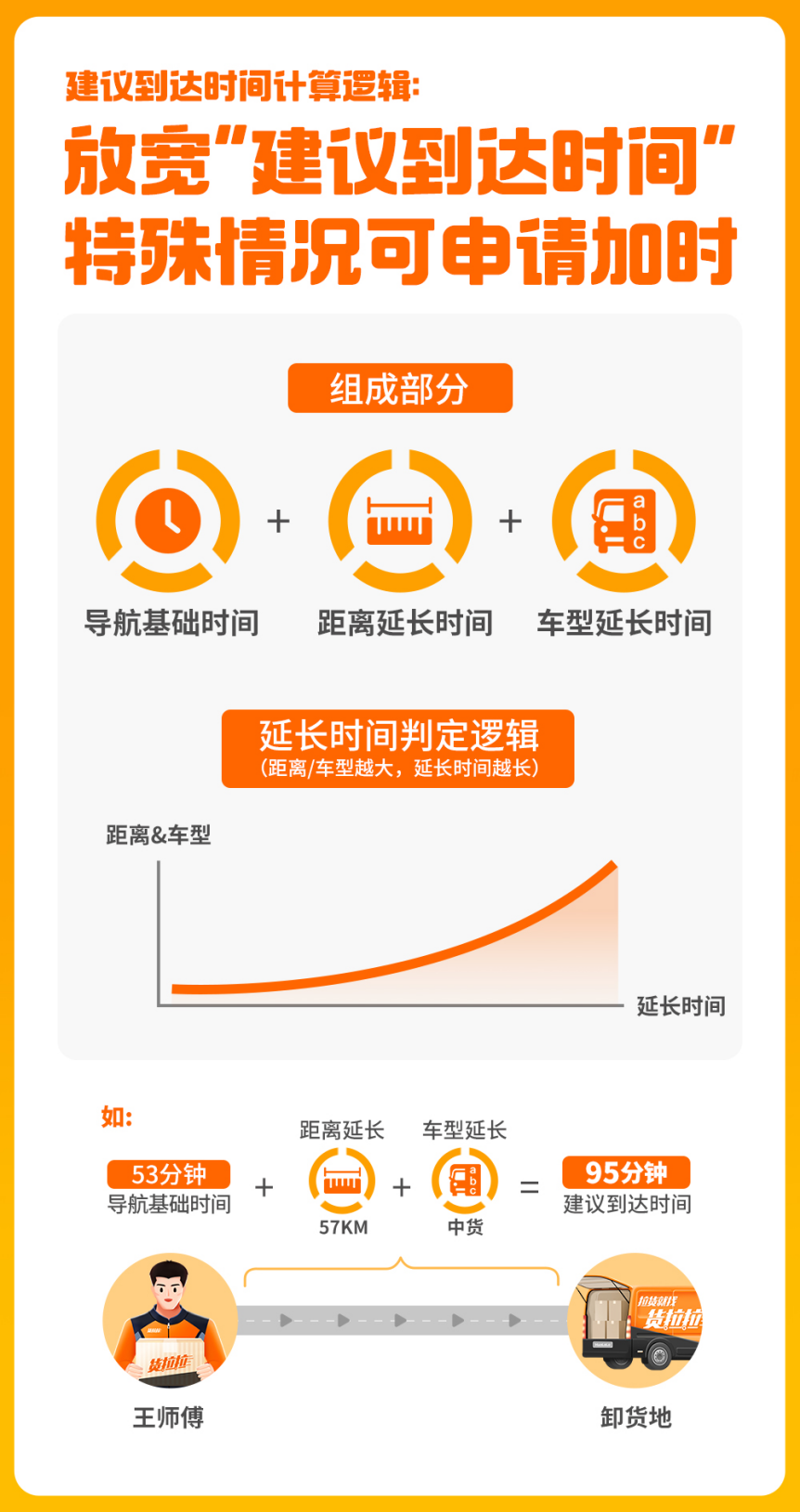
从“算法黑箱”到“协商共治”——平台发展需以开放倾听为基
Huan Qiu Wang· 2025-09-18 10:13
Core Insights - The article highlights the long-standing "relationship dilemma" in platform economies, where laborers lack transparency and dialogue with algorithms, leading to misunderstandings and mistrust [1][2] - The need for open dialogue mechanisms and transparency in algorithm rules is emphasized as essential for improving labor relations and ensuring sustainable platform development [3][4] Group 1: Labor Relations and Trust - A significant 62.7% of drivers believe that "platform rules are not transparent," indicating a major concern regarding trust and understanding between drivers and platforms [2] - The complexity of algorithm rules and dynamic commission rates contribute to a lack of trust among laborers, which can negatively impact service quality and platform stability [1][2] Group 2: Initiatives for Improvement - The first national "Orange Heart Protection Algorithm Consultation Conference" was held by Huolala, expanding the discussion topics from 5 to 15, covering various aspects of driver rights and platform rules [3] - Major platforms like Meituan and Ele.me are also shifting towards "two-way negotiation" by implementing measures such as eliminating penalties for delays and optimizing order assignment mechanisms [3] Group 3: Policy Alignment and Industry Standards - The trend of enhancing labor rights aligns with national policies aimed at protecting new employment forms, emphasizing the importance of laborer participation in the negotiation process [4] - Huolala's practices serve as a benchmark for the industry, responding positively to policy requirements and promoting effective collaboration between platforms and laborers [4] Group 4: Practical Measures and Innovations - Huolala has introduced an "algorithm disclosure" feature on its website to make platform rules more accessible and understandable, increasing driver income efficiency by adjusting order allocation algorithms [5] - The company has implemented a dual settlement mechanism to address issues like payment delays and occupational injuries, investing 10 million yuan annually to support drivers [5] - The shift from a "black box" to a "glass house" in platform governance signifies a deeper transformation in the industry, fostering a collaborative environment between platforms and laborers [5]
法院信息化蓝皮书建议:需关注算法公开列入司法公开的必要性
Nan Fang Du Shi Bao· 2025-06-11 03:44
Core Insights - The "Court Informationization Blue Book" released by the Chinese Academy of Social Sciences highlights significant advancements in online litigation processes, particularly in civil and administrative second-instance cases, with over 370,000 online filings by the end of 2024, reducing the average filing time by over 70% compared to pre-trial periods [1][2] Group 1: Online Litigation Developments - The pilot program for online second-instance filings has been implemented in 16 regions, allowing for same-day applications and filings [1] - Shandong High Court has processed 99,000 online second-instance applications, with an average filing time reduction of over two-thirds [2] Group 2: Cross-Domain Litigation Services - The Supreme People's Court has guided 13 pilot regions to provide cross-domain services, significantly lowering litigation costs and enabling local processing of legal matters [2] Group 3: Dispute Resolution Innovations - The court's informationization efforts have led to the establishment of a mediation platform that has resolved over 2.5 million disputes through local governance units [3] Group 4: Technological Integration and Recommendations - The blue book emphasizes the need for developing specialized models for court litigation to reduce reliance on external technologies and suggests regular assessments of algorithm fairness and reliability [4]
货拉拉公布第二批算法公开举措:预计2025年将降低抽佣共计2.3亿元
news flash· 2025-05-29 12:16
Core Viewpoint - The digital freight platform Huolala has announced its second batch of algorithm disclosure measures, aimed at enhancing fairness and reducing costs for drivers [1] Group 1: Algorithm Disclosure - The disclosed content includes dynamic evaluation algorithms and rules to improve the fairness of order distribution [1] - The optimization of the automatic commission reduction algorithm is part of ongoing efforts to alleviate financial burdens on drivers [1] Group 2: Driver Support Initiatives - Huolala has improved its "driver autonomy, proximity priority" order distribution model, increasing the proportion of orders prioritized by distance from 90% to 93% [1] - The platform plans to launch additional driver commission reduction products, expecting to lower commissions by a total of 230 million yuan by 2025 [1] - The company will increase order subsidies, with an anticipated annual investment of nearly 70 million yuan to enhance driver income [1]
算法“开箱”让“杀熟”曝光
Guang Zhou Ri Bao· 2025-04-29 21:30
Group 1 - The core issue of "big data killing familiarity" involves platforms using personal data to implement differential pricing, leading to consumer dissatisfaction [1] - Consumers report being charged more for the same products in live-streaming sessions, highlighting a lack of transparency in pricing [1] - The collection of personal information and the subsequent analysis of consumer habits are the preliminary steps that enable differential pricing strategies [1] Group 2 - Algorithms should not operate outside of governance; their design and application must align with human-centered principles to protect consumer rights [2] - There is a call for platforms to adopt an open approach, enhancing algorithm transparency to combat "big data killing familiarity" [2] - Recommendations include returning control of information recommendations to users and establishing industry standards to improve algorithm transparency [2]