算法自强

Search documents
中国工程院院士郑纬民详解“主权AI”
Zhong Guo Xin Wen Wang· 2025-12-22 12:03
Core Viewpoint - The success of "sovereign AI" depends on the willingness of a sufficient number of developers to write code on the platform for the long term [1][2]. Group 1: Sovereign AI and Its Importance - "Sovereign AI" is a critical issue that every country must address to enhance future national competitiveness [1]. - The core of "sovereign AI" lies in achieving a complete system of "autonomous computing power, self-reliant algorithms, and independent ecology" [2]. Group 2: Requirements for Autonomous Computing Power - Autonomous computing power has three requirements: 1. Self-sufficient chip design capabilities 2. Controllable manufacturing and supply chain risks 3. Strong system and cluster delivery capabilities [2]. Group 3: Importance of Ecosystem Independence - Ecosystem independence is considered more important than autonomous computing power and self-reliant algorithms, as it signifies the transition from chips that can run software to those that users are willing to utilize [2]. - Developers are key to ecosystem construction, and a user-friendly development environment must be established for domestic chip platforms to effectively serve the developer community [2]. Group 4: Industry Challenges and Collaboration - The current Chinese chip industry faces issues of internal competition and fragmentation, with different manufacturers providing varying interfaces requiring different adaptations [2]. - It is essential for the industry to unite to address the problems of insufficient applications and weak ecosystems, emphasizing the importance of collaboration between the industry and application sectors [2]. Group 5: Role of Companies in Ecosystem Development - The founder and CEO of Moore Threads, Zhang Jianzhong, emphasizes that the ecosystem is the core moat and value of the GPU industry [3]. - Moore Threads is committed to increasing R&D investment to tackle core technological challenges from hardware to software, aiming to build a self-reliant and strong domestic computing industry ecosystem through open innovation and collaboration with ecosystem partners [3].
摩尔线程公布新GPU架构和万卡集群
Guan Cha Zhe Wang· 2025-12-20 07:27
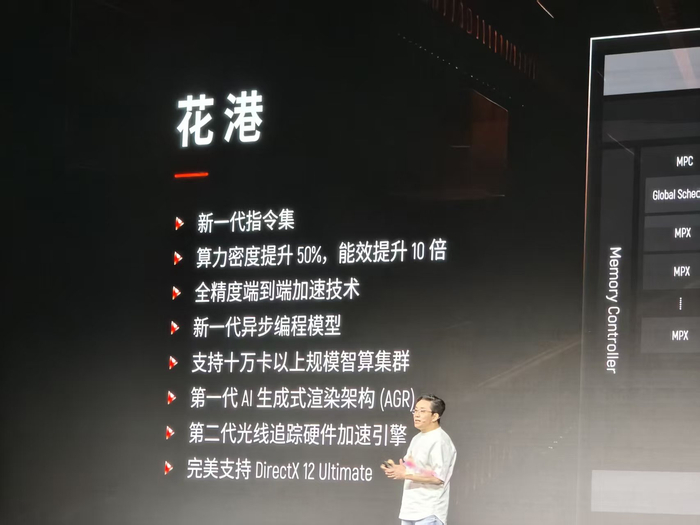
Core Insights - The article discusses the launch of new GPU products by the company Moore Threads at the first MUSA Developer Conference, highlighting advancements in GPU architecture and AI training chips [1][7]. Group 1: Product Announcements - Moore Threads unveiled its next-generation GPU architecture "Huagang," which supports full precision computing from FP4 to FP64, with a 50% increase in density and a 10-fold improvement in efficiency [7]. - The company introduced the AI training and inference chip "Huashan" and the graphics rendering chip "Lushan," along with the "Kua'a" 10,000-card computing cluster [1][7]. - The "Kua'a" computing cluster boasts a floating-point computing capability of 10 Exa-Flops, with a training utilization rate of 60% for dense models and 40% for MOE models, achieving a linear scaling efficiency of 95% [9]. Group 2: Industry Context and Challenges - The development of "sovereign AI" is emphasized as crucial for enhancing national competitiveness, focusing on achieving autonomy in computing power, algorithm strength, and ecosystem independence [2]. - The performance gap between domestic graphics cards and leading international products is narrowing, although building large-scale intelligent computing systems remains a significant challenge [2]. - The competitive landscape for GPU companies is intense, with major players like NVIDIA and Huawei holding a combined market share of 94.4% in the intelligent computing chip market, indicating a fragmented market with over 15 participants [20]. Group 3: Financial Performance and Market Outlook - Moore Threads reported a revenue of 785 million yuan and a net loss of 724 million yuan for the first three quarters of the year, with projections indicating a continued net loss in 2025 [17]. - The company’s market capitalization fluctuated, initially exceeding 400 billion yuan but currently around 310 billion yuan [17]. - The article notes that many GPU startups are experiencing significant losses, with competitors like Muxi and Biran Technology also facing financial challenges [19]. Group 4: Ecosystem Development - The CEO of Moore Threads highlighted the importance of building a user-friendly development environment to foster a robust ecosystem, which is seen as a critical competitive advantage in the GPU industry [23]. - The company aims to enhance its research and development efforts to overcome core technological challenges and deepen collaboration with ecosystem partners [23].