
算力自主

Search documents
一场决定中国AI命运的“双向奔赴”
Guan Cha Zhe Wang· 2026-02-13 06:13
Core Viewpoint - The global technology industry is experiencing significant upheaval, driven by the explosive growth of artificial intelligence (AI) and geopolitical tensions affecting global tech cooperation. Despite concerns about China's AI industry, a transformative change is underway, emphasizing the need for technological self-reliance and innovation [1]. Group 1: Industry Challenges - The Chinese AI industry faces profound changes amid a competitive landscape, with issues such as supply-demand mismatches and ecosystem incompatibility leading to challenges in domestic computing power [1]. - The traditional approach of simply increasing computing power through advanced GPU purchases is no longer viable due to intensified geopolitical crises and chip restrictions imposed by Western countries [3]. - The reliance on "special supply" chips may provide temporary relief but poses long-term risks, as it hinders true technological innovation and keeps Chinese firms as followers rather than leaders in the AI space [4]. Group 2: Emerging Solutions - The industry is recognizing that depending on foreign computing power is not sustainable, leading to the exploration of various paths toward self-sufficiency, including a "full-stack self-research" model that integrates chips, frameworks, and application ecosystems [4]. - A collaborative movement involving government, industry, academia, and applications is emerging, focusing on building a closed-loop industry ecosystem that enhances the integration of computing infrastructure, large model manufacturers, and application scenarios [4]. Group 3: Synergy Between Hardware and Software - The shift from independent development of chips, frameworks, and algorithms to a highly coupled relationship between large models and underlying hardware systems is a significant change in the Chinese AI industry [5]. - The recent collaboration between domestic computing power and large models is seen as a critical path for China's AI industry to leapfrog ahead, moving from "using foreign chips to run Chinese models" to "creating Chinese chips for Chinese models" [6][8]. - Successful examples include the DeepSeek model, which has improved inference efficiency by over 30% through adaptation to domestic chips, showcasing a trend towards greater autonomy in technology [7]. Group 4: Infrastructure Development - The launch of the national supercomputing internet core node in Zhengzhou marks a pivotal moment, creating the largest domestic AI computing resource pool and facilitating the integration of various domestic acceleration cards [8][9]. - This system has achieved several milestones, including transforming scarce computing resources into accessible public services and enabling the systematic implementation of soft-hard collaboration [8]. - The rapid growth of the supercomputing internet platform, with over 1.13 million registered users and significant daily processing capabilities, indicates a strong demand for optimized large model adaptations across various fields [9].
AI,刷屏!3只A股霸榜前三,中国人工智能50强发布!
券商中国· 2026-01-19 09:52
Core Viewpoint - The 2025 Hurun China AI Companies Top 50 list has been released, highlighting significant growth in the AI sector, particularly in AI chip companies, with Cambricon leading the list at a valuation of 630 billion RMB, reflecting a 165% increase from the previous year [2][4]. Group 1: Top Companies - Cambricon ranks first with a valuation of 630 billion RMB, specializing in AI chips [2][3]. - Moore Threads, the leading domestic GPU company, ranks second with a valuation of 310 billion RMB [2][3]. - Muxi Technology, the second domestic GPU company, ranks third with a valuation of 250 billion RMB [2][3]. - The top ten list includes seven AI chip-related companies, indicating a strong presence in this segment [2][4]. Group 2: Market Trends - AI concept stocks have shown mixed performance, with some stocks like Giant Network and Tian Di Online experiencing significant gains, while others like Vision China faced declines [6]. - The AI chip sector has seen a notable increase in the number of companies listed, with 14 AI chip companies making the list, up from 9 last year [5][4]. - The overall market for AI applications is expected to continue growing, driven by policy support and advancements in AI infrastructure [7][6]. Group 3: Industry Insights - The concentration of AI companies is primarily in first-tier cities, with Beijing leading with 19 companies, followed by Shanghai with 14 [4]. - The recent surge in AI chip companies is attributed to the tightening of high-end AI chip export controls by the U.S., prompting domestic companies to accelerate their capabilities [4][5]. - The AI application market is at a pivotal point, with ongoing policy support and technological advancements expected to drive further growth [7][6].



美政府“放行”后,外媒议论英伟达H200在华销售前景
Huan Qiu Shi Bao· 2026-01-08 22:47
Group 1 - The U.S. government allowed Nvidia to export its H200 chips to China, leading to speculation about the timing and future sales prospects in the Chinese market [1][2] - China is the largest semiconductor market globally, and Nvidia's entry could represent a significant victory, with potential revenues of $50 billion in the AI chip sector over the next few years [1] - Due to uncertainties in sales prospects, Nvidia is now requiring full payment in advance from Chinese customers, with no options for order cancellation, refunds, or reconfiguration [1] Group 2 - The Chinese government is cautiously evaluating the potential sale of the H200 chip, reflecting concerns about reliance on imported chips and the impact on domestic innovation capabilities [2] - Chinese semiconductor companies like Huawei and Cambricon are gaining market share, indicating a shift away from dependence on imported chips [2] - The fluctuating U.S. stance on high-end chips creates uncertainty for users, emphasizing the need for vigilance in the Chinese semiconductor industry to maintain confidence in domestic production efforts [2]

壁仞科技凭啥成为港股“国产GPU第一股”?
Sou Hu Cai Jing· 2026-01-02 07:23
Core Viewpoint - Biren Technology has successfully listed on the Hong Kong Stock Exchange, becoming the first domestic GPU stock and marking a significant milestone in China's computing landscape [2][5]. Company Overview - Founded in 2019 by Zhang Wen, former president of SenseTime, Biren Technology focuses on GPU technology and has filed over 1,500 patents globally, ranking first among Chinese general GPU companies [3][4]. - The company has raised over 5 billion HKD through its IPO, with 85% of the net proceeds allocated for R&D to advance next-generation products and solutions [5]. Financial Performance - Biren Technology reported revenues of 49,900 CNY in 2022, 62.03 million CNY in 2023, and projected 337 million CNY in 2024, with significant losses totaling 6.357 billion CNY over three and a half years [3][4]. - The company holds 24 binding orders valued at approximately 822 million CNY, along with framework sales agreements worth 1.241 billion CNY, indicating a solid foundation for future growth [3]. Market Position and Strategy - Biren Technology currently holds a market share of 0.16% in the Chinese smart computing chip market and 0.20% in the GPGPU market, with expectations to capture about 0.2% of the market by 2025 [6]. - The company aims to enhance its full-stack capabilities, focusing on high-performance general GPUs and supporting AI, cloud computing, and big data applications [6]. Industry Context - The demand for domestic AI chips is surging, with ByteDance planning to procure over 40 billion CNY worth of domestic AI chips by 2026, creating significant opportunities for companies like Biren Technology [6]. - Despite the growth potential, there remains a substantial gap between domestic GPU manufacturers and industry leader NVIDIA, which reported revenues of 130.5 billion USD in 2025, highlighting the challenges ahead for local firms [7].

中国版英伟达市值飙升468%!登顶全球能源科技龙头
Sou Hu Cai Jing· 2025-12-27 01:35
Core Insights - The article highlights the emergence of a domestic GPU chip company, Moore Threads, which is being referred to as the "Chinese version of Nvidia," marking a significant shift in the high-end computing power landscape [1][6] - Moore Threads made a remarkable debut on the STAR Market, with its stock price soaring from an initial offering price of 114.28 yuan to over 940 yuan, achieving a market capitalization of 336 billion yuan shortly after its listing [1][3] Group 1: Market Performance - Moore Threads' market capitalization surged due to substantial market recognition and official data, with an IPO fundraising total of nearly 8 billion yuan and a net fundraising amount of 7.576 billion yuan, aimed at GPU chip research and ecosystem development [3] - Within just six days of its listing, the company's stock price increased by 723.49%, significantly outperforming the STAR Composite Index and the STAR 50 Index, establishing itself as a key player in the 2025 A-share technology stock surge [3] Group 2: Technological Advancements - The company showcased its technological capabilities with the new GPU architecture "Huagang," which enhances computing density by 50% and can improve efficiency by up to 10 times, supporting full precision calculations from FP4 to FP64 [4] - The "Kua'e" Wan Card Intelligent Computing Cluster demonstrates high performance in energy big data processing and large-scale AI model training, achieving a computing utilization rate of 60% and a linear expansion efficiency of 95%, aligning with international standards [4] Group 3: Strategic Partnerships - Moore Threads has established strong ecological partnerships, joining the "AI Capability Joint Fleet" led by China Mobile, which includes 21 ecosystem companies to promote the "AI+" strategy [5] - The company actively participated in the China Computing Conference, contributing to the OISA 2.0 protocol, ensuring compatibility with mainstream AI frameworks and applications, thereby facilitating seamless integration into domestic communication and energy networks [5] Group 4: Industry Impact - The rise of Moore Threads signifies a pivotal step for China in achieving autonomy in energy technology, previously dominated by international giants, and reducing reliance on imported core computing power [6] - The company's products are now being utilized in critical areas such as new energy scheduling and smart grids, empowering Chinese energy enterprises with independent computing capabilities and fostering the development of a complete domestic computing power industry chain [6]

中国工程院院士郑纬民详解“主权AI”
Zhong Guo Xin Wen Wang· 2025-12-22 12:03
Core Viewpoint - The success of "sovereign AI" depends on the willingness of a sufficient number of developers to write code on the platform for the long term [1][2]. Group 1: Sovereign AI and Its Importance - "Sovereign AI" is a critical issue that every country must address to enhance future national competitiveness [1]. - The core of "sovereign AI" lies in achieving a complete system of "autonomous computing power, self-reliant algorithms, and independent ecology" [2]. Group 2: Requirements for Autonomous Computing Power - Autonomous computing power has three requirements: 1. Self-sufficient chip design capabilities 2. Controllable manufacturing and supply chain risks 3. Strong system and cluster delivery capabilities [2]. Group 3: Importance of Ecosystem Independence - Ecosystem independence is considered more important than autonomous computing power and self-reliant algorithms, as it signifies the transition from chips that can run software to those that users are willing to utilize [2]. - Developers are key to ecosystem construction, and a user-friendly development environment must be established for domestic chip platforms to effectively serve the developer community [2]. Group 4: Industry Challenges and Collaboration - The current Chinese chip industry faces issues of internal competition and fragmentation, with different manufacturers providing varying interfaces requiring different adaptations [2]. - It is essential for the industry to unite to address the problems of insufficient applications and weak ecosystems, emphasizing the importance of collaboration between the industry and application sectors [2]. Group 5: Role of Companies in Ecosystem Development - The founder and CEO of Moore Threads, Zhang Jianzhong, emphasizes that the ecosystem is the core moat and value of the GPU industry [3]. - Moore Threads is committed to increasing R&D investment to tackle core technological challenges from hardware to software, aiming to build a self-reliant and strong domestic computing industry ecosystem through open innovation and collaboration with ecosystem partners [3].
摩尔线程公布新GPU架构和万卡集群
Guan Cha Zhe Wang· 2025-12-20 07:27
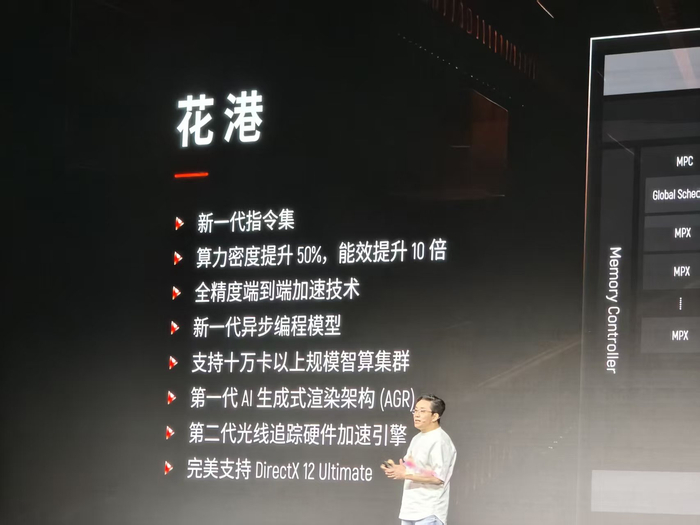
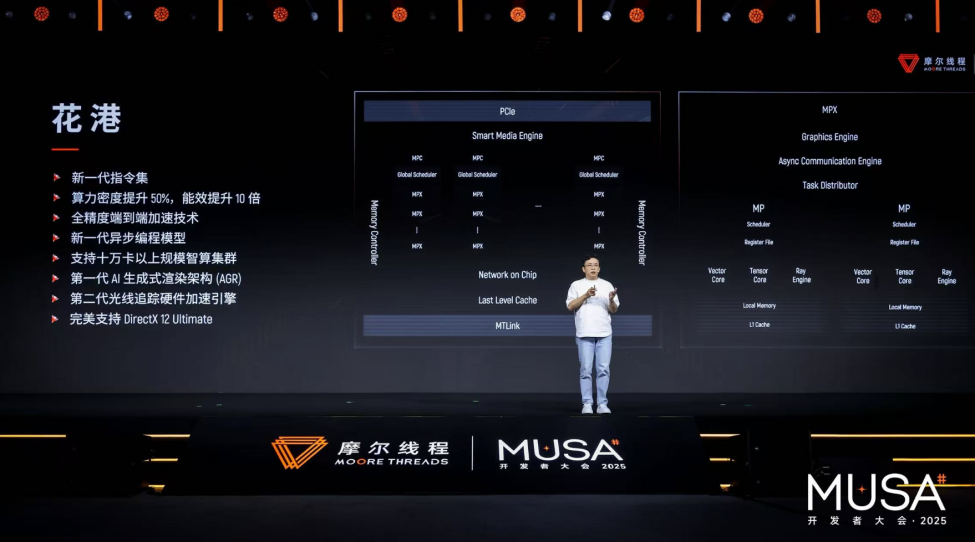
Core Insights - The article discusses the launch of new GPU products by the company Moore Threads at the first MUSA Developer Conference, highlighting advancements in GPU architecture and AI training chips [1][7]. Group 1: Product Announcements - Moore Threads unveiled its next-generation GPU architecture "Huagang," which supports full precision computing from FP4 to FP64, with a 50% increase in density and a 10-fold improvement in efficiency [7]. - The company introduced the AI training and inference chip "Huashan" and the graphics rendering chip "Lushan," along with the "Kua'a" 10,000-card computing cluster [1][7]. - The "Kua'a" computing cluster boasts a floating-point computing capability of 10 Exa-Flops, with a training utilization rate of 60% for dense models and 40% for MOE models, achieving a linear scaling efficiency of 95% [9]. Group 2: Industry Context and Challenges - The development of "sovereign AI" is emphasized as crucial for enhancing national competitiveness, focusing on achieving autonomy in computing power, algorithm strength, and ecosystem independence [2]. - The performance gap between domestic graphics cards and leading international products is narrowing, although building large-scale intelligent computing systems remains a significant challenge [2]. - The competitive landscape for GPU companies is intense, with major players like NVIDIA and Huawei holding a combined market share of 94.4% in the intelligent computing chip market, indicating a fragmented market with over 15 participants [20]. Group 3: Financial Performance and Market Outlook - Moore Threads reported a revenue of 785 million yuan and a net loss of 724 million yuan for the first three quarters of the year, with projections indicating a continued net loss in 2025 [17]. - The company’s market capitalization fluctuated, initially exceeding 400 billion yuan but currently around 310 billion yuan [17]. - The article notes that many GPU startups are experiencing significant losses, with competitors like Muxi and Biran Technology also facing financial challenges [19]. Group 4: Ecosystem Development - The CEO of Moore Threads highlighted the importance of building a user-friendly development environment to foster a robust ecosystem, which is seen as a critical competitive advantage in the GPU industry [23]. - The company aims to enhance its research and development efforts to overcome core technological challenges and deepen collaboration with ecosystem partners [23].
摩尔线程亮出全栈技术底牌:“花港”新架构与万卡集群冲击高端GPU市场格局
Huan Qiu Wang· 2025-12-20 07:00
Core Insights - The article highlights the significant advancements made by Moore Threads in the GPU sector, particularly through the introduction of the new "Huagang" architecture and the "Kua'e" ten-thousand card intelligent computing cluster, which supports trillion-parameter model training [2][3]. Architecture Innovations - The "Huagang" architecture showcases a 50% increase in computing density and up to 10 times improvement in efficiency, fully supporting precision calculations from FP4 to FP64. It integrates the self-developed MTLink high-speed interconnect technology, facilitating cluster expansion beyond 100,000 cards [3][5]. - Two chips have been planned based on the "Huagang" architecture: "Huashan" for AI training and inference integration, and "Lushan" aimed at high-performance graphics rendering, with performance improvements of 64 times for AI computation, 16 times for geometric processing, and 50 times for ray tracing [5]. Cluster Capabilities - The "Kua'e" ten-thousand card intelligent computing cluster has publicly disclosed key engineering efficiency metrics, achieving a model compute utilization (MFU) of 60% for dense models and 40% for mixture of experts (MOE) models, with a linear scaling efficiency of 95% and effective training time exceeding 90% [6]. Ecosystem Development - Moore Threads announced the iteration of its unified software architecture MUSA to version 5.0, with plans to gradually open-source core components, including computation acceleration libraries and system management frameworks [8]. - The "Moore Academy" platform has attracted nearly 200,000 learners and collaborates with over 200 universities nationwide, reflecting a comprehensive approach to ecosystem building through technology open-sourcing, developer tool provision, and early talent cultivation [9]. Technological Integration and Exploration - The release indicates a trend towards the deep integration of graphics, AI, and high-performance computing, with hardware-level ray tracing acceleration and the introduction of the AI generative rendering technology MTAGR 1.0 [10]. - The company is also exploring cutting-edge fields such as embodied intelligence and AI for science, showcasing its ambition to redefine the value of GPUs as a general computing platform [10]. Industry Context - The comprehensive technology showcase reflects the current stage of domestic high-end computing power development, transitioning from single-chip innovations to tackling large-scale system engineering and building a thriving application ecosystem [11]. - The efficiency disclosure of the ten-thousand card cluster signifies that domestic computing infrastructure is beginning to undergo rigorous testing in large-scale, high-load scenarios, while the architecture iteration and integration of graphics and AI demonstrate the company's intent to define the next generation of computing architecture [11].
突围2025:国产GPU集体上市,然后呢?(深度好文)
Sou Hu Cai Jing· 2025-12-09 10:16
Core Insights - The year 2025 is a pivotal moment for the domestic GPU industry in China, marked by a wave of IPOs from companies like Moore Threads and Muxi Technology, which highlights the urgency for funding to sustain operations and growth [2][4] - The rapid listing of these companies is driven by a need for capital to navigate the lengthy R&D phase and to ensure survival in a competitive landscape [2][4] - The challenges facing domestic GPU manufacturers extend beyond product design to include supply chain vulnerabilities and the dominance of the CUDA ecosystem, which poses significant barriers to entry [9][10] Financial Performance - Moore Threads reported cumulative revenue of 609 million yuan over the past three years (2022-2024) with a net loss of 5.005 billion yuan, while Muxi Technology had cumulative revenue of 1.117 billion yuan and a net loss of 3.29 billion yuan during the same period [4] - The financial data reflects a common trend in the GPU industry, characterized by high R&D investments and significant operational losses [4] Market Dynamics - The investment strategy in the GPU sector is described as a "wolf pack tactic," where several leading companies are encouraged to go public to secure funding, with the expectation that only a few will emerge as winners [6][7] - The current market environment is shifting from a focus on fundraising to a competitive emphasis on engineering capabilities and market delivery, as companies strive to meet the demands of large clients [14] Supply Chain and Ecosystem Challenges - The reliance on external manufacturing capabilities is identified as a critical issue, with domestic manufacturers struggling to achieve scale in production and yield control [10] - The entrenched CUDA ecosystem, developed over nearly two decades, presents a formidable challenge for domestic GPU companies, making it difficult to attract customers who face high costs in switching ecosystems [10][11] Strategic Responses - Some domestic GPU manufacturers are adopting a pragmatic approach by promoting heterogeneous mixed training, which involves using a mix of different brands within a computing cluster to enhance compatibility and robustness [11][12] - The focus is shifting towards collaboration with existing ecosystems rather than outright replacement, which is seen as a more realistic strategy for overcoming barriers [12] Future Outlook - The industry is transitioning from a narrative-driven phase to one focused on tangible results and performance metrics, with a heightened emphasis on engineering reliability and stability [14] - The explosion of AI inference demand presents new opportunities for growth, with companies exploring supernode solutions to enhance performance [15] - The competitive landscape is expected to undergo significant changes within the next year, with only a few companies likely to survive the intense competition [15]
科创半导体ETF(588170)、半导体材料ETF(562590)午后涨超3%,机构:科技主线有望持续占优
Mei Ri Jing Ji Xin Wen· 2025-10-27 05:52
Group 1 - The semiconductor sector experienced a rise and subsequent pullback, with the Sci-Tech Semiconductor ETF (588170) and Semiconductor Materials ETF (562590) gaining 3.04% and 3.67% respectively in the afternoon session [1] - According to data from China Merchants Securities, as of September 5, 2025, Moer Thread is negotiating expected orders worth approximately 2.004 billion yuan, with over 1.7 billion yuan in AI computing projects [1] - The current order scale for Muxi stands at 1.43 billion yuan, indicating a ramp-up in domestic AI computing capabilities [1] Group 2 - Galaxy Securities highlighted that the demand for high-performance computing chips is being driven by both cloud-based large model training and edge AI application deployment [1] - Domestic manufacturers like Huawei Ascend and Muxi are enhancing market confidence in autonomous computing capabilities through technological iterations [1] - The semiconductor sector is undergoing a structural market trend, with equipment and materials benefiting from domestic innovation and technological upgrades [1] Group 3 - The Sci-Tech Semiconductor ETF (588170) and its linked funds track the Shanghai Stock Exchange Sci-Tech Board Semiconductor Materials and Equipment Theme Index, focusing on semiconductor equipment (61%) and materials (23%) [2] - The semiconductor equipment and materials industry is a key area for domestic substitution, characterized by low domestic replacement rates and high ceilings for domestic substitution [2] - The Semiconductor Materials ETF (562590) also emphasizes the upstream semiconductor sector, with significant allocations to semiconductor equipment (61%) and materials (21%) [2]