粮食流通

Search documents
我国粮食流通能力持续提升
Sou Hu Cai Jing· 2025-12-30 21:59
Core Insights - The total grain acquisition by various enterprises reached 830 billion jin this year, with a storage loss rate for farmers reduced to approximately 3%, a decrease of 5 percentage points compared to a decade ago [1][2] - The grain industry is expected to maintain a total output value of over 4 trillion yuan by 2025, supported by sufficient government reserves and improved storage structures [1][2] Group 1: Grain Acquisition and Market Stability - Grain production in China reached 14,297.5 billion jin this year, an increase of 167.5 billion jin from the previous year [2] - The grain acquisition volume has remained stable above 800 billion jin for three consecutive years, indicating a robust grain market [2] - The government is focused on ensuring stable prices and supply, especially as the New Year and Spring Festival approach, with efforts to enhance grain acquisition [2] Group 2: Development of the Grain Industry - The grain industry is experiencing simultaneous growth in scale and efficiency, with significant investments in quality grain projects leading to improved industry standards [3] - By September this year, 462 billion yuan in fiscal funds had been allocated, attracting over 840 billion yuan in social investment for more than 8,400 projects [3] - The government aims to support the development of grain market entities and enhance grain quality management and technological support [3] Group 3: Storage and Regulatory Improvements - The construction of grain storage and logistics projects has advanced, with over 730 million tons of standard grain storage capacity available [4] - A significant transformation in grain management and storage methods has occurred, with a focus on legal governance and information-based supervision [4] - The government is committed to enhancing the regulatory framework and modernizing grain and material reserve management by 2026 [5]
去年我国人均粮食占有量达500公斤
Mei Ri Jing Ji Xin Wen· 2025-10-14 13:37
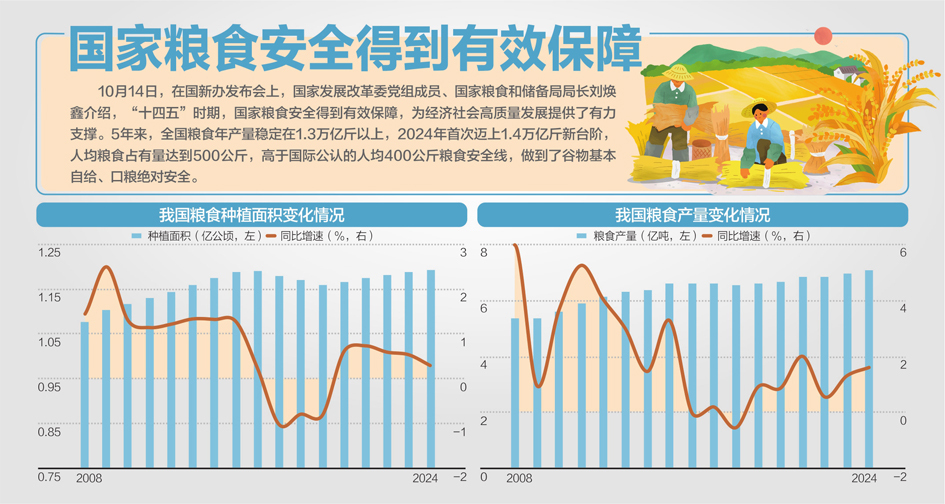
Core Insights - The Chinese government has effectively ensured food security during the "14th Five-Year Plan" period, providing strong support for high-quality economic and social development [1] Group 1: Grain Production and Supply - National grain production has remained stable at over 1.3 trillion jin annually for the past five years, with a projected increase to 1.4 trillion jin in 2024, marking a significant milestone [3] - Per capita grain availability has increased by 25 kg compared to the end of the "13th Five-Year Plan," reaching 500 kg, which exceeds the internationally recognized safety line of 400 kg [3] - The capacity for grain storage has significantly improved, with the total capacity of standard grain warehouses exceeding 730 million tons, an increase of 58 million tons from the end of the "13th Five-Year Plan" [3] Group 2: Market and Government Collaboration - Market-oriented grain procurement has become predominant, accounting for over 90% of total grain purchases, enhancing market fluidity and vitality [4] - The government has implemented minimum purchase price policies for key grains like wheat and rice, effectively stabilizing expectations and safeguarding farmers' interests [4] - The autumn grain procurement process is underway, focusing on ensuring adequate resources, funding, and transportation to facilitate market participation [4][5] Group 3: Quality Assurance and Regulatory Measures - The safety of grain quality is crucial for public health, and the government has revised over 100 national standards and 50 industry standards to enhance food safety [6][7] - A comprehensive grain quality inspection and monitoring system has been established, improving the capacity for grain quality assurance and safety monitoring [7] - The government emphasizes the need for a collaborative regulatory mechanism to strengthen oversight across the entire food supply chain [7]