粮食质量安全

Search documents
新华社权威速览·非凡“十四五” | 保障“舌尖上的安全” 粮食储备部门做了这些工作
Xin Hua She· 2025-10-14 14:16
Group 1 - The core objective is to ensure food safety, health, and security for the population, which is crucial for national food security, covering the entire chain of grain acquisition and storage [1] - During the "14th Five-Year Plan" period, significant efforts have been made by grain reserve departments to safeguard food safety for the public [1] Group 2 - The standard system in the grain sector has been continuously improved, with over 100 national standards and more than 50 industry standards revised or established, including standards for wheat flour and rapeseed oil [4] - The initiative aims to guide moderate processing of grains and oils, promoting scientific and healthy consumption of these products [4] Group 3 - The quality inspection system for grain has been advanced, enhancing the capacity for grain quality safety inspection and monitoring [6] - A nationwide inspection of policy-related grain and oil reserves has been conducted to ensure compliance and safety [6]


去年我国人均粮食占有量达500公斤
Mei Ri Jing Ji Xin Wen· 2025-10-14 13:37
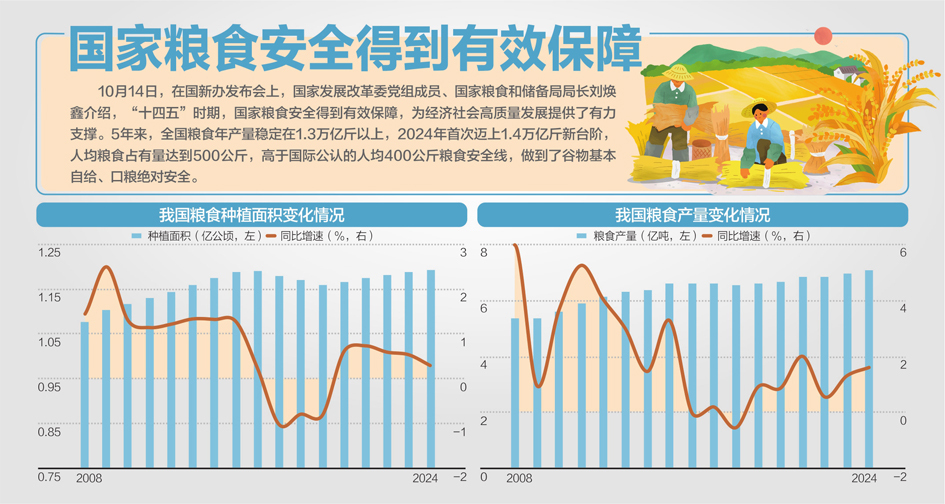
Core Insights - The Chinese government has effectively ensured food security during the "14th Five-Year Plan" period, providing strong support for high-quality economic and social development [1] Group 1: Grain Production and Supply - National grain production has remained stable at over 1.3 trillion jin annually for the past five years, with a projected increase to 1.4 trillion jin in 2024, marking a significant milestone [3] - Per capita grain availability has increased by 25 kg compared to the end of the "13th Five-Year Plan," reaching 500 kg, which exceeds the internationally recognized safety line of 400 kg [3] - The capacity for grain storage has significantly improved, with the total capacity of standard grain warehouses exceeding 730 million tons, an increase of 58 million tons from the end of the "13th Five-Year Plan" [3] Group 2: Market and Government Collaboration - Market-oriented grain procurement has become predominant, accounting for over 90% of total grain purchases, enhancing market fluidity and vitality [4] - The government has implemented minimum purchase price policies for key grains like wheat and rice, effectively stabilizing expectations and safeguarding farmers' interests [4] - The autumn grain procurement process is underway, focusing on ensuring adequate resources, funding, and transportation to facilitate market participation [4][5] Group 3: Quality Assurance and Regulatory Measures - The safety of grain quality is crucial for public health, and the government has revised over 100 national standards and 50 industry standards to enhance food safety [6][7] - A comprehensive grain quality inspection and monitoring system has been established, improving the capacity for grain quality assurance and safety monitoring [7] - The government emphasizes the need for a collaborative regulatory mechanism to strengthen oversight across the entire food supply chain [7]
国家粮食和储备局最新发声!
券商中国· 2025-10-14 06:52
Core Viewpoint - The article emphasizes that the autumn grain purchase prices are expected to remain at a reasonable level, supported by market-oriented procurement and policy-based storage measures [1][2]. Group 1: Grain Purchase and Market Dynamics - The National Development and Reform Commission highlighted that over 90% of grain purchases in China are market-oriented, which has effectively enhanced market vitality and circulation [3]. - The annual grain production in China has stabilized above 1.3 trillion jin (approximately 650 million tons) over the past five years, with projections for 2024 to exceed 1.4 trillion jin, increasing per capita grain availability by 25 kg to 500 kg, surpassing the international safety line of 400 kg [3]. Group 2: Autumn Grain Harvest and Purchase Strategy - As of October 10, over 50% of the autumn grain harvest has been completed, with specific crop harvests: nearly 60% for mid-season rice, over 50% for corn, and 55% for soybeans [4]. - The autumn grain purchase work is focusing on four key areas: promoting market-oriented procurement, organizing policy-based storage, optimizing services for farmers, and maintaining a good purchasing order [5]. Group 3: Regulatory Framework and Quality Assurance - The legal framework for grain safety has been progressively improved over the past five years, establishing a robust legal basis for grain management and storage [6]. - The National Food and Reserve Administration is committed to enhancing the monitoring capabilities for grain quality safety, ensuring that all aspects of the grain supply chain are effectively regulated [7].

国家粮食和物资储备局答21:加快建立食品贮存监管机制
2 1 Shi Ji Jing Ji Bao Dao· 2025-10-14 05:26
Core Viewpoint - The article discusses the achievements in grain circulation reform and development during the "14th Five-Year Plan" period, emphasizing the importance of ensuring grain quality safety throughout the entire supply chain [1][2][3] Group 1: Management System - The management system for grain quality safety has been continuously improved, with the implementation of laws and regulations such as the "Grain Security Law" and the "Grain Circulation Management Regulations" [1] - The National Grain and Material Reserve Bureau has organized the revision of various regulations, including the "Grain Quality Safety Supervision Measures" and the "Government Grain and Oil Reserve Quality Safety Management Measures," to strengthen corporate responsibility and departmental oversight [1] Group 2: Standard System - Since 2021, over 100 national standards and 50 industry standards in the grain sector have been revised or established, focusing on green, high-quality, nutritious, and healthy grain [2] - The revision of mandatory national standards for wheat and other varieties has been carried out to improve quality indicators, while standards for grain storage and processing have been developed to enhance storage quality and promote healthy consumption [2] Group 3: Quality Inspection System - A grain quality safety inspection and monitoring system has been established, with a focus on provincial, municipal, and county-level collaboration to ensure timely responses and information flow [2] - The capacity for grain inspection and testing has been enhanced, contributing to the monitoring of grain quality safety and the overall good quality of stored grain and oil [2] Group 4: Future Directions - The National Grain and Material Reserve Bureau plans to deepen the responsibilities in grain acquisition and storage, aiming to establish a food storage supervision mechanism and enhance monitoring capabilities [3]
食品饮料周报:白酒愁云惨淡,啤酒迎来春天
Zheng Quan Zhi Xing· 2025-07-25 07:17
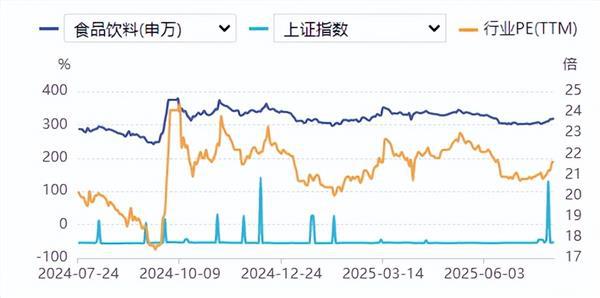
Market Performance - The Shanghai and Shenzhen 300 Index increased by 1.69%, while the Shenwan Food and Beverage Index rose by 0.56% during the week of July 21-25, 2025 [1] - The top five performing stocks included ST Xifa, Jiaoda Onlian, Huang Shanghuang, Tianyoude Wine, and Knight Dairy [1] Institutional Insights - Dongwu Securities emphasizes a focus on five sectors: beverages, new consumption, new retail, dairy, liquor, and health products. Key companies include Dongpeng Beverage and Nongfu Spring in the beverage sector [2] - The liquor sector is experiencing a bottoming out, with recommendations to consider buying on the left side, highlighting stocks like Kweichow Moutai, Luzhou Laojiao, Shanxi Fenjiu, and Wuliangye [2] - The beer market remains stable, with notable performances from Yanjing Beer and Zhujiang Beer, while the consumer goods sector shows a slight weakening in growth momentum [3] Regulatory Developments - A national standard for campus meal service management has been approved, aimed at enhancing food safety regulations for meal preparation and delivery services in schools [7] - The Ministry of Public Security reported the resolution of over 540 criminal cases related to counterfeit "special supply wine," with 260,000 bottles seized and an involved amount of 3.7 billion yuan [6] Industry Trends - The liquor market is facing challenges, with several small to medium-sized liquor companies issuing profit warnings. However, major liquor companies like Kweichow Moutai are seeing increased investment from prominent fund managers [9] - The beer sector is experiencing a resurgence, driven by favorable weather and events boosting consumer demand, with companies like Yanjing and Zhujiang Beer reporting growth [9] Company Developments - The Guizhou Renhuai City Wine Association has approved a new self-discipline convention, which includes strict regulations on production and marketing practices [10] - Luzhou Laojiao Group has established a new partnership with a capital contribution of approximately 245 million yuan, focusing on enterprise management and consulting services [12] - Qinghua Fenjiu launched a new product, the Qinghua Fenjiu 30 Revival Edition, with upgrades in packaging and quality [13]