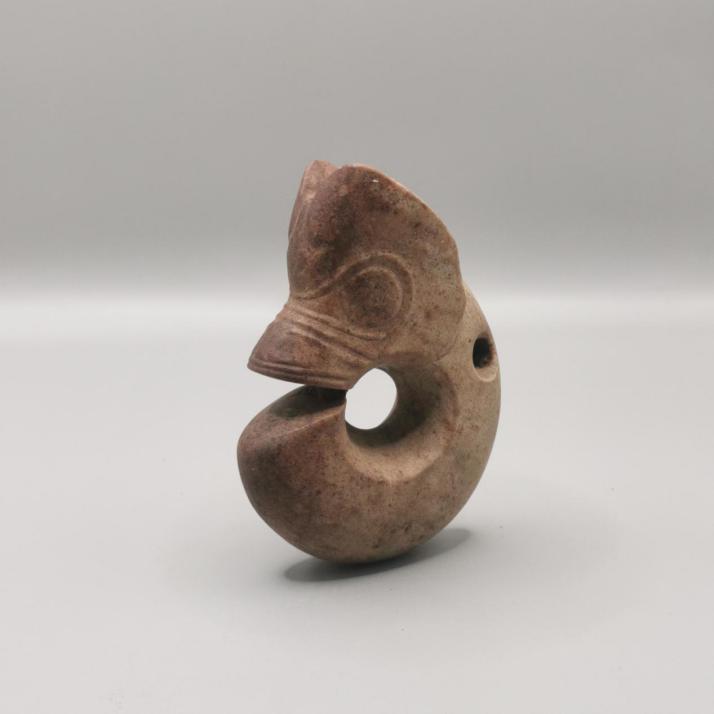
红山社会文明化进程研究

Search documents
考古专家:红山文化奠基后世礼制 开启“天人关系”最初探索
Zhong Guo Xin Wen Wang· 2025-12-17 03:25
Core Viewpoint - The "Hongshan Culture" is recognized as a foundational element in the development of later ceremonial systems and the initial exploration of the "relationship between heaven and humanity" in Chinese civilization [1][3]. Group 1: Research Findings - The Hongshan culture dates back 6,500 to 4,800 years and is characterized by two types of sites: ritual and residential, reflecting a society that emphasizes rituals over secular life [3]. - Archaeological findings indicate a complex social structure within the Hongshan culture, showcasing a multifaceted society that provides critical insights into the development of ancient state systems [4]. - The integration of local traditions and shamanistic practices into a cohesive belief system laid the groundwork for a unified social order, which was essential for the establishment of the "Hongshan Ancient State" [4]. Group 2: Ritual and Governance - The ritual system that emerged during the mid-Hongshan period, characterized by "respect for heaven, earth, and ancestors," established a hierarchical order that was widely accepted within the region [4]. - The "Niuhuangliang site" is identified as the highest-level multifunctional ritual center of the Hongshan culture, comparable to state-level sacrificial sites, reinforcing its significance in the cultural and social order [5]. - The development of a ritual-based governance model facilitated cultural identity and social order, marking a significant step towards civilization in ancient China [5].

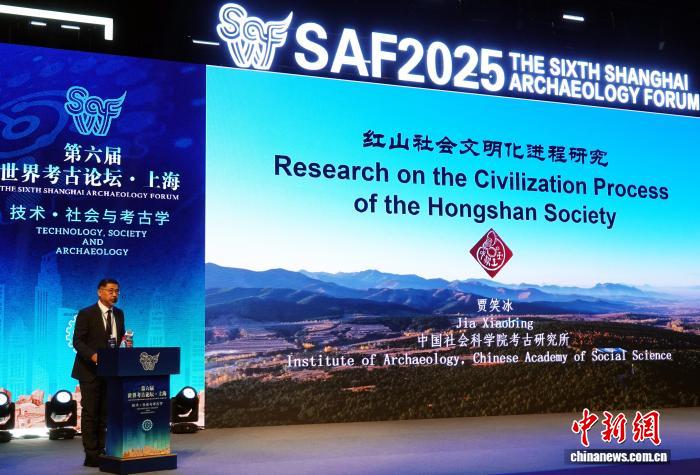
第六届世界考古论坛在沪举办 中国四项目入选重大田野考古发现和重要考古研究
Xin Hua Wang· 2025-12-16 12:29
Core Viewpoint - The sixth World Archaeological Forum held in Shanghai showcased 22 significant field archaeological discoveries and important archaeological research results, highlighting advancements in understanding human civilization and cultural heritage [1] Group 1: Major Archaeological Discoveries - The research on the Hongshan social civilization process and the Qingjian Zhaigou site from Shaanxi were selected for the major field archaeological discoveries exhibition [1] - The Hongshan civilization research, led by a team from the Chinese Academy of Social Sciences, involved extensive studies across various sites, including the Niuhua Liang site and the Zhengjiagou site in Hebei, revealing significant insights into the development of Hongshan society and tracing the origins of Chinese civilization [1] Group 2: Important Archaeological Research Results - The project "From Aggregation to Integration: Interactions of Populations in Central and Southern Inner Mongolia during the Eastern Zhou Period," led by Zhang Xu, was included in the important archaeological research results exhibition [1] - The molecular archaeology research project, directed by researcher Fu Qiaomei, aimed to map the migration, evolution, and adaptation of populations in East Asia over the past 100,000 years, also featured in the forum [1] Group 3: Forum Details - The sixth World Archaeological Forum was co-hosted by the Chinese Academy of Social Sciences, Shanghai Municipal Government, and the National Cultural Heritage Administration, focusing on the theme "Technology, Society, and Archaeology" [1] - Concurrently, the "Jade and Civilization: Liangzhu Culture Special Exhibition" was held at the new museum of Shanghai University [1]
中国两项考古入选世界考古论坛重大田野考古发现成果展示
Ren Min Ri Bao· 2025-12-16 02:35
Core Insights - The "6th World Archaeology Forum" held in Shanghai focuses on the theme of "Technology, Society, and Archaeology," showcasing significant archaeological discoveries and research outcomes from around the world, emphasizing how technology shapes human society and connects regional civilizations [1] Group 1: Major Archaeological Discoveries - The "Hongshan Society Civilization Process Research" led by the Chinese Academy of Social Sciences has made significant findings over the years, showcasing the development of the Hongshan society from various perspectives [1] - The Niuhua Liang site, a representative of the prosperous phase of Hongshan culture, has been confirmed as a major ritual center, with new excavations revealing a large architectural complex of 60,000 square meters [1] - The Zhengjiagou site in the Sanggan River basin, identified as a Hongshan culture site, provides new insights into the burial practices and social development of the late Hongshan culture [2] Group 2: Ritual Sites and Cultural Insights - Newly discovered ritual sites such as Dongshantou, Sanjiadongbei, and Yuanbaoshan further illustrate the consistency of social norms within the Hongshan culture, contributing to the understanding of its "unified society" characteristics [4] - The findings at Yuanbaoshan and Dongshantou enrich the understanding of ritual activities within the Hongshan culture, providing new data on the spiritual world of Hongshan society [4] Group 3: Social Complexity and Development - Recent archaeological discoveries expand the temporal and spatial framework of the Hongshan culture, revealing a complex social structure that does not simply evolve into a state form but develops through religious authority, technological division of labor, and regional networks [11] - The Qingjian Zaigou site in Shaanxi has fundamentally updated the understanding of the late Shang Dynasty's civilization process, revealing a highly developed bronze civilization with complex social structures [11][12] - The Zaigou site, covering approximately 3 million square meters, features large rammed earth buildings and a variety of burial sites, highlighting the characteristics of a central settlement in the northern Loess Plateau during the Shang Dynasty [12][14] Group 4: Artifacts and Cultural Exchange - The Zaigou site has yielded over 40 chariots, the largest number found outside the Yin ruins, including the earliest known double-yoke chariot, pushing back the timeline of its appearance by about 1,000 years [16] - Artifacts such as bronze chariot fittings and jade ornaments found at the Zaigou site indicate close economic and cultural exchanges with the Shang Dynasty [18][22] - The findings at the Zaigou site provide crucial archaeological support for understanding the complex interactions between the Shang Dynasty and regional states, enriching the knowledge of early Chinese civilization formation [22][23]