
经济反噬

Search documents
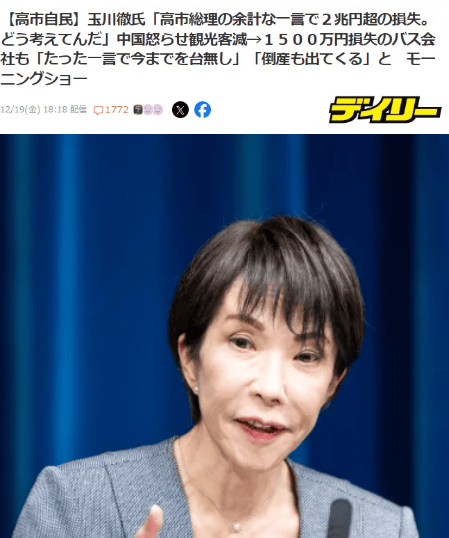
高市一句错言!日本观光业崩了:损失破2兆,从业者哭求止损
Sou Hu Cai Jing· 2025-12-20 09:46
Group 1 - The core viewpoint is that the recent remarks by Prime Minister Kishi have led to a catastrophic impact on Japan's tourism industry, resulting in a projected loss exceeding 2 trillion yen due to a significant drop in Chinese tourist arrivals [2] - The tourism sector has experienced a dramatic decline in core customer numbers, with flight bookings from China to Osaka dropping by 55% to 65% year-on-year for the winter season to early spring, and spending by Chinese tourists in large malls and duty-free shops plummeting over 70% compared to previous years [2][3] - The over-reliance on the Chinese market has been exposed as a vulnerability for Japan's tourism industry, severely undermining recovery confidence and causing ripple effects in related sectors such as retail and transportation [2] Group 2 - The harsh winter for the tourism industry has led to a survival crisis for many small and medium-sized operators, with reports of occupancy rates below 10% for accommodations and numerous tour guides being forced to find alternative jobs [3] - Over 2,000 small tourism businesses are on the brink of collapse, significantly increasing unemployment risks for workers already suffering from economic downturns, presenting a direct challenge to their livelihoods [3][4] - The Japan National Tourism Association is urgently seeking to revive tourism cooperation with China, indicating the pressing need to alleviate tensions and restore the tourism market, which reflects a clear intention to salvage the industry [3][4] Group 3 - The academic community has voiced concerns regarding the damaging consequences of Kishi's remarks, emphasizing the need for a retraction and apology to prevent further losses in the tourism sector [4] - The proactive stance taken by scholars marks a departure from traditional academic neutrality, highlighting the serious predicament facing Japan's economy and the tourism industry [4] - If Kishi maintains a hardline stance without retracting his statements, the winter crisis in the tourism sector may worsen, potentially dragging down Japan's overall economic recovery [4]

特朗普的关税豪赌是一场损人更害己的单边讹诈
Di Yi Cai Jing· 2025-04-21 11:59
Group 1 - The article criticizes the U.S. tariff policy as a unilateral and reckless approach that undermines international trade order and serves political interests [1][10] - The U.S. has imposed various tariffs on imports from China and other countries, including a 20% tariff on all Chinese goods and 25% on steel and aluminum [2][3] - The implementation of "reciprocal tariffs" has led to significant increases in tariffs on imports from various countries, with rates reaching as high as 125% for certain goods from China [3][4] Group 2 - The article argues that the "reciprocal tariff" calculation method is flawed and does not accurately reflect trade imbalances, as it is based on arbitrary parameters set by the U.S. [4][5] - The U.S. tariff policy is said to violate World Trade Organization (WTO) principles, including the most-favored-nation treatment and non-discrimination rules [5][6] - The article highlights that the U.S. trade deficit is a structural issue that cannot be resolved through tariffs, as it is influenced by comparative advantages and international division of labor [7][8] Group 3 - The article notes that since the onset of the trade war in 2018, the overall U.S. trade deficit has not decreased, but rather has been redistributed among trading partners [8][9] - It emphasizes that high tariffs will not effectively fund domestic tax cuts, as tariff revenue is minimal compared to income and sales taxes [9][10] - The article warns that the tariff policy is likely to increase inflationary pressures in the U.S., ultimately burdening consumers [10][11] Group 4 - The article discusses the political pressures facing the U.S. tariff policy, with increasing opposition from both parties and concerns about its economic impact [10][11] - It highlights the potential for significant market volatility and economic downturns as a result of the tariff measures, with major financial institutions adjusting their growth forecasts [11][12] - The article concludes that the high tariffs may distort global resource allocation and weaken the U.S. industrial base, contradicting the political promises made by the Trump administration [12][13]