经济战争

Search documents
古巴宣布“国际紧急状态”意味着什么
Xin Lang Cai Jing· 2026-02-02 18:02
Group 1 - The U.S. is engaging with high-level officials in Cuba and believes an agreement can be reached, following President Trump's executive order threatening tariffs on goods from countries supplying oil to Cuba [1][2] - Cuba's Foreign Minister announced a "state of international emergency" in response to U.S. actions, claiming that the U.S. poses an unusual threat to national security and international peace [1][2] - The Cuban government views the U.S. sanctions as a calculated economic war, exacerbating the already severe living conditions for the Cuban people [4][6] Group 2 - Cuba relies on imports for the majority of its oil needs, producing only 40,000 barrels per day out of a required 110,000 barrels, making it vulnerable to U.S. sanctions [5][6] - Mexico is currently a key oil supplier to Cuba, and the U.S. is pressuring Mexico to halt oil shipments, which could lead to severe disruptions in Cuba's energy supply and essential services [6] - The potential implementation of U.S. sanctions could paralyze various sectors in Cuba, including electricity production, transportation, and healthcare, leading to a comprehensive societal impact [6]
热点问答|古巴宣布“国际紧急状态”意味着什么
Xin Hua She· 2026-02-02 08:40
Core Viewpoint - The announcement of an "international emergency" by Cuba is a response to the U.S. administration's recent actions, particularly the executive order signed by President Trump, which threatens to impose tariffs on goods from countries supplying oil to Cuba, indicating a potential economic conflict between the two nations [1][2]. Group 1: U.S. Actions and Responses - President Trump signed an executive order on January 29, declaring a national emergency due to perceived threats from the Cuban government to U.S. national security, which includes establishing a tariff mechanism on goods from countries providing oil to Cuba [1]. - Cuba's Foreign Minister, Rodriguez, criticized the U.S. actions as a significant threat not only to Cuba but also to international peace and security, attributing the situation to domestic anti-Cuba forces in the U.S. [1][2]. - Trump indicated that the U.S. is in talks with high-level Cuban officials and expressed optimism about reaching an agreement, although specific details were not disclosed [2]. Group 2: Economic Impact on Cuba - Rodriguez condemned the U.S. actions as a new round of oil blockade, stating that the Cuban people are enduring the longest and harshest economic blockade, which is exacerbating living conditions [3]. - The economic blockade is described as a calculated economic war, severely limiting Cuba's ability to generate foreign exchange and impacting nearly all sectors capable of producing income [3]. - Cuba's energy supply is critically affected, with the country relying on imports for the majority of its oil needs, and recent U.S. sanctions are expected to worsen the already challenging energy situation [5]. Group 3: Humanitarian Concerns - The Cuban government has stated that it requires approximately 110,000 barrels of oil daily but can only produce 40,000 barrels domestically, making it heavily reliant on imports [5]. - Mexico is currently a significant oil supplier to Cuba, and U.S. pressure on Mexico to halt oil shipments is seen as a direct threat to Cuba's energy security [5]. - The potential implementation of U.S. sanctions could lead to widespread disruptions in essential services in Cuba, including electricity production, transportation, and healthcare, which could have dire humanitarian implications [5].
美国新一轮石油封锁行动是一场“经济战争”
Xin Lang Cai Jing· 2026-02-01 13:09
Core Viewpoint - The recent U.S. oil blockade against Cuba is characterized as an "economic war" rather than traditional sanctions, significantly worsening the living conditions of the Cuban population [1]. Group 1: Economic Impact - The U.S. oil blockade is expected to place greater pressure on the Cuban economy, described as a "precisely calculated economic war" [1]. - The U.S. has threatened to impose tariffs on goods from countries supplying oil to Cuba, further complicating Cuba's economic situation [1]. - Almost all sectors capable of generating foreign exchange for Cuba are under restrictions due to U.S. monitoring of potential revenue sources [1]. Group 2: Tourism Sector - The tourism industry, a vital source of foreign exchange for Cuba, has been adversely affected by U.S. travel restrictions, limiting the number of foreign visitors [1]. - Without these artificial barriers, Cuba could attract more tourists due to its geographical location and cultural appeal, which would aid economic development [1]. Group 3: Security and Cooperation - The U.S. characterization of Cuba as a "security threat" lacks factual basis, as Cuba does not pose any military or security threat to the U.S. [1]. - Cuba has maintained cooperation with relevant countries in combating drug trafficking and transnational crime [1]. Group 4: Regional Stability - External pressures for "regime change" could lead to regional instability, as highlighted by the new U.S. national security strategy that views Latin America and the Caribbean as an "exclusive area" for the U.S. [2]. - Historical experiences suggest that unjust treatment under external pressure may actually enhance social cohesion within the affected country [2].
专访丨美国新一轮石油封锁行动是一场“经济战争”——访古巴学者费尔南德斯
Xin Hua Wang· 2026-02-01 08:52
Core Viewpoint - The recent U.S. oil blockade against Cuba is characterized as an "economic war" rather than traditional sanctions, significantly worsening the living conditions of the Cuban population [1]. Group 1: Economic Impact - The new U.S. oil blockade will place greater pressure on the Cuban economy, described as a "precisely calculated economic war" [1]. - The U.S. continues to monitor and attempt to cut off any potential revenue sources for Cuba, severely limiting almost all areas capable of generating foreign exchange [1]. - Tourism, a vital source of foreign exchange for Cuba, is heavily impacted by U.S. travel restrictions, which prevent a larger influx of foreign visitors that could boost economic development [1]. Group 2: Political Context - The U.S. characterizes Cuba as a "security threat" without factual basis, as Cuba does not pose any military or security threat to the U.S. and has cooperated with other countries in combating drug trafficking and transnational crime [1]. - The new U.S. National Security Strategy report views Latin America and the Caribbean as an "exclusive area" for the U.S., a perspective that has been expressed more openly and aggressively than before [2]. - Historical experience suggests that external pressure and unfair treatment can actually enhance social cohesion within a country [2].
特朗普警告普京:不结束冲突,就开打“经济战”
Jin Shi Shu Ju· 2025-08-26 23:44
Core Viewpoint - President Trump is prepared to escalate economic sanctions against Russia if President Putin does not agree to a ceasefire, indicating a potential "economic war" with severe consequences for Russia [2][3]. Group 1: Economic Sanctions and Military Conflict - Trump emphasized that the ongoing conflict in Ukraine has resulted in thousands of deaths weekly, and he is willing to impose serious economic repercussions on Russia if necessary [3]. - He has a history of using economic sanctions and high tariffs as threats in international relations, stating that the consequences for Russia would be "very serious" if the conflict continues [3]. - Trump mentioned that he had hoped for a breakthrough in the conflict following a historic summit with Putin, but no new meetings have been scheduled between Putin and Zelensky since then [3][4]. Group 2: Diplomatic Efforts and Relationships - Zelensky has been urging for a meeting with Putin, suggesting that Turkey, Gulf countries, or European nations could host the negotiations [4]. - Trump criticized Zelensky for not being sufficiently grateful for U.S. aid and suggested that he has become an obstacle to peace [4]. - A senior advisor to Zelensky indicated that Ukraine is urgently seeking more Western weapons, expressing concerns that Russia remains uninterested in peace despite recent summits [4]. Group 3: Trade Policies and Tariffs - Trump hinted at the possibility of implementing costly tariffs on Russia, Ukraine, or any other countries to enforce peace, although he did not provide specific details [4]. - He has already decided to double tariffs on Indian imports to 50% in response to India's continued purchase of Russian oil, but has not yet taken further action against other countries buying Russian oil [4].
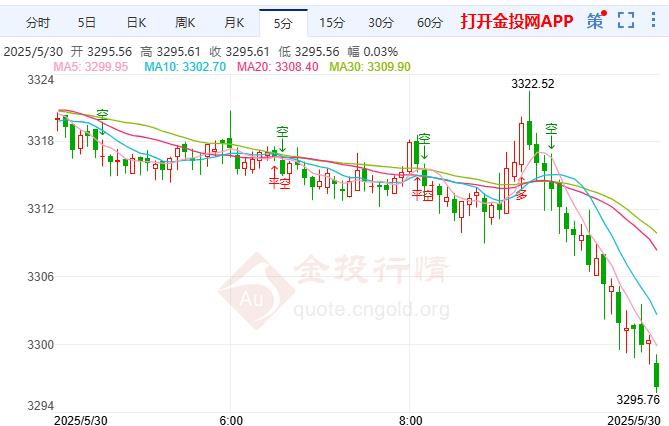
黄金价格有所回落 全球债务市场发出危险信号
Jin Tou Wang· 2025-05-30 06:34
Group 1 - The current market situation indicates the beginning of a prolonged economic war rather than the end of trade disputes, as highlighted by Capital Economics' chief analyst Kyle Rodda [3] - Recent data shows an unexpected rise in initial jobless claims in the U.S. to 268,000, and the first quarter GDP revision was lowered to 1.1%, raising concerns about a potential "Trump recession" [3] - The U.S. 30-year Treasury auction faced historic cold reception with the winning yield soaring to 4.85%, while Japan's central bank had to intervene to suppress the 10-year bond yield, indicating unsustainable fiscal conditions in both countries [3] Group 2 - The core CPI in Tokyo rose by 3.2% year-on-year, leading to a 0.3% jump in the yen, as markets speculate on a potential interest rate hike by the Bank of Japan in July, contrasting with expectations of a rate cut by the Federal Reserve [3] - The dollar/yen monthly line still shows a modest decline of 0.5%, primarily due to safe-haven demand triggered by Trump's "America First" policy [3] - Economies.com analysts noted that the recent pullback in spot gold prices is a corrective move aimed at consolidating previous gains and addressing the overbought conditions indicated by the RSI [4]