绿色数字化

Search documents
远光软件(002063) - 002063远光软件投资者关系管理信息20251216
2025-12-16 09:04
Group 1: Company Performance - The company follows a diversified product and market strategy, enhancing core technological and product capabilities while expanding market outreach [1] - As of Q3 2025, the company reported a revenue of CNY 1.57 billion, a year-on-year increase of 1.99%, and a net profit attributable to shareholders of CNY 123 million, up 11.89% year-on-year [1] Group 2: Medical Sector Progress - The company has successfully implemented smart financial projects in several hospitals, including the Shenzhen Second People's Hospital and Fudan University Huashan Hospital, with various management modules now operational [2] Group 3: Market Value Management - The company is open to various market value management strategies, including share buybacks, dividends, and mergers, depending on financial arrangements and stock performance [3] Group 4: Collaboration with Major Shareholder - The company collaborates with State Grid Digital Technology Co., which supports the DAP product's validation and market promotion, and participates in the energy internet subsidiary [4] - Future cooperation will focus on leveraging product, business, and platform advantages to foster a collaborative industrial ecosystem [5]

中国石化20251104
2025-11-05 01:29
Summary of China Petroleum & Chemical Corporation (Sinopec) Conference Call Industry Overview - The conference call discusses the performance and outlook of the oil and gas industry, particularly focusing on Sinopec's operations in a challenging market environment characterized by fluctuating international oil prices and changing domestic demand. Key Financial Performance - For the first three quarters of 2025, Sinopec reported an EBITDA of 54.4 billion RMB, with Q3 contributing 14.9 billion RMB, reflecting a year-on-year growth of 3.3% [2][3] - The net profit attributable to shareholders for the first three quarters was 32.1 billion RMB, with Q3 net profit at 8.3 billion RMB, also showing a year-on-year increase of 3.5% [2][3] - Operating cash flow reached 114.8 billion RMB, marking a 13% year-on-year increase, while the debt-to-asset ratio stood at 54.8% [2][3] Upstream Operations - Sinopec enhanced exploration efforts, achieving a 2.2% year-on-year increase in oil and gas equivalent production to 394 million barrels, with natural gas production rising by 5% [2][4] - The upstream segment generated an EBITDA of 38.1 billion RMB, with unit cash operating costs decreasing by 4.6% [2][4] Refining and Sales - The refining segment processed 190 million tons of crude oil, producing 110 million tons of refined products, with refining margins at 6.1 USD per barrel, an 8% year-on-year increase [2][4] - However, the refined oil sales segment faced challenges due to declining international oil prices and weak domestic demand, resulting in an EBIT of 12.8 billion RMB, a 6.9% year-on-year decline when excluding inventory changes [2][4] Chemical Segment - The chemical segment faced difficulties, with ethylene production increasing by 15.4% to 11.59 million tons, but the segment reported an EBITDA loss of 8.2 billion RMB [2][4] Capital Expenditure - Capital expenditures for the first three quarters totaled 71.6 billion RMB, with the upstream segment accounting for the largest share at 41.6 billion RMB, primarily for oil and gas capacity and storage facility construction [2][4] Market Strategy and Future Outlook - Sinopec is focusing on a dual circulation development strategy, emphasizing refining integration, high-end differentiation, green digitalization, and international operations [3][10] - The company plans to strictly review project investments to enhance economic efficiency and green low-carbon levels, with an expected average annual growth rate of 3.9% in domestic ethylene consumption during the upcoming five-year plan [3][10] Challenges and Risks - The company is navigating a complex market with international oil prices showing a downward trend, with Brent crude averaging a 14.4% year-on-year decline [3][4] - The impact of sanctions on Russia and OPEC's production decisions are being monitored, but Sinopec maintains a diversified procurement strategy to mitigate supply chain risks [7][8] Inventory Management - Sinopec adheres to a low inventory strategy, maintaining raw material inventory at around 20 days to manage market volatility effectively [8] Future Projects and Collaborations - Sinopec is reviewing future project plans, including collaborations in high-end materials and cross-border e-commerce, while continuing to phase out smaller, outdated refining units [12][13] Conclusion - Sinopec's performance reflects resilience in a challenging environment, with strategic initiatives aimed at enhancing operational efficiency and adapting to market dynamics. The focus on sustainable growth and innovation positions the company for future opportunities despite current challenges in the oil and gas sector.

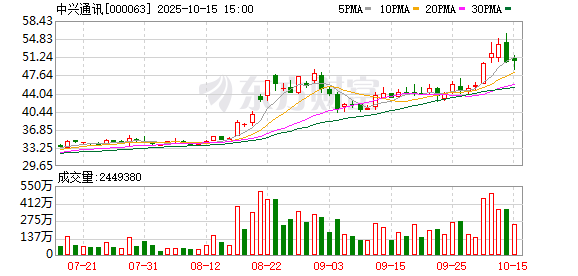
中兴通讯“三位一体”助力北非数字化转型
Xin Hua Cai Jing· 2025-10-15 22:40
Core Viewpoint - ZTE Corporation is actively contributing to the digital transformation of North African countries through a "three-in-one" strategy that includes infrastructure co-construction, technology capability transfer, and ecosystem co-creation [2] Group 1: Infrastructure Co-construction - ZTE is not only providing communication equipment but also collaborating with local operators to build high-quality 5G and fiber networks for the future [2] Group 2: Technology Capability Transfer - ZTE has established local training centers and innovation labs to cultivate local communication technology talent, empowering local teams to operate and maintain systems independently [2] Group 3: Ecosystem Co-creation - ZTE collaborates with local fintech companies, banks, and content providers to develop applications such as mobile payments, digital agriculture, and online education, integrating technology into daily life [2] Group 4: Future Focus Areas - ZTE plans to emphasize "green digitalization" and "agricultural digitalization," aiming to introduce energy-efficient technologies to reduce carbon emissions and utilize IoT and big data for precision irrigation and agricultural monitoring [2]