绿色机场

Search documents
预见2026:《2026年中国机场建设行业全景图谱》(附市场现状、竞争格局和发展趋势等)
Qian Zhan Wang· 2026-02-23 02:11
Core Insights - The Chinese airport construction industry is experiencing significant growth, with a projected investment of 140.43 billion yuan in 2024, contributing to a total fixed asset investment of 204.03 billion yuan in civil aviation [9][25]. Industry Overview - Airport construction includes site selection, overall planning, preliminary design, detailed design, implementation, and acceptance of airport projects [2]. - The industry supply chain consists of upstream material and equipment suppliers, midstream construction companies, and downstream airport management departments [2][4]. Industry Policy Background - The "12th Five-Year Plan" focused on constructing international hub and trunk airports, while the "13th Five-Year Plan" continued to enhance their functions and develop general airports [5]. - The "14th Five-Year Plan" aims to accelerate the construction of international airport clusters and improve air transport capacity [5]. Current Industry Development - The airport construction industry is capital-intensive, with significant fixed asset investments supported by policies aimed at boosting economic growth and infrastructure [9]. - From 2016 to 2024, the total fixed asset investment in civil aviation is expected to show a fluctuating growth trend [9]. Competitive Landscape - The industry is characterized by a competitive landscape with various companies holding different levels of qualifications, including 24 companies with first-level qualifications for runway engineering [11][12]. - The market concentration for runway engineering is high, with the top 10 companies capturing 70.13% of the market share [18]. International Competitiveness - Chinese companies have participated in airport construction projects in developing countries, indicating a moderate level of international competitiveness [15][17]. Market Concentration Analysis - In 2024, the top five companies in the air traffic control and weak current engineering sectors accounted for 56.21% of the market share, showing slight growth from 2023 [19]. Regional Competitive Landscape - By the end of 2024, companies with first-level qualifications for airport construction projects are primarily located in Beijing, Sichuan, Liaoning, Guangdong, and Shanxi, with Beijing holding the highest share at 18.8% [22]. Future Development Trends - The industry is moving towards smart, green, balanced regional development, and integrated hub construction, with significant advancements in technology and sustainability [25][27]. - The application of smart technologies is expected to reduce construction time by 15%-20%, and by 2030, major airports will achieve digital operations [27]. - Green construction is becoming a requirement, with 87% of new airport projects planned to incorporate distributed energy systems by 2025 [27]. - The construction strategy is focusing on balancing development between eastern and western regions, with a significant increase in general airports expected by 2030 [27].







吉安井冈山机场开展飞行区光伏系统全面“体检”
Zhong Guo Min Hang Wang· 2026-01-05 05:56
Core Insights - The article discusses the annual comprehensive inspection and maintenance of the distributed photovoltaic (PV) power generation system at Ji'an Jinggangshan Airport, aimed at ensuring efficient and safe operation while reinforcing green airport construction achievements [1][2] Group 1: Inspection and Maintenance - The inspection covered all PV power generation units in the flight area, with a detailed and systematic approach [1] - Technicians conducted thorough checks on solar panel surfaces for issues such as micro-cracks, hot spots, dust accumulation, or glass damage [1] - The maintenance team tested and reinforced the sealing, insulation resistance, and connection tightness of component wiring, junction boxes, and combiner boxes [1] Group 2: Equipment and Performance Analysis - Key electrical equipment, including inverters and distribution cabinets, underwent comprehensive parameter collection and analysis regarding operational status, heat dissipation, and alarm records [1] - The stability of PV brackets, effectiveness of lightning protection grounding systems, and potential shading issues were also evaluated and documented [1] Group 3: Operational Efficiency and Risk Management - The maintenance adhered to strict operational protocols, utilizing a "zoned, short time slot, dual-monitor" work mode to efficiently progress during flight gaps [2] - All inspection data was recorded in real-time and analyzed by qualified professionals, resulting in a "health diagnosis report" for each PV unit to identify performance shortcomings and potential risks [2] - Most PV equipment was found to be in good operational condition, with power generation efficiency meeting design expectations [2] Group 4: Remedial Actions and Outcomes - The maintenance team developed targeted action plans for identified issues, such as decreased surface cleanliness and minor cable sheath aging, and promptly initiated cleaning, replacement, and clearing work [2] - The systematic "check-up" and preventive maintenance improved the stability and conversion efficiency of the distributed PV system, contributing to reduced operational costs and supporting the dual goals of safe airport operations and green development [2]
山东临沂国际机场新航站楼启用
Zhong Guo Min Hang Wang· 2025-12-26 11:23
Core Viewpoint - The new terminal at Linyi International Airport, designed under the "port-city integration" concept, aims to enhance operational capacity and efficiency, marking a significant step towards higher quality regional development and modernization of the aviation hub [1][3]. Group 1: Infrastructure and Investment - The new terminal covers an area of 413 acres with a total investment of 3.096 billion yuan, designed to accommodate an annual passenger throughput of 12 million [1]. - The terminal building has a total area of 100,600 square meters and features a mixed flow model for incoming and outgoing passengers [3]. Group 2: Technological Integration - The airport incorporates advanced technology throughout the travel process, including an automated baggage sorting and centralized security check system, enhancing operational efficiency and safety [7][9]. - Facial recognition technology is implemented across check-in, security, and boarding processes, supported by an AI imaging algorithm for smart security [9]. Group 3: Architectural Design and Sustainability - The terminal features an ETFE air pillow membrane structure, which is lightweight and offers excellent transparency, aligning with green and low-carbon development goals [12]. - The design integrates local cultural elements, showcasing the region's heritage and enhancing the passenger experience through artistic features [12]. Group 4: Operational Goals and Future Outlook - The new terminal is positioned as a key infrastructure to support Linyi's new development framework and high-quality growth, focusing on safety, efficiency, and service excellence [13]. - The airport management aims to leverage the new terminal to strengthen its passenger and cargo operations, enhancing safety, operational efficiency, and service quality [13].
新疆机场集团2项成果入围自治区第四届群众性创新标杆成果交流
Zhong Guo Min Hang Wang· 2025-10-20 05:26
Core Viewpoint - The Xinjiang Airport Group has achieved significant breakthroughs in grassroots technological and management innovation, as evidenced by its two projects being selected for a prominent innovation exchange event in the region [1][2]. Group 1: Innovation Achievements - The "Airport All-Domain Intelligent Centralized Visualization Supervision Platform" integrates big data and 3D digital twin technology to enhance real-time perception, precise forecasting, intelligent analysis, and collaborative command of airport operations, significantly improving overall control efficiency and emergency response capabilities [1]. - The "Urumqi Airport Terminal Environmental Monitoring and Early Warning System" focuses on passenger travel experience and health environment assurance, enabling dynamic monitoring and early warning of environmental indicators such as temperature, humidity, and noise within the terminal [1]. Group 2: Future Directions - The Xinjiang Airport Group aims to leverage its recent recognition to further promote grassroots innovation activities, fostering an environment of learning from and surpassing benchmarks to inject continuous innovative momentum into the company's high-quality development [2].
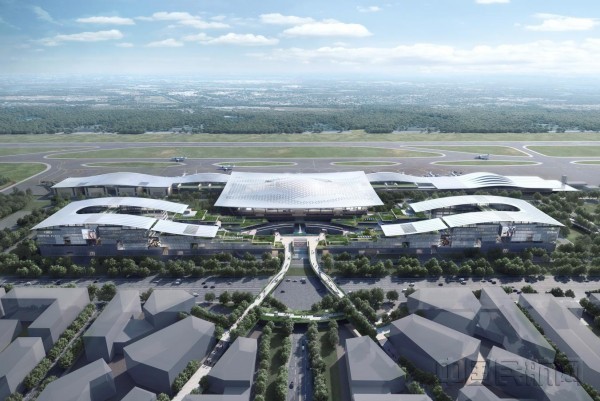
西宁机场三期扩建工程建成投运 按照2030年旅客吞吐量2100万人次目标设计
Zhong Guo Min Hang Wang· 2025-08-07 02:29
Core Viewpoint - The completion and operation of the Xining Caojiabao International Airport Phase III expansion project marks a significant milestone in the development of civil aviation in Qinghai, enhancing the province's connectivity and supporting its economic growth [1][3]. Group 1: Project Overview - The Xining Airport Phase III expansion project officially opened on August 7, 2023, after five years of construction [1]. - The total investment for the project is 10.712 billion yuan, with 9.983 billion yuan allocated for airport engineering [6]. - The project includes the construction of a new 158,000 square meter T3 terminal, a second parallel taxiway, a 173,000 square meter comprehensive transportation center, and a 18,800 square meter cargo area [6]. Group 2: Economic Impact - The expansion is expected to significantly boost passenger and cargo traffic, with annual passenger volume projected to reach 8.5 million and cargo volume 40,000 tons, representing a 15-fold and 7-fold increase respectively compared to pre-restructuring levels [4]. - The project aims to support Qinghai's goal of becoming a high-level open economy and a hub for ecological civilization [3]. Group 3: Strategic Goals - The Western Airport Group is committed to enhancing the air transport network, focusing on the Xining-Xi'an air express line, improving domestic transfer flights, and expanding international connections [4]. - The project is aligned with the national strategy for high-quality economic development and aims to establish a safe, green, smart, and culturally rich airport [3][4]. Group 4: Technological Innovations - The construction utilized advanced technologies, including BIM (Building Information Modeling), to optimize processes and reduce costs, achieving over ten provincial and ministerial awards for its innovative approaches [5][6]. - The project faced unique challenges due to geological conditions and required the application of 31 new technologies and 12 provincial construction methods [5].