
美元稳定

Search documents
美国如期降息25个基点,但美联储官员内部仍存争议
Huan Qiu Wang· 2025-10-30 01:08
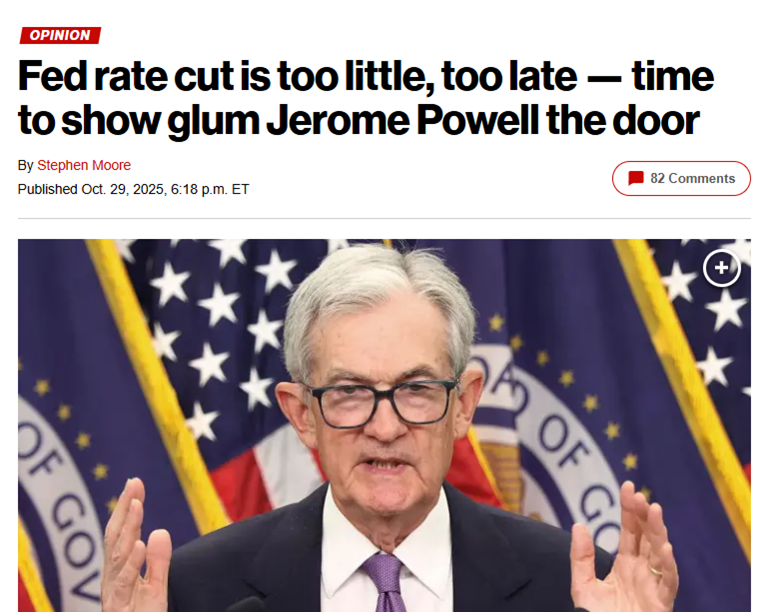
Group 1 - The Federal Reserve lowered the federal funds rate by 25 basis points to a range of 3.75%-4.00%, marking the second rate cut of the year [1] - The Fed announced the end of balance sheet reduction starting December 1, indicating a shift in monetary policy [1] - Internal disagreements among Fed officials were noted, with some advocating for a larger rate cut of 50 basis points while others preferred to maintain the current rate [1] Group 2 - The Fed's statement highlighted persistent high inflation and rising risks in the job market, suggesting a moderately restrictive monetary policy stance [1] - Commentary from the New York Post criticized the Fed's traditional view that growth leads to inflation, arguing for a focus on dollar stability and fiscal responsibility [1] - Powell's remarks indicated uncertainty regarding further rate cuts in December, influenced by data gaps due to government shutdowns [4]

‘OUT OF CONTROL': This is one of the greatest contributors to inflation, economist explains
Youtube· 2025-09-20 04:30
Federal Reserve and Economic Perspectives - The Federal Reserve's recent decision to cut interest rates by 25 basis points has been met with mixed reactions, with some arguing that the Fed is misreading economic signals and projecting overly pessimistic growth rates of 1.6% for this year and 1.5% for next year, despite a recent GDP growth print of 3.3% [4][5] - Steven Myron's appointment to the Federal Reserve Board is seen as a positive development, bringing a fresh perspective to an institution criticized for groupthink and a fear of economic growth [6][7] - There is a belief that the Fed's primary role should be to maintain a strong and stable dollar, rather than engaging in broader economic interventions [13][14] Immigration and Labor Market - The closure of borders and a reduction in immigration are viewed as disinflationary factors, potentially alleviating shelter inflation caused by a fixed supply of housing [2][17] - The introduction of a $100,000 fee for H-1B visas aims to discourage companies from hiring foreign workers over American graduates, reflecting concerns about job replacement and labor market dynamics [17][18] - The discussion around H-1B visas includes the potential for auctioning these visas to better align with market dynamics, which could generate significant revenue [22][23] Government Spending and Inflation - There is a strong argument that cutting government spending is more critical for controlling inflation than further interest rate cuts, with current spending levels being a significant contributor to inflationary pressures [8] - The potential revenue from tariffs and visa fees raises questions about how to best utilize these funds, with suggestions including lowering tax rates rather than providing rebates [24][25]