
美国债务扩张

Search documents
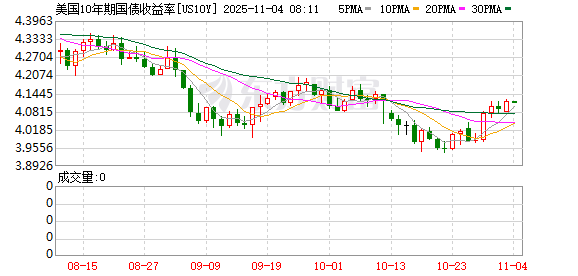
美债收益率全线上扬 降息预期降温与债务供给放量成推手
Xin Hua Cai Jing· 2025-11-04 00:11
Core Viewpoint - The U.S. Treasury market is under pressure with rising yields, influenced by cautious statements from Federal Reserve officials regarding interest rate cuts and a surge in corporate debt supply [2][3] Group 1: Treasury Yield Movements - On November 3, U.S. Treasury yields rose across the board, with the 10-year yield increasing by 2.71 basis points to 4.1046%, the 2-year yield up by 2.47 basis points to 3.5984%, and the 30-year yield rising by 3.68 basis points to 4.6879% [2] - The yield curve has shifted upward, reflecting a pessimistic sentiment in the market, particularly with long-term bonds showing significant weakness [2] Group 2: Economic and Political Context - The ongoing U.S. government shutdown, which began on October 1, is on track to become the longest in history, disrupting the release of key economic data and increasing uncertainty for policymakers and investors regarding inflation and employment trends [2] - Federal Reserve Governor Cook indicated that the decision on potential rate cuts in December will depend on information available between now and then, highlighting the risks associated with maintaining high rates and the potential consequences of aggressive cuts [2][3] Group 3: Market Sentiment and Future Outlook - Market sentiment has been affected by the rapid decline in Treasury yields, with expectations for significant rate cuts being tempered by recent comments from Fed Chair Powell [2] - Cook emphasized the importance of not acting blindly, as the lack of recent official data on employment, inflation, and economic growth necessitates careful analysis of available administrative and private sector data [2]

威尔鑫点金·׀ 美国债务空中加油后激升 对黄金市场有何影响
Sou Hu Cai Jing· 2025-08-13 07:40
Core Viewpoint - The article discusses the impact of the recent surge in U.S. debt on the gold market, highlighting the disconnect between rising debt levels and gold price movements, as well as the implications for inflation and monetary policy [1][12]. Group 1: Gold Market Analysis - On Tuesday, the international spot gold price opened at $3341.84, reaching a high of $3358.85 and a low of $3330.75, closing at $3348.12, with a slight increase of $5.92 or 0.18% [1]. - The Wellxin precious metals index opened at 6884.43 points, peaked at 6848.79 points, and closed at 6900.80 points, reflecting a gain of 16.34 points or 0.24% [3]. - Domestic gold market indicators show a narrowing premium over theoretical prices, with Shanghai AUTD gold price dropping to a discount of 1.26 yuan per gram, indicating weakened demand [6]. Group 2: U.S. Economic Indicators - The U.S. July CPI data was released, maintaining a year-on-year rate of 2.7%, which was better than the expected rise to 2.8% [7]. - The core CPI, excluding food and energy, rose to 3.1%, leading to a decrease in expectations for a 50 basis point rate cut by the Federal Reserve [9]. - The U.S. federal debt reached approximately $37 trillion, with a significant increase of $702.5 billion in July alone, raising questions about the sustainability of fiscal policy [14][15]. Group 3: Inflation and Monetary Policy Outlook - The article suggests that the recent CPI data does not provide a clear picture of inflation trends, as the true impact of global tariffs on domestic inflation will only be evident in future reports [9][12]. - The ISM non-manufacturing price index has reached a two-year high, indicating potential upward pressure on inflation, which could complicate the Federal Reserve's monetary policy decisions [11]. - The article posits that the current economic environment, characterized by rising debt and inflationary pressures, may lead to a prolonged period of low interest rates, similar to past economic cycles [19].
